Thursday, Feb 19, 2026
2:05 p.m. PT
San Francisco, CA
Artificial IntelligenceCentral BanksFederal Open Market Committee (FOMC)Financial ConditionsInflationInterest RatesLabor MarketsMonetary PolicyU.S. Economy
Transcript
The following transcript has been edited lightly for clarity.
Rob Kaplan:
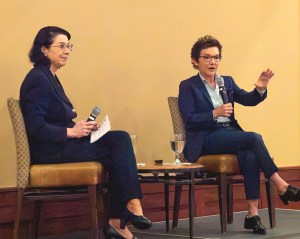
Thank you, Jim. Thank you, Laura. Thank you everybody for being here. It’s great to have an audience of folks associated with business and from Harvard Business School and associated with the San Francisco Fed. It’s a thrill to be here with Mary Daly. So let me say a few words about Mary, and then we’ll get right into it. She wanted me to keep this brief, so I’ll take a couple of liberties.
I’ve known Mary since the mid ’90s, since she was actually head of research at the San Francisco Fed. And then in 1996, she joined the San Francisco Fed. She became the president of the San Francisco Fed and member of the FOMC in 2018. And I’ve had a thrill working with her for years since then. Her background shows a PhD from Syracuse. She has an MS from the University of Illinois at Urbana, and very importantly, she has a BA from the University of Missouri at Kansas City. I’m from Kansas City, so I particularly love that. She has been a visiting professor at Cornell and UC Davis. Has been an advisor to the Congressional Budget Office, Library of Congress, and the Social Security Administration.
Her research focuses on employment, wage trends, economic growth, and economic shocks. She has an advanced understanding, based on all that research, of the Federal Reserve’s maximum employment and inflation mandate. One of the things that’s I know has always been important to Mary and is very important to us at the Fed, is to hear from businesses and the private economy about what’s affecting your business, how are you experiencing it as businesspeople and as households. And in that regard, we thought it would be great to do this event today. So with that, Mary, it’s a great to be with you.
Mary C. Daly:
It’s a complete pleasure, Rob. Thank you so much for having this conversation with me. I’m looking forward to it. I haven’t seen you in a couple of months.
Rob Kaplan:
I know.
Mary C. Daly:
So I’m excited to see you again.
Rob Kaplan:
So I get the liberty of asking you a few questions maybe I always wanted to ask you, I actually haven’t asked. I’ll start with-
Mary C. Daly:
Oh, wow. Okay.
Rob Kaplan:
What made you decide to become an economist? How did that happen?
Mary C. Daly:
Well, I’d like to say that I dug deep into my soul and I realized this is what I always wanted to do. But I knew I always wanted to work with and for people, and I really liked the idea of being a detective, trying to figure problems out. But I started thinking I could be a psychologist. Early in my development, I realized, or my training in college, I realized that was not actually going to be good for the people who I might try to serve because I’m extremely impatient. I’m driven to change. I’m an early to accept, early to adopt. And that’s not really great when people are trying to find their way somewhere. But a nice professor, mentor of mine said, “You can think about economics because it’s a subject about people, but you’re really far away from them. And so you can’t do any harm.”
No, in all seriousness though, economics has been one of my true passions in my life now because I always have to bring my curiosity. You have to have a great deal of ability to think about different things, manage different inputs, and then come to a decision, but then have that humility to ask again and say, “Where am I missing something? What do I need to keep track of?” And learning from other people and being in conversation. So ultimately, it’s been a terrific career, a terrific discipline for me, and it allows me to talk to people like you and all of you. So I appreciate it.
Rob Kaplan:
And what got you to join the Fed back in 1990?
Mary C. Daly:
I thought I would be an academic. So I get a PhD, and like every other PhD in my class and who I knew, you have an idea you want to be an academic. But I’d gone to Maxwell School in Syracuse, which is an interdisciplinary public policy program with economics, public policy, public administration, thinking about not just how to study and do research, but how to make it practical in people’s lives. And I appreciated that part of it. And when I came to the Fed, I’m a microeconomist doing labor economics and fiscal and public policy, and this is a macro shop doing monetary policy, but they were interested in the skill set I was bringing. And there is a dual mandate, full employment and price stability. And I thought, “This is a great place for me and maybe I’ll stay a year,” and I’ve stayed a little more.
Rob Kaplan:
So you went from being head of research here to president of the Fed. You might just explain to people what does a Fed president do?
Mary C. Daly:
Yes. And you can compare notes with me at this point.
Rob Kaplan:
I’m going to listen.
Mary C. Daly:
Okay. So here’s the thing that I like most about being president, and I think Rob, you would share this view, is that your day to day is different every day in many ways, but you always have the same core responsibilities. We want to make good monetary policy, which means we’re listening to people who are living in the economy, not just thinking that our study books and our models and our data are going to be sufficient. We’re really thinking about what are people doing, how are they investing and saving and thinking about prices and employment, et cetera. So that’s a big part of our job and something that I really appreciate.
We’re also leading our teams. Most reserve banks, all reserve banks, really, as we’re all reserve banks, most of our people are in operations doing supervision and payments and working in information technology to make sure we can do electronic payments and keep them safe and sound. And so we’re leading. Doing cash processing. So we’re leading, we’re CEOs, we’re running businesses. And because our mantras, if you will, they’re really touchstones, are we’re fiduciary stewards of public funds and we’re fiduciary stewards of public trust, that we have to act like a private sector CEO and really drive to efficiency, effectiveness, resiliency, delivering, in our case, to the shareholders, which are the American people. So I really like that.
And so to do that well, and we’ve always appreciated it, having Rob, as someone who has thought about this a lot, you have to be leading. So you have to be thinking constantly about how am I leading? How am I showing up? How am I looking forward, focusing on later while I’m working on next and now? And those are the types of things that keep me busy, and I enjoy that. So I enjoy doing things like this, but I also enjoy inspiring a team to do our best work, even in times when there’s a lot of change.
Rob Kaplan:
So just to flesh out a little bit, you might tell people, how many people do you have at the San Francisco Fed?
Mary C. Daly:
So at this point, roughly a little bit under, so 1,800 probably. And one of the things we do is we cover the nine western states in the 12th District. And most of our people work in operations, in IT, or in payments or supervision—those are where most of our employees are—cash. And the number of people who are doing economics is actually relatively small, less than 1% of our total teams. And so this is how the reserve banks are generally distributed across the United States, with that real focus on just delivering core services.
Rob Kaplan:
And then you have some system-wide responsibilities, all Fed presidents do. What are your system-wide responsibilities?
Mary C. Daly:
Well, my system-wide responsibilities are, you have to have a pretty large span in this role. So I work on making sure the research departments are holding themselves to the highest standard. All the reserve bank presidents are responsible for their individuals, but we have to work together in terms of interrogating the most important issues. We have research and make sure we have the computing and technology, and we’re doing all our work well.
I also work on the banking side of things with Vice Chair Bowman. It’s her core responsibility, but we work here to make sure that our teams are understanding and she’s getting what she needs to do the kinds of work she wants to do. And then we talk about communities and public engagement. I’m on the payments committee, so I’m working on everything from how do we do cash to how do we think about FedNow, and how should we even think about stablecoin’s evolution in a world where the Fed might have to be in that environment.
So those are the responsibilities I do. I do a lot of work on AI. So I dabble in technology…
Rob Kaplan:
Going to ask you about that.
Mary C. Daly:
…but a lot of work in AI. What do they call me in the system? An AI champion. So I think I am an AI champion. I just believe strongly that it has a lot of possibilities and that, most importantly, making our people aware of it and aware of its power is the best way to have great responsibility to use it well.
Rob Kaplan:
So people might be surprised, in addition to going to the FOMC meeting every six weeks, and you’ve got 19 people around the table, seven governors, 12 presidents, how often are you… People might be surprised how often you’re working with the other presidents, you mind talking about that a little bit, on committees and other activities.
Mary C. Daly:
Oh, I spend a lot of my time with the other presidents. And the reason is because, I was trying to explain this to someone the other day, so I’ll do the same here, is that we are running… Reserve banks are set up, there’s 12 in the United States. They’re really pseudo-private agencies or firms. But we are meant to work together to make sure that, when it’s practical and efficient and effective, we’re actually doing things collectively, because you don’t want things to run differently in the Atlanta district than you want them to run in the San Francisco district. And so while we’re local in our geography, we are national in our thinking.
And so we have to work together. We have to make good decisions, the best decisions we possibly can at any moment in time about workforce, about technology, about how to deliver on our goals. So my day to day, if you asked right now, how much time am I spending with my colleagues, it’s a good fraction of my week really. And they usually get up much earlier because they’re on the East Coast. And so my day starts really early, talking to my colleagues in the East.
Rob Kaplan:
Okay, with that background, let’s talk about the economy.
Mary C. Daly:
Okay.
Rob Kaplan:
Why don’t I just throw it to you to talk about your outlook for the US economy.
Mary C. Daly:
I’m hearing from businesses that there’s a cautious optimism out there. And I have to say, I feel that cautious optimism when I talk with communities, with firms, and even with workers—cautiously optimistic. Now, the cautious optimism is highest, I think, in the firms, who are saying we weathered a lot of change last year. There were policy changes, there were tariffs, immigration policy, deregulation, tax policy. But now firms are starting to really see the lay of the land.
And then interestingly, for the firms we talked to, which were a range of industries, all the industries you can think of, they’ve just been surprised how strong consumer spending has been and how well the consumer is doing, despite the fact that we have slowed a lot in the labor market relative to the previous years. And so that means they’re cautiously optimistic. So still a little bit of uncertainty, but the uncertainty is more manageable now, and the footing seems stronger. So I’m cautiously optimistic on the economy.
On the labor market, we’ve got it in a better place in my judgment. We took 75 basis points off the policy rate. You see the labor market not being in that state where it looked like it might falter. Now it’s, in fact, turned a little bit the other way. That’s good news. And inflation continues to come down outside of the goods sector, which of course, once tariffs roll off, we expect it to come down. Something to continue to watch. But our dual mandate goals that are price stability and full employment, both seem to be in a good place. Policy’s in a good place. And we have the opportunity now to think through what information’s coming in, what impact will AI have, how will productivity evolve, how will demand strength evolve, and how should we manage policy going forward?
Rob Kaplan:
So just for background for the group, the Fed, as you remember, raised rates up to five and a quarter, five and a half percent, stayed there for a while, and then starting in September of ’24, first lowered rates a hundred basis points, then paused for a while, and then as you said, three quarters in the fall and they’re now at three and a half, three and three quarters. As you approached three and a half, three and three quarters, there clearly was more debate…
Mary C. Daly:
Yes, it’s healthy.
Rob Kaplan:
…it’s healthy, and the press enjoyed following. Tell us why, particularly as we got to December, just explain to the group what the pros and cons were and why there was so much debate about whether to do that rate cut in December.
Mary C. Daly:
I really love that question, Rob. Thank you for asking it, because when you get to the point where it’s… Let me start this way. When inflation’s far, far above our target and the labor market’s going strong, the policy decision’s easy. It’s just about how fast, right? Raise rates. And how fast do you go? Usually as fast as you can go without creating so much volatility, you’ve injured something. So when you’re on the opposite world and we have a pandemic and the labor market’s terrible, it looks really bad for the economy, it’s super easy if just everybody agrees on lower rates.
The hard part where you get this debate is in a situation where there’s close calls because you’ve got competing things going on, and you’re not really sure what the outlook will be. You have forecasts, but you don’t know for sure. So in December, you’re in this space of should we wait a little bit longer to just get more information, to have even more confidence that inflation’s coming down to its 2% target, or should you put a little more weight on the fact that the labor market looks vulnerable, if not weakening, and ward that off? Because you were trying to balance, we were both all trying to balance getting it to a place where you’re making progress on inflation, but you’re not doing it at the expense of the labor market.
And so there’s a lot of vigorous debate. People have different views. It’s a place where I strongly believe reasonable people could disagree, with the underline on reasonable. And so I see that level of debate as not only okay, but exactly what you all should expect from us. If we weren’t debating, then I think we would rightly be criticized for all being in an echo chamber and probably being more likely to be wrong.
Rob Kaplan:
Okay. So let’s talk a little bit about part of the elements of this. Unemployment, as you talked, the labor force looked a little weaker in the fall, and we knew fiscal stimulus is coming, but it still was weakening, and so you basically wanted to buy some insurance for that. But inflation was a little bit sticky, and the tariffs were an element of that. And there were other elements. You might talk about, the Fed has done a good job seeing inflation go from as high as 9% all the way down to, let’s say two and three quarters, something in that neighborhood. Why is the last mile from two and three quarters to two, why is that so challenging?
Mary C. Daly:
So obviously we think about this a lot, and there’s a whole discussion, not usually here because there’s not that much evidence that the last mile’s harder than the first mile, but it turns out that this last mile has been more challenging. So why is it? Is it that that’s just always true of the last mile, it’s like running a marathon, or is it something else? And I would offer it’s something else. It’s a series of different shocks, and I said, I studied shocks. Shocks can be good, shocks can be bad, but it’s a series of different shocks. So inflation’s coming down and then we have the tariff announcement. So then there’s some input cost increases, and of course those are going to get fed into goods prices, and you see that. Not nearly as much as a standard model would’ve predicted or many forecasters anticipated, but still something. And so that means that inflation’s a little higher than what we had forecast, and that’s the tariff effect.
Then there’s the other part of it, which is just the services inflation. And so let’s break services into two components, housing and everything else. So housing services, that’s just notoriously slow. And the reason is because you have to wait for rental prices to roll over, right? You’ve got to get new renters in, they’re going to get lower rents, or you’ve got to get the leases to turn over. They’re sometimes on a three-year window. All of that just takes time. And so now in the last year, we’ve seen housing inflation start to come down and it just keeps coming down. That was just a delayed reaction relative to… and it’s really similar to what we expected. So there’s that.
And then the third thing is the services of all the other services. There, two-thirds of costs for firms are labor. And so it takes time for the labor market to slow, to come off of its frothiness, to get to a solid place for wage growth to follow, and for firms to be able to say, “Well, even if things are going up, I still don’t have to pay two-thirds of my cost in this rising place.” Workers now, if you do measured productivity and inflation, are not even keeping up with those two things. They’re just a little bit below, but they’re kind of… Now things are more in balance, so then firms don’t have as much impetus to pass through.
And then I think some of the good news on inflation potentially is that firms are using technology, and you can think of, it’s GenAI, but some of it’s just average machine learning that they just got good at because they needed to. And so just building technology and to manage costs so that they cannot pass along price increases to the extent that they might otherwise, but they can still continue to meet demand. So I think that’s why it’s been sticky. That’s why the forecast is for it to continue to come down as the labor market remains just steady, not too hot, not too cold, as the housing services keep coming down and as the tariffs roll through and off.
Rob Kaplan:
So picking up on that, as we head into ’26, we’ve got two powerful forces that I know you’re dealing with. One is we’ve got a new fiscal stimulus, which is tax on tips, tax on overtime, accelerated depreciation, tax refunds coming in the first quarter. So that’s stimulative on the one hand. And then second, we’ve got these phases of AI, and I’ll just lay them out and then you should comment, because I know you do a lot of work on this and have spoken a lot about it. There’s the infrastructure part of AI, which is this, you pick at five, six, 700 billion a year where it looks like we’re going to spend another six, 700 billion, numbers keep going up in CapEx, power data centers, creating compute. And then we’ve got the second part of AI, which we might be in the early innings of downstream adoption, which as you’ve mentioned, could improve productivity. How do you factor all those moving pieces into trying to think about your outlook and monetary policy?
Mary C. Daly:
Sure, and that’s a terrific question. So when I look at it, the CapEx is everywhere. And so I think people are, the first curiosity was, is this a bubble? Is it just too much? I think people are kind of reassuring themselves now that there’s there there. And so there’s real demand for these services, and these services aren’t being built just to hope people come. It’s not the field of dreams, it’s actually building to existing demand. So I think that’s just going to keep going. So the place where people are worried that that will be potentially inflationary is, in a model it might tell you it is if you’re stacking up against a constrained labor market and you need construction workers and you need cable layers and all those things and you can’t get them. But right now with the labor market more subdued, you don’t see those pressures as much.
But that’s in building materials. So, so far we haven’t seen inflation coming from that, but that’s a possibility that people have mentioned, and it takes a while before those things turn into a productive resource. Right now, they’re just being built. Okay, so then what are you doing with the adoption? As you mentioned, we’re in the first or second inning of, I know you like baseball. I won’t reference football. So we’re in the first or second inning of this, and so it’s very early days, but what we’re seeing is as companies do it, they’re going from the experimentation phase of maybe we should just get used to it. I remember when I first talked about this in ’23, companies were telling me, “Well, my employees have it, so I better know what it is.” And so they’re trying to get it so that they can help their employees not use it in a way that might be something they don’t prefer.
So now they’re like, okay, now we’re laying out workforce training. We’re trying to interrogate the possibilities with this technology. But really what we’re seeing early on is cost savings, automation in somewhat siloed aspects. So you might automate some component of your… so you have a lot of financial people in the audience. You might automate some component of your loan system or your lending system, but those aren’t being transformed. And so for technology to go from just a one-time savings because you’ve changed something from having this much capital labor ratio to this much, and you’ve got the cost savings to something that just transforms, you have to change the whole entire production process. You have to reorganize work and business. And we saw that in the ‘90s with computers, and that was a fraction of what AI is capable of. We just don’t know when it’s going to happen.
And so I think the big thing for monetary policy now is not debating whether it’s going to be affecting 2026, but is it… When will this transformation emerge? And then, what does that mean for policy? So we’re going to have to look deeply at the green shoots as I think of them, things where there’s examples where businesses are doing them, but you don’t see them at scale yet. Because those are going to be part of our predictive analysis to say, we don’t want to get too far ahead to constrain an economy that has a possibility of productivity coming down the train, but you don’t want to be so hopeful on productivity that you forget you do have above-target inflation. And that’s the balance of things that I think will really dominate this year and next year.
Rob Kaplan:
So when we talk to companies at our firm, we’re seeing lots of open jobs, plumbers, electricians, technicians, probably haven’t seen this many, I can’t remember when we’ve seen this many open jobs, and the immigration policy may be having some effect. On the other hand, we also see college graduates struggling to find jobs, and then we see businesses tell us we’re going to be able to do certain… controller’s department is going to have less people. And I know you’re looking at all those things, and sometimes it’s hard to tease out how much of the labor market weakness is cyclical slowing versus there’s a structural change, and we think we know AI is going to create more labor for structural change. How do you think about the role of the Fed in the cyclical versus the structural? Does it have a role in both?
Mary C. Daly:
Yeah, so the typical theory, I’ll just give you the standard theory is we can’t do anything about structural problems, but we can offset cyclical ones. So that would say, if you could identify that it was all structural, just you say, “This is just going to happen. We can’t do much about it.” So if we had that kind of clarity, well then everything could be easier, but you never have that kind of clarity. I remember after the financial crisis, and it’s really relevant, because after the financial crisis, there was huge debates about, isn’t this all structural? You cannot make construction workers into nurses. If you remember, we had a very weak demand for construction workers, a very high demand for nurses. People said, “It’s okay if the unemployment rate’s 7% because those are just people who can’t change into one thing or another.” The truth is, we had so little demand, firms weren’t hiring anybody, whether they were construction workers or nurses. And so it’s kind of the sense of they get so blended, it’s really hard to pull them apart.
And so the thing to watch is prices and what’s happening with the price of labor, what’s happening with the price of goods and services. And that’s why the inflation part is so important to be linked together, because the labor market isn’t always going to give you perfect clarity. Some of it could be firms saying, “Well, I’m not sure about…” Let me just give you a perfect example in the labor market today. Firms might be saying, “I’m not quite sure. I’m cautiously optimistic, but I’m not ragingly optimistic.” So I’m going to say, “Well, I don’t know how many workers I want to hire, and maybe I can use AI to limp along or get along.” And while I’m doing that, I’ll experiment. And so I certainly don’t want to bring in new college graduates, get them all excited about being in our firm only to find that I need to let them go. So I’m going to sit tight.
Is that cyclical or secular? Hard to know. So you don’t want to make a decision preemptively and then injure the economy or their labor market chances because you think you know what you don’t. So I just have very open mind about this and a good deal of humility about how much we can pinpoint cyclical or secular until it’s over. And then think hard about, what do I see on the price level and the price data and is inflation going up? Do I see wages drifting up? Right now, we don’t. So that gives me some sense. And inflation expectations are relatively well anchored, so that gives me some sense. We’ve got policy in the right place, and we have more work to do, but we don’t want to be so committed to one point of view or another that we end up behind or over our skis.
Rob Kaplan:
You have a very unique district. You mentioned, like you said, it’s nine states. You have obviously heavy technology insight here. You go to Washington D.C. for your two-day meeting, you’ve got 18 other colleagues. Just give a feel to the group here, what do you try to bring from the 12th District into that discussion? And explain for the group a little bit what you’re listening for among your colleagues and what you’re bringing and how that dynamic works at the FOMC.
Mary C. Daly:
Sure, absolutely. So one of the things that after all these years of doing this kind of work I’ve come to is… The 11th District’s similar. There’s a little bit of entrepreneurship.
Rob Kaplan:
That’s Texas.
Mary C. Daly:
Yeah, that’s Texas. So there’s a little bit of just like, “Oh, we can do this. Oh yeah, sure. The rules have changed. Sure, no problem. We got this.” And so there’s a little bit of that. So I would say the 11th and 12th districts, so that’s the Dallas Fed and the San Francisco Fed. You’re going to see it in our areas a little early. We’re almost like leaders, leading indicators in things, because people are going to do this. So I try to bring that because I think, well, if there’s a trend coming, it’s useful to get ahead and say it, not just in technology but in trade, other things.
The second thing that’s really important is that when people say San Francisco Fed, they think we mean we’re sitting in only San Francisco, but we have all the coastal states, Alaska and Hawaii, two totally different economies from the lower 48 and the mainland. And then the other part is the Intermountain West. So that’s Nevada, Utah, Idaho, Arizona. Think about how diverse this district is, and yet when we see things happening, and they’re happening in all of those states, then you sort of know that it’s coming.
So an example would be tariff announcements last year. So tariff announcements came. There was this commentary about how businesses are just going to sit on their hands. They’re not going to do anything. They’re too afraid. So I happened to be in Utah shortly after that, a couple of times, cranes are everywhere. They’re building. They’re putting up new cranes. Here’s what I know about cranes. I know more than you’d think about cranes, not the birds. People do not operate those cranes—it’s expensive— even if you’ve got the fixed cost of putting it up, you don’t move it if you’re thinking that everything’s going to blow up, and you certainly don’t put a new one up. And so they did. And I went to Alaska, same thing was happening. So anywhere I went.
So I took that back to the FOMC and said, “Look, there’s cranes out there. People aren’t sitting on their hands. They’re being a little more thoughtful, steady, but they’re still moving.” And so they’re not as stuck in stasis. And I think that’s important because it’s not just the technology. The technology is an enabler. People make decisions. And businesses were on the lines making decisions, putting money in, not giving up on the economy and going forward.
And I think that’s the part about it that is useful when I go to the FOMC, because it can be easy to think all the external things could just stymie business. And if you wait for the data to come, you’re too late. But if you think about the people talking to you and you take that back, then that’s really important. I mean, you and I, now our transcripts are out, Rob, so we can talk about it. But we talked about this all the time.
Rob Kaplan:
Right, that’s right.
Mary C. Daly:
Is what’s happening in our districts that make the economy work.
Rob Kaplan:
So let’s get a few other things, bugaboos, and then we’re going to go to audience questions, because I still get asked this all the time. Political pressure, political considerations, cajoling from the outside, that has an effect on you, right?
Mary C. Daly:
No.
Rob Kaplan:
Exactly. Yeah, so explain that.
Mary C. Daly:
Okay. So I mean, seriously, when you work at the Federal Reserve and you come in, especially when you’re on the FOMC, you have to just believe in the following: your job is to set monetary policy for the United States, complete your dual mandate goals of price stability and full employment. And if you came in the front, you saw that we have a sign that says, “Our work serves every American.” That is something you have to be able to take that. And you cannot be political. You have to be apolitical because that will just cloud your judgment.
So, when people walk through the door of the FOMC meeting room, they just put all that behind them. That’s just not something that we discuss. And I invite you to go look at the transcripts. These just are not things that people talk about. We talk about, what are the factors you’re seeing in your district? What are the models you look at saying? What are business leaders and community leaders and workers saying, and how do we think about inflation and full employment? And not just today, but in our forecast because policy acts with a lag. So that apolitical… It’s just like a vow. You have to do it. And if you can’t do it, then you don’t work at the Fed, and you aren’t on the FOMC.
Rob Kaplan:
Okay. And I’m also going to ask you, in being on the FOMC for these number of years, the biggest lesson you’ve learned from attending these meetings for all these years, biggest thing where if you had somebody new joining the FOMC, let me give you one piece of advice on something you ought to do, what would that advice be?
Mary C. Daly:
I participated as a staff person and also in this role. And the thing that’s the most important thing is to listen more than you talk. Because listening to others is what shapes your ability to think about the economy. And our job isn’t just to speak about what we know, it’s to learn about what we don’t. And so I find the people around the table who have a completely different view, whether they’re from a different region or they’ve looked at a different model, or they have different analysis, that those are the best people to talk with because they’re challenging my thinking and making me a better thinker. And if we put all those people together, and we’ve listened, then we have the best chance of making good policy.
Rob Kaplan:
Okay. So let me stop here. I’m going to ask a couple of questions at the end, but let’s go to Laura, and let’s take questions from the audience.
Laura Choi:
All right, thanks so much. Thank you everyone for submitting your questions. Okay, there we go. Thank you so much. We got a number of questions on some common themes. So we’re going to bundle a few things together. So the first question, the current administration has put forth several policies around deregulation, immigration, taxes, and AI, that could impact the economy. So how do you recommend that businesses fashion their response during this time of uncertainty?
Mary C. Daly:
Okay, I’m going to go, Rob, then you have to say, with your business school training, if this is what you would’ve said. So for me, when I talk to businesses, I put together a speech, I think last year on this topic because I was just so interested in how businesses were doing it. It’s that there’s so many different things going on, and they’ll have a net impact on the economy that looks different than any of the individual impacts. So you have to net it out. In order to do that, you have to not react to any one of the changes, but actually step back and investigate all of the changes and be steady enough to make the right decisions, but not in stasis so that you’re not doing anything.
And so, it’s the idea of recognizing these are pretty large changes across a wide range of variables. And any one that you run to may actually not be the one that nets out to be the most important. So that’s stepping back, taking a moment and maybe moving forward a little more thoughtfully is good, but not stopping because if you stop, the economy’s going forward, and you’re behind. So that’s the best advice I have. That’s how we do our business here at the Fed. We think about things, but we’re also moving because we have goals. We have to serve the American people in our case.
Rob Kaplan:
I think that’s a great answer. I mean, what’s been hard the last year and a quarter, some of the changes have been so abrupt. I think businesses have had a hard time adjusting to it, but it’s always in the context of, what’s your business do that’s distinctive? How do we add value that’s distinctive? And I think businesses have found it’s best also because sometimes there’s a first shot and a second shot. Don’t overreact. Think about it. Consider it. It may feel like you’ve got to move quickly. Don’t. Take more time. Be deliberative. And I think that served people well, particularly in the last 18 months.
Mary C. Daly:
We’re going to give out T-shirts to say steady the boat.
Rob Kaplan:
Right.
Laura Choi:
Great. All right. Well, Mary, I know you touched on this a little bit, but there were several questions about the importance of Fed independence. You talked a little bit about the apolitical nature of the work, but one of the questions is, how do you think about it, but what’s the best way to protect that going forward?
Mary C. Daly:
That’s a great question. I get asked about it a lot. I guess I’ll start with, I don’t think about it as protecting it as much as doing our job and demonstrating it, right? So the Fed independence, I would say, let’s broaden this to central bank independence. It’s a historical feature of modern economies that we have an independent central bank because it allows central bank policy, whatever the mandates are, to smooth through changes in administrations, which has been a beneficial feature of the stability of economies. But you do that by achieving your goals. We have congressionally mandated goals and responsibilities, we put our heads down, do that work, and then the deeds speak for themselves.
So, I think that’s why you don’t hear a lot of Fed officials out talking about this. We instead work towards this and demonstrate it. And so I think that’s the best way is, people who trust you and trust the work actually understand the independence. It’s when we don’t seem accountable, or we’re not transparent, or it looks like we’re talking our own book as opposed to doing the work that we’re meant to do, that we would get into trouble. So that’s why I don’t tend to do any of that. I tend to focus on what’s the work, be good fiduciary stewards of public funds and public trust, and demonstrate through our actions that we are doing what Congress asked.
Laura Choi:
Great.
Rob Kaplan:
Can I ask a follow-up to that? The chair, A lot of people think the chair has enormous power in deciding on the Fed funds, here. Why don’t you explain, how does that dynamic work?
Mary C. Daly:
Sure.
Rob Kaplan:
In terms of Fed independence, and the role of the current chair or a new chair?
Mary C. Daly:
Yeah, absolutely. So it’s an interesting, and I think really good feature of the Federal Reserve, is that when Congress put it out… In 1913, they put this together. They recognized that you wanted to have not one person making policy, but a group of people working to decide on policy. And that some of those individuals should be in DC, appointed and confirmed, appointed by the President, confirmed by the Senate. And then there should be some others who are reflecting the United States, and have a private sector component to them, with private boards of directors. And then we should all go and collectively think through the policy that would be best for our nation, under the dual mandate remit of full employment and price stability.
So, when we go, the chair is the presider over that process, but not the sole decider in that moment. And so, the chair’s role… and I’ve worked for, when we get a new chair it’ll be my fifth chair, in my time in the Fed. And each of them has their own way of doing it, but they’re all doing the same thing. Inviting of views and opinions, thinking about not just what we’re doing today, but what do we need to do over the next year and a half and forward? What are the factors? And the chairs that are successful, which I would say, I’ve worked for successful chairs. Chairs who are successful are voraciously intellectually curious, because they recognize the best policy is made not by them deciding and then trying to figure out how to get others to do it, but by them deciding and creating an evidence base that makes it obvious what should be done.
And I think that’s the important thing. It’s not a power role, it’s an intellectual influence role, and you do your best influence by bringing best evidence and listening.
Laura Choi:
All right. We got a number of questions about AI. I know you touched on it a little bit, but we can go a little bit deeper. Can you speak a little bit more about your thoughts about AI diffusion, the diffusion curve, impacts into the economy? And then also, how are you using AI as part of the work here at the San Francisco Fed, and in your own life?
Mary C. Daly:
Sure. Okay. Well, let me start with the diffusion curve. The truth is no one knows what the diffusion curve’s really looking like, but I think most people who are at least thinking about AI believe it’s faster than previous technologies. But I did give a talk earlier this week, when I compared it to electricity. Now it depends on if you’re thinking about the adoption curve of GenAI, that looks pretty fast. Or if you’re thinking about AI. AI started back in the ’40s and ’50s, so it’s been 70 years we’ve been doing this, and firms that have been doing machine learning for two decades are thinking, “Well, why is everybody so excited about it now? It’s been…”So I think part of it is just the GenAI part, you know, ChatGPT and the LLMs get released, and everybody suddenly knows what it is, that that’s sort of spurred it forward. So I think it’s faster. How fast it turns into the kinds of transformative productivity gains we talked about earlier, still an open question. But I see it. People are using it.
So how are we using it? Let me start in the San Francisco Fed, but in general the Federal Reserve system, more system-wide, is that we all took an approach of: We’ve got to make sure that we’re doing our work well. No risk, do our work successfully, but we also need to be modern. Because you need to be efficient, effective, and resilient, and using modern tools does that. So we weren’t the very first people to adopt it, but we’re certainly not going to be the last. So we’ve been using this, and we started in a process that is going to resemble many, many businesses that I know, and I think in here.
We start by getting our workforces familiar, and making sure people understand. Giving them practice environments that are ring-fenced, that they can do things non-production-wise, but be in a safe environment where there’s no real things going on but learning.
Then you take it out to say, “Okay, what can we do for broad workforce training?” Making sure that if we’re buying tools or you’re using tools, people know how to use them so it’s not just an expense, it’s actually an ROI.
And then we got to a place where we have vendors, like all firms have, you just turn on this feature in the vendor. Right? If you have accounting software, or tax software or whatever, you’re just turning on the feature, but there’s always a human in the loop.
And then finally, thinking about coding, and other things. I told you we use a lot of information technology workers because we’re building things that are for the electronic payment system. Well, you can do those things faster and better and more effectively, but you also have to have a human in the loop. Because we’re always coming back to, how do we make sure we’re doing things effectively, efficiently, and resiliently, but also safely? And promoting the safety and soundness of all the work we do.
In my personal life, I’m a geek. You can’t get a PhD in something and not be weirdly geeky. So I think, much to my wife’s dismay, I practice this every night. I have all the models on my personal phone, and I practice them, and I’m trying to get them to do all kinds of things for me. And I do remember they’re not my friend, they are models.
Laura Choi:
Great. Well, staying on the theme of your personal life, not too personal.
Mary C. Daly:
Uh-oh.
Laura Choi:
There’s a question: Very interested in your background. I’m wondering how your personal background has impacted you as a policymaker?
Mary C. Daly:
It’s one of those things you only realize, I don’t know if you’ve all had this experience, it depends on how old you are, how much you’ve gone through this. But you don’t realize how much something’s influenced you along the way, you usually realize that when you look back and see why you’ve cared about things as much as you have. But for me, I’m now to a point where I could look back and say, “Yes, absolutely, that my upbringing has influenced me.”
I will pull up three themes that I think are relevant for today. I remind young people all the time that just because it feels some way today, doesn’t mean it’s always going to be that way. I started from very different background than I actually ended up in. I never forget those roots, because they’re people who could use a lift and a helping hand. They’re valuable. If I hadn’t found a place to change my trajectory, I would have had a very different life. But I was lucky to find a place, and so I think part of that is just making sure that we try to reproduce that good fortune so more people have it, but also recognizing you can tell young people, “Just because it’s harder to find a job today doesn’t mean it’s always going to be like that.” I’ve graduated into three recessions, so I get it. It’s challenging, but the world can be different down the road.
The second thing that’s really affected me is, I grew up in the… My family kind of struggled with the high inflation, and then the Volcker disinflation and the high unemployment. And I remember what that felt like for the families in my community. And I recognize the pain that having the last four years has cost, where people had high inflation and now they’re worried about the job market. And so that’s why this dual mandate is so important to me. That’s why working at the Fed, I’m so committed to doing both, because people ultimately want both. They want price stability and full employment, not either/or. And doing that work has been there.
And then finally, I think it’s just a privilege to serve. And I got that out of my upbringing, recognizing, watching people, seeing people help me and make sure that things were available. And it’s just a privilege to serve. Whether you serve from a private sector job or a public sector one, the idea that you’re contributing to the world and helping others is something I take a lot of joy in, and pride. And it just came, I think from how I grew up, but also how I’ve been able to live.
Laura Choi:
Great. Well, we’ve got a lot of questions, but I do want to make sure to leave time for you to do your…. Any closing remarks, any final thoughts, before we conclude?
Rob Kaplan:
So there’s… people are always trying to understand the Fed. There’s a big press corps that’s covering it. There are people in industry constantly looking at it. If you had to give a suggestion, or a few suggestions to people in this audience if they want to understand the Fed, what should they be looking at? They could read Fed… president’s speeches, other officials? What were two or three things they ought to do to be able to follow and understand the Fed?
Mary C. Daly:
Yeah, that’s a great question. Thanks for asking that. So I’d say that a lot of the sensibilities people get about the Fed come from the media, but the media is just doing a particular slice on things. So I think reading, watching the chair’s press conference. I actually, if you haven’t ever watched the chair’s press conference, it’s a fun thing to watch. Because he unpacks things in a way that really can help you understand the logic behind the answers, not just the answers that get picked up in the headline news. So I think that’s something nice to do. We actually have a watch party here, so that employees can do it. And it’s important to just have people see: What does this look like? And how does he answer questions, and what’s the thinking behind that?
I think another thing is reading the president’s or governor’s speeches, they’re not too long. Or watching a fireside chat. And then coming to our events, we all have websites, you can see what the public events are. All the Reserve Banks have websites you can watch. Usually they’ll broadcast all the chair’s remarks, and many of the governor’s remarks, in a way you can partake. And I think that’s just a nice way to see, even if you don’t do it all the time, have a smattering of opportunities to do that. And if you do it not just for one of the participants in the FOMC, but for more than one, you’ll see the diversity of views. But you’ll see one common theme. Everyone’s trying to think through things. And even when it gets characterized in the press as, “That person was definitive, and that person was the opposite in definitive,” when you listen, it doesn’t come across that way. When you listen, they’re having conversations like Rob and I have just had. Trying to really get to things, being open-minded, willing to change your mind if the ideas change.
Rob Kaplan:
Well, let me just say, and then I’ll turn it to Laura. I think you’ve been a great Fed president.
Mary C. Daly:
You’re kind.
Rob Kaplan:
You’ve been a great leader, and I want to say it’s been great to talk today, and thank you for your leadership.
Mary C. Daly:
Thank you very much. Appreciate it.
Laura Choi:
Thanks.
Summary
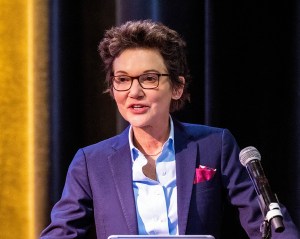
Federal Reserve Bank of San Francisco President and CEO Mary C. Daly sat down for a conversation moderated by former Federal Reserve Bank of Dallas President and CEO Rob Kaplan, who currently serves as Vice Chairman of Goldman Sachs. President Daly discussed her latest thinking on U.S. economic conditions and the Bay Area economy.
Sign up for notifications on Mary C. Daly’s speeches, remarks, and fireside chats.
About the Speaker
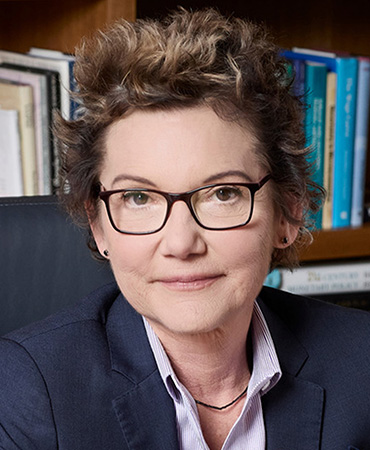
Mary C. Daly is President and Chief Executive Officer of the Federal Reserve Bank of San Francisco. In that capacity, she serves the Twelfth Federal Reserve District in setting monetary policy. Prior to that, she was the executive vice president and director of research at the San Francisco Fed, which she joined in 1996. Read Mary C. Daly’s full bio.
Related: