Tuesday, Feb 17, 2026
11:30 a.m. PT
San Jose, CA
Artificial IntelligenceEmployment & UnemploymentGrowth & ProductivityLabor Markets
Transcript
The following transcript has been edited lightly for clarity.
Ed Ludlow:
Good morning, everyone. I’d hope that we’d start by talking about productivity and some of the data that you’ve just said, “Well, no one really knows.” The question with AI in the US economy is what has happened thus far, right? I’ll hit you with some of the official data that I’ve been tracking and you can tell me the utility of it or not.
Mary C. Daly:
Okay. I’m ready.
Ed Ludlow:
In US productivity, I always go with the Bureau of Labor Statistics’ measure of output per hour x non-farm business sector. If you look at the data over 50 years, that chart was really interesting. The side-by-side of electricity and AI over 50 years, the average [inaudible 00:18:49] reading’s about 1.9% annual rate on productivity. Something’s happened in the last 10 quarters where it’s higher, just under 3%, 2.7%. Do we really know what that is, and is it AI?
Mary C. Daly:
We don’t know. I mean that’s the part that makes it hard is in productivity numbers, especially when they’re happening in what I would think of as real-time, it’s very challenging to assess or draw it back to exactly what the factors are that have shaped it. In fact, people still don’t agree on what happened in the nineties all the time if you look at research. It’s just something to keep in mind. Then what you do, what any good economist or any industry person would do is they’d say, “Well, what am I seeing? What am I seeing?” Right now, while we can’t find it in the macro studies that would do very sophisticated empirical econometrics and ask the questions, how much of this is AI? We still can see that there’s something going on there. The question isn’t is it happening, the question is how long will it persist.
Clearly something’s happening in the economy, but if you make a series, to go back to your question about productivity, if you make a series of one-time adjustments, so say you automate a production line, or you use AI to help in loan application process, you save money once, you don’t save money forever. I mean you keep saving that money, but you don’t get growth out of that. You don’t get productivity growth. You get one-time adjustments to the level of productivity of your employees or your process. What we’re looking for is a technology to give us consistently good changes in productivity so that all industries at scale get better, industries figure out new ways to generate revenue, new ways to do product design, new ideas to come and shape the economy. That’s the thing that has a sustained productivity growth part. It’s undeniable productivity growth has gone up, what’s not as clear as how long will that last.
Ed Ludlow:
Broadly people want to see and understand how AI impacts workforce, and more recently maybe inflation. If we go back to the nineties and what Greenspan saw in productivity gains contributing to economic growth, there was a consideration around both of those things.
Mary C. Daly:
Absolutely.
Ed Ludlow:
You said that it’s not the playbook to go back to what happened in the nineties and apply it today, but what do you see in those things? Is it possible that AI is driving productivity gains resulting in economic growth, but without the inflation?
Mary C. Daly:
It is absolutely possible and something we have to interrogate. I mean right now, as you know too well, inflation’s still above our target, our 2% target, and price level’s been much higher for a long time and people are feeling stretched by the high inflation that they see. Now oftentimes people say, “Well, now AI is going to hurt the labor market, and so now I’m in double doom,” as people say. I think, ultimately, the way many people think about AI is the investment part of any technology can actually boost demand for good services and people, and can then raise the pressure on inflation. But then the productivity part comes, and that’s a disinflationary part. You can see this is all about the timing.
What we end up investigating is not just the models but asking questions. Are the build out of data centers raising prices for construction workers? Are the build out of data centers raising prices for metals and other things that go into them? The raw materials. Then on the other side of that, are the productivity gains already affecting the cost structure of firms? Do they see that? Even if a series of one-off adjustments can actually change the cost structure, and if you look at profit margins, when prices haven’t been rising as rapidly as they once were and firms are saying they don’t have as much power to pass through, you would think that they’re doing something to help margin protection. I think there’s something going on here whether we want to link it all back to AI and then use that as a demonstrated proof that we’re in a transformative state. I think that’s a little bit too far, but certainly something’s happening.
Thinking about productivity growth is exactly what we did back in the 1990s. We saw evidence firms were being more productive. We were interrogating how long that would last. Interestingly, the 1990s, when I said it was the roaring nineties that followed, it was good growth, but it was also a good labor market, a really strong labor market. Those two things went together because ultimately, we had this conversation in the roundtable, and one of the participants made a great point. It’s true. This is how economics works, is if an employee using AI gets much more productive, you hire more of them, not fewer of them, so the economy grows faster, the product development goes faster, and demand gets stronger.
Ed Ludlow:
I’m going to jump ahead to data center. I’d been saving it to end, but it’s highly relevant to San Jose, the build out of data center. Very recently, the CEO of PG&E, Patty Poppy, came on the program and made the argument that it’s possible that the data center build out, within PG&E’s jurisdiction, actually brings down wholesale electricity prices because the hyperscalers take on the capital burden and they are buyers in aggregate of electricity. Your constituents in the 12th district will find it hard to see that argument playing out.
Mary C. Daly:
Well, I think we have to separate what we’re talking about into; now, next, later. Let’s think about now. Right now we have more demand than we have supply for energy, for electricity. We regularly have CEO round tables with the big power companies across the 12th district, you can look throughout the nation. Demand for power is higher than the supply of power. There’s a lot of reasons why supply is falling behind. One is the demand’s just gone up rapidly, but another part is that they’ve got an aging infrastructure, they have to get those things built out. It’s a highly regulated industry, so the infrastructure doesn’t just come on like a light switch. There were supply chain issues that made it hard to get the transformers and other things. So all of this just adds to the imbalance of demand versus supply.
The remedy for that isn’t to take away demand, it’s to increase supply. When any CEO of a power company says, we can solve this problem by adding more supply, absolutely, but that’s a next and later. What you said, my constituents, what consumers and businesses are saying is, “I’m worried my electricity prices are going to rise, and they’ve already been going up,” and the CEOs of power companies are saying, “But if we just keep building, that will go down,” and both are true.
Ed Ludlow:
Go down as far as it will be disinflationary.
Mary C. Daly:
It’s hard to say energy could be disinflationary if we get to a point where supply is greater than demand. Right now I’m just looking for supply to equal demand. That would be a big benefit to consumers because it would mean that we wouldn’t keep seeing inflationary pressure coming out of the energy sector.
Ed Ludlow:
The other thing I wanted to ask you, through the lens of constituents of the 12th district, is one reason you might focus on productivity is there is a direct read through to GDP growth and other data sets that you can look at. The anxiety in the real world is, well, an AI tool can make me more productive or it can displace me altogether. Where do you see that tension in the economy right now?
Mary C. Daly:
One of the things that is true is that the labor market has slowed, but it’s slowed for a whole variety of reasons. Much like when you said, “Well, productivity’s risen, Mary, so isn’t that AI?” I think we always want to be a little humble about the correlations we see and ascribing causality to them. I wanted to temper your enthusiasm for thinking all the productivity growth is AI. Might be, but it could just be general cost management in a slowing economy or to manage tariff costs, et cetera. On the labor market, the labor market is slowing. It’s slowing in industries that are directly telling us that they’re using AI and it’s slowing in industries that aren’t. It’s one of the things that I just want to be cautious.
We talk to workers, we talk to communities all the time. What’s true, in technologies, is a really interesting thing. No technology ever reduces net employment, not in the history of technologies, but it does change what that employment looks like. There’s a period of replacement. Right now, it’s replacement of tasks. So if your job has certain tasks in it, AI can do those for you, and the next part is augmentation. You have replace, augment and create. What’s interesting about AI is that unlike say electricity when the candle lighters, or the lamp lighters, or the candle makers got displaced before the US completely became electrified, this is going more quickly. If you go to a firm, I was on a panel at the Reagan National Library Economic Forum with Patrick Collison from Stripe, sorry. He’s going to kill me. Stripe. Don’t tell him. Okay, but from Stripe.
Interestingly, he said, “I am hiring more coders than I’m laying off, but I am laying off coders whose technology skills didn’t advance or they weren’t the right workers.” You’re seeing this, right? You’re seeing businesses re-skill themselves to meet the AI moment, and that’s going to cause worker anxiety. Right now, worker anxiety is high. We’re in a low-firing, low-hiring environment that’s already going to make people feel vulnerable. If you haven’t found a job and you’re newly minted out of college, you just think I was supposed to get a job before I graduated, now I still don’t have one, that’s very worrisome to people. Then if you’re thinking, “Well, I might lose my job, but I don’t know how long it will take to get another one,” then you’re worried about that. So I think it’s natural for the sentiment to feel nervous, but it’s not the same thing as AI is taking all the jobs because what we’re really seeing is AI is replacing tasks, augmenting workers.
When we talk to firms, most of those firms are saying, “I’m augmenting my workforce.” If you’re big manufacturing firms, they don’t have enough workers that do skilled labor, and so they’re looking to augment their workforce. Then we’re also seeing jobs created. It’s interesting, I gave a talk on this in 2023, and I used prompt engineers as the jobs they were creating, but those jobs are now being replaced.
Ed Ludlow:
That’s a warning, right? That time period of change.
Mary C. Daly:
It’s a warning, you could think of it that way, or it’s an indicator. Let’s take the warning. The warning is you can’t keep up. I would say let’s use it as an indicator. It’s an indicator that technology’s evolving really fast and workforces need to skill in durable skills and durable skills are be AI ready, be able to use AI to lift yourself in the educational space. Use the technologies that are out there to build your skills up, because you can learn a lot, fast, if you train yourself to look at AI, say, give me a lesson on how to write … I’ve been thinking about this, how to write a smart contract from end to end. What sort of software would I need? How would I do it? What would the code look like? How would I test the code? How would I know it’s right before I execute on this smart contract? You can do these things in an evening, and then it’s just about being able to do that.
I think that’s the message for workers, and I would’ve taught my young self this same thing is if you put off technology because you’re afraid of it, then you won’t be in the first place of trying to use the technology to further your own abilities.
Ed Ludlow:
Can we extend that to the Fed? Now, bear with me on that one.
Mary C. Daly:
Okay, I’m ready.
Ed Ludlow:
You talked about disaggregated data, but also improved measurement, citing Greenspan in that sense, if AI is so good, can it process larger sets of data and make more accurate economic forecasts than traditional Fed models can?
Mary C. Daly:
We don’t right now use AI in our monetary policy work, but we do use it in research, as researchers. If you go to any academic institution, you’re going to see researchers using AI to see what they can do better on coding and other things, but also data and analytics. What do you see? The place we are there is AI doesn’t give you answers to problems, it helps you get to the discovery perspective. If I use AI, as a researcher, to look at a bunch of data, I still have to test my hypothesis. I have to go in with a hypothesis. What am I trying to answer? So that’s the human person, and so that’s why it’s not particularly well tooled right now to replace our forecasters and our thinkers, our scholars who think about this …
Ed Ludlow:
It can’t produce a more accurate neutral rate, for example.
Mary C. Daly:
Well, you’re still going to get estimates that are between 11 and negative three on the neutral rate of interest. I’m not kidding. The models that we have can produce an estimate from negative three to positive 11. What does that tell you? The neutral rate of interest is not a truth, with a capital T, It’s an estimate. It’s a theoretical construct to help us understand how to benchmark policy, but you can’t use it as a threshold that you can do surgical adjustments around. No one calibrates monetary policy surgically with a neutral rate of interest estimate for those reasons.
We are using AI though with the Fed, and many people may be surprised about that. Would you like to learn about that?
Ed Ludlow:
Yes, please. How?
Mary C. Daly:
Okay. Many might think I work in an institution that waits for … We’re still getting electricity, you might think that, but no, we actually are not the earliest adopters because remember, we’re fiduciary stewards of public funds, but also fiduciary stewards of public trust. We really have to make sure that we’re working in the most risk-free and risk-managed environment we possibly can. We have been at this since, really in 2023. The first thing that we did as a system, and I’ll really speak about the 12 Federal Reserve banks that are across the country. We worked as a system to say, “We need to make sure our employees, our teams, are ready to understand AI. So what do we need to do? We need to have lessons, work gatherings, et cetera, get people familiar and get people focused in areas that we can practice with.”
We built a practice environment that was completely ring-fenced and not in production. It’s just a practice environment. You’re trying it out. Of course, we got what most businesses got. The other businesses did exactly the same thing. What do you get? You get the early adopters. The good news about early adopters is they’re often ambassadors. So then we’re holding tech cafes and things to help other people learn that. So that was then. Then in 2024 and 25, we really made a full-court press push. March Madness is coming up. We really went hard at making sure that people had not just the, if they’re interested, do it, but that this is something that we really want you to learn.
Ed Ludlow:
This relates to the operations within the system?
Mary C. Daly:
This is the operations. I should have said that before, I’m sorry. I meant to do that.
Ed Ludlow:
It’s okay.
Mary C. Daly:
If you were at a reserve bank, and again, little-known facts, these are facts that people don’t know about the Fed. If you go to a reserve bank or any of our operations, most of the people who work with us are operations people. We process cash, we do all the electronic payment system backbones, make sure they operate on time. If you’re in the financial sector, you know Fedwire, a CH, Fed Now, all of that is operated by our operations teams. We also support Vice Chair Bowman in supervision of banks and all of those things are … Then we have all our support people who help make sure that that occurs. If you can do AI and you can use it, you can think of opportunities.
So the next thing we did, get our workforce ready is number one. Next thing you do is, and this is again, all the businesses we talk to, you see what your vendors are already offering. If you have a technology vendor, an accounting vendor, an HR vendor, and then you just turn the service on. If you turn the service on before your team is ready, you don’t really get an ROI out of it. So again, fiduciary stewards of public funds, we have to make sure. We’re all still in this ring-fenced proprietary environment because the public has to know that we’re not introducing risk to this. Then, of course, the place we’re working now is where many, many people are working, which is if you have a lot of technology workers, then the coding assist is just so important.
One of the things, back to workforce, it doesn’t create a massive change in who you have working for you. What it means is they can do their work faster, better, and more effectively. If you think of the three principles of the Fed, we need to be efficient, effective, and resilient. It also builds in that resilience for us, because we have quality assurance and unit testing, all the things that can slow you down if you’re not right, or interrupt your ability to serve, those things can all be assisted with AI in a really positive way. Again, not monetary policy, but definitely, like all other companies who are working on this space, making sure we’re not behind and delivering good value for … The shareholders of the Fed are the American people, and we owe them the effort to make sure we’re modernizing ourselves and keeping up with the things that can help us do our work faster, better, and more effectively.
Ed Ludlow:
I do have two questions relating to AI and monetary policy quickly, and I know we want to get some Audience questions as well because I’m conscious there are students in the room who will go out into the workforce. I think that the main thing, reflecting back on the nineties, is that there are anticipated impacts from AI on the economy. PCE is the preferred gauge of inflation, running higher beyond 2%. How do you manage that? Many would argue that those anticipated AI-driven productivity gains would justify lower rates, but they are that; anticipated.
Mary C. Daly:
Yeah. I think that really it’s important to recognize that monetary policy is a forward-looking business, but it’s also an evidence-based business. There will be a point in time when we’ll have enough confidence that the anticipated effects are materializing. Where would you look for that? You’d for that in what’s happening with price pressures, not just aggregate inflation, but if you disaggregate it and you ask yourself a question, are the AI using sectors just doing less pass-through of input costs into prices? Well, maybe that tells you something. That’s where the research really becomes important; you ask questions, but you also do research where you can disaggregate firms, you can disaggregate prices, and you can ask, where do we see price pressures and how do we think they will evolve? That’s important. You can’t wait because remember, monetary policy has a 12 to 18 month lag.
So right now we’re modestly restrictive, slightly restrictive, depending on who you talk to. If you have a neutral rate of around 3% interest, remember that’s the one with the big range. But if you have a neutral rate of interest, think this is around 3%, we have some ways to go, 75 basis points roughly, before we get to that level, but we need to get inflation down and we need to make sure that it’s on a good path. I’m certainly looking at AI and productivity growth as one mechanism that continues to help us bring inflation low, but we also have restrictive policy and other factors that are all bringing it back to target.
Ed Ludlow:
How are you thinking about the labor market now, particularly post-January jobs, which showed essentially the most hiring in more than a year? It was an interesting data point.
Mary C. Daly:
Well, one of the things that I’ll offer here, and it’s something you don’t look at, I look at it a lot, but is that a lot of the job growth in our nation right now is located in healthcare and education. While it’s not bad to have jobs growing in healthcare and education, if you look at the rest of the economy, there hasn’t really been any job growth. In fact, there’s been job decline, negative job growth, basically, job losses. That just makes me put a underscore on this idea that the labor market has a no hiring, no firing, that’s already making you a little vulnerable to a negative shock, pushing you below, but also if all your jobs are in healthcare and education, think of all those workers trained for other sectors who are not getting opportunities. I think that’s where we have more work to do to make sure that vulnerability, doesn’t turn into fragility.
That’s less about AI and more about the diversified growth in the economy. If companies are able to really see positive demand growth as the uncertainty decreases, then I think that’s a possibility that would be a positive boost for the economy. Then it’s about should we look at a positive boost for the economy as an inflationary event, or should we think that a positive boost for the economy comes with AI and doesn’t actually induce inflation?
Ed Ludlow:
Diversity in the economy is where I want to end it before we take audience questions. One of the features on the show regularly is compensation in the field of AI, stock-based compensation, competitive salaries, the newly-minted millionaires in the field buying property in San Francisco. Within the 12th district, one of the things I always reflect on is if I drive from the Bay Area down to So Cal, on the 5 or the 101, the agricultural sector of this state in particular, but you could expand that to the other regions of the district. There’s a big contrast there. Could you reflect on both; what you see at the high end of the tech sector and what you do, or do not, see in agriculture feeling benefit from AI?
Mary C. Daly:
Well, it’s interesting. As I said, we have round tables, and I had one this morning, but I have them with all kinds of industries. I like to do them by industry. We had an agricultural round table; how are you using AI. Surprisingly far ahead of where you think. They’re using it to do everything from … Think about idea generation. How do you get better crops, more weather resistant, drought resistant, fire resistant, smoke resistant. AI can help there because it can help generate ideas. Another thing they’re doing is using AI to think about what’s the right planting season? How do I forecast weather?
Ed Ludlow:
It’s predictive.
Mary C. Daly:
It’s predictive. And then of course, using it in their plants and processing to help augment their technology along the production lines. This is why I think it’s more pervasive than many understand, is that we’ve had travel and entertainment, we’ve had consumer retail, we’ve had builders, commercial developers, agricultural, you name it. Everybody’s trying to see how this can make their business work better. The question is when we finish this part, which I think we’ve been in, of using it for cost management and just getting your budgets right, is it going to start to change into revenue generation, et cetera? We’re seeing the seeds of that using it for product development, et cetera, but that’s the uncertainty around this, is when does it move from something that’s just in the development stages … With electricity, the wealthy urban areas had it and the rural areas didn’t.
In this, could this go faster? Is the diffusion of AI and its use cases faster? We had a great discussion at this round table this morning [inaudible 00:44:10], and I’m not sharing all of our points, so it is still Chatham House rules, guys. Seriously, the learning is there’s a lot of perspectives out there that say that AI could be an equalizing force. I think we need to interrogate, is it an equalizing force as vigorously as we interrogate could it be driving further inequality? I don’t think we know the answer to that.
I will end with this. In the end, the decision’s going to be ours. It’s not going to be the technologies. The technologies don’t kind of inherently decide. We decide.
Ed Ludlow:
We’re going to take a couple of quick questions from the audience, but while we find the mic … Oh, we have some in advance. I know they’re in the room we are here at San Jose State University.
Mary C. Daly:
Which I’m very excited to be at.
Ed Ludlow:
There are those that will soon be going into the workforce here. One of them is student questions. Tough one. What advice do you have for new economists, especially those with a desire to enter public service? We got in a little bit about how the Fed and Federal Reserve Bank of San Francisco is, or isn’t, using AI, but reflect on that.
Mary C. Daly:
Sure. Absolutely. First of all, I will just say thank you. You’re an economist and you’re going into public service, fantastic. Seriously, we need people like yourselves who are interested in doing this. This is a very fantastic career. I would call it a vocation to be in public service and serving on the types of things that are the Federal Reserve’s and other public institution’s missions. So that’s important.
The important thing about public service that I think is overlooked is one of the biggest skills you have to have as an economist is being a detective. A detective never gets satisfied by looking at one thing. You test your theories, you dig deeper, you’re never really satisfied. People ask me, “Mary, why are you constantly curious and never really satisfied with the answers?” I said, “The minute you get confident, you lose.” You want to be confident in the moment and humble enough to ask again, is this right? And why would it be wrong? And how do you do that? That’s an important thing.
I’ll say that AI is a technology, it’s not a miracle. It’s about how you find a way to relate to AI that makes you better, a better detective if you’re an economist, a better public servant if you choose to work in that field. That’s how I use it. I’m always trying to make myself better at serving those who I’ve got the responsibility to serve. And doing that with a technology or with just being out in a factory floor and learning how businesses are doing it, that’s the magic there. So don’t get yourself monolined into only one skill. It’s really about having the detective range of skills and recognizing those skills have to change to meet a changing environment, but to also meet the moment. The skills I developed in the mid-nineties, I’ve certainly had to change and augment those to be able to do my job today.
Ed Ludlow:
Present Daily, quite a few of the other questions are the other side of the remit, which is regulation. In your speech, you mentioned that financial services, the financial sector, early adopters in many ways. The question is; how do you balance regulation that ensures safety, within the financial system, but also allows them to innovate, move faster?
Mary C. Daly:
I do have to say, because this is a weird aspect of Federal Reserve, I don’t know if it’s weird, I think it’s right, but it’s a unique aspect of Federal Reserve’s system. The Reserve bank presidents don’t do any regulation, right?
Ed Ludlow:
Supervisory, yeah.
Mary C. Daly:
And we don’t even do any supervision. That’s all left with Vice Chair Bowman and the Board of Governors. The rules get made by the full Board of Governors, not the Reserve Bank presidents. That said, we can talk about regulation more generally, not just in financial services. There’s always a tension. If you’re an economist, you know this, if you’re a business, this, there’s always a tension. If you let fully unregulated innovation occur, you could do customer and consumer harm. If you do so much regulation that no innovation occurs, well, then you will end in stasis. Somewhere in the middle is where the nation has to go and nations … We have, historically, had a very robust financial sector in the United States that’s facilitated a lot of intermediation, and growth, and sort of allowed us to be the country that we’ve been in terms of doing things.
So we don’t want that to stop, but as new tools and technologies come out, it’s not about cutting them off, it’s really about thinking about how they can be done safely, but still innovatively. I think that magic place is not something you get to, and then you’re always there. It’s constant recalibration, constantly asking the question, the bridle is too tight, or the reins too tight, or are they too loose? It’s very much like monetary policy in that way. You don’t get to a point and say, “Great. We won. Victory.” You actually are always …
If you’ve ever ridden a horse, and if you haven’t, I apologize, but if you’ve ever ridden a horse, it’s not my first vocation, you know if you pull too tight, it stops on a dime and you’re over the head. If you let go too much, it runs too fast and you’re over the back. It’s basically trying to manage the bridle so that you get the innovation you want without exposing consumers, or other businesses, or the society to harm.
Ed Ludlow:
Let me ask a final question, and we will end on, I guess, a positive note.
Mary C. Daly:
Oh, good.
Ed Ludlow:
Which data sets and what you see in the real world, because you still go out into the real world, gives you most optimism about the impact that AI will have on the US economy, and specifically that of the 12th district.
Mary C. Daly:
I will say that when I first came to this job in 1996, I am going to work at the San Francisco Federal Reserve. I had been to California a year before, down in southern California at the Rand Institute. I remember going to a conference there, and we met a lot of business people thinking about, not AI, but something else. I came home and I told my wife, “We’ve got to go there. It’s filled with entrepreneurs, it’s filled with people who have never heard the word no. They just heard why not.”
What’s interesting about the 12th district is all of those people don’t live in California, they live in Utah, they live in Idaho, they live in Vegas. They live in the entire Inter Mountain West, west of the Rockies. I’m not saying anything about other places, they’re all very innovative too, but there is something here that gives me optimism because it’s not that people say, “Well, AI is coming and let me figure out how to not be eaten up by it. It’s like AI is here, let’s figure out how to harness this tool to create a better business, a better economy.”
Really the thing that gets me jazzed and optimistic is people talk about a better world. How do we make things better for people? How do we change education so there’s more quality? How do we help the globe have more opportunity? How do we harness what’s sitting here in front of us with all these people, into something powerful that changes lives and livelihoods? So that’s what gets me optimistic. They’re just not talking about what they might do. If I said, now, next, later, there’s not too many conversations with people who live out here who talk about way later, they’re all talking about now and next. That gets me excited.
Ed Ludlow:
With that, all that’s left to do is to thank the Silicon Valley Leadership Group, San Jose State University, our host, and San Francisco Federal Reserve Bank president, Mary C. Daly. Thank you very much.
Mary C. Daly:
Thank you. Appreciate it.
Summary
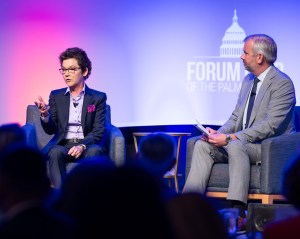
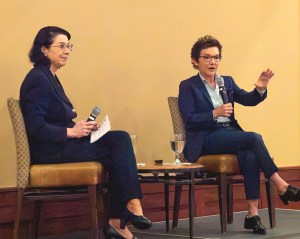
Hosted by the Silicon Valley Leadership Group and San Jose State University, President Mary C. Daly delivered keynote remarks on AI and the U.S. economy. Following her remarks, she sat down with Bloomberg Tech’s Ed Ludlow for a moderated conversation and audience questions.
From the Event
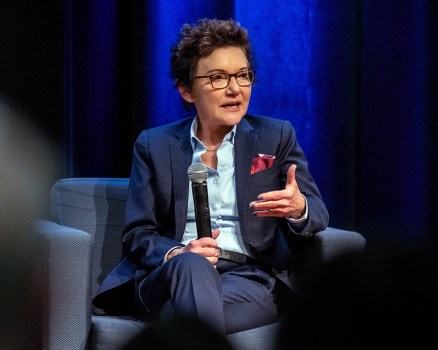
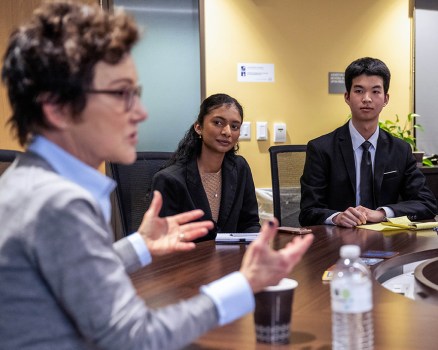
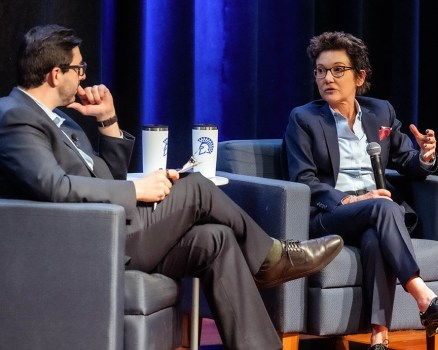
Photo credit – Robert Bain, San Jose State University
Sign up for notifications on Mary C. Daly’s speeches, remarks, and fireside chats.
About the Speaker

Mary C. Daly is President and Chief Executive Officer of the Federal Reserve Bank of San Francisco. In that capacity, she serves the Twelfth Federal Reserve District in setting monetary policy. Prior to that, she was the executive vice president and director of research at the San Francisco Fed, which she joined in 1996. Read Mary C. Daly’s full bio.
Related: