Wednesday, Apr 08, 2026
10:05 a.m. PT
St. George, Utah
Cash OperationsInflationInterest RatesMacroeconomicsMonetary PolicyU.S. Economy
Transcript
The following transcript has been edited lightly for clarity.
Chip Childs:
Well, I want to also welcome you, Mary, for coming here to St. George. I think this is the first time we’ve had a President and CEO of the 12th District come to St. George. And it really does show the enormous importance of outreach that you have. And it’s a pleasure to have you here. But I want to address some questions that I had through your speech, but first and foremost, let’s just get into it. What’s your economic outlook today?
Mary Daly:
Yeah, that’s the number one question. I got stopped on the airplane and asked that question, what’s the outlook for the economy? So let me start there. One of the things that has been remarkable about the US economy, I would say remarkable, is how resilient it’s been to a series of things that nobody expected to happen. Let’s start all the way back with the pandemic. I mean, we came out of that pandemic and roared back in terms of demand. Supply wasn’t quite there. So we ended up with higher inflation and more disruptions than you would want, but it’s really a remarkable thing. The same thing held last year when we came… The economy starts off strong at the beginning of the year, and then there’s Liberation Day and tariffs. And many commentators were extraordinarily worried that this was going to tip the US economy over, but it did not, right? And now, we have volatility from the war and the oil prices and things. And so far though, what we’ve seen is, consumers are still spending, businesses are still investing, and sentiment hasn’t completely fallen. There’s a concern that maybe this will push inflation up. That’s our job. We’ll focus on that. And there’s a concern that maybe the labor market isn’t as solid, but we’re not seeing that. We’re seeing it settle at a good place.
So from my vantage point today, I see the underlying fundamentals of the economy as really in a good place. The question is, what’s going to happen with the war? How long will prices of oil and gas stay elevated? And what will be the, we call these the knock-on effects be in terms of other goods and services? It’s really too early to make any statements about that because we don’t know how long the conflict will last, but importantly, we do know that the underlying fundamentals of the economy remain solid. And those are things that are important to how we see inflation progressing over…
Mary Daly:
Things that are important to how we see inflation progressing over time, and how we see growth and the labor market progressing.
Chip Childs:
Good. We live in a crazy level of volatility right now, with noise everywhere. How are you, in your role, able to kind of cut through the noise, and all the distraction, and everything, to make sure that you’re making the right monetary decisions? What’s your process for that?
Mary Daly:
Yeah, that’s a great question. So one of the things that is really important in this work is that you don’t move around as much as the news does or the markets do or even the outlook does. And one of the reasons that we are good at that, better at that, is because we have all the data and the fundamentals and our models, of course, and that helps. But we also talk to businesses. So here’s something that is… I just think an example is worth a thousand words. So let me give you an example. So last year, right after Liberation Day, Chip, you hosted me at Brigham Young. Went to Brigham Young and I’m in Provo. We do a round table in Salt Lake first, that Chip organized for us. And I ask everyone, how are you feeling about tariffs? These are businesses that are going to have a tariff impact because they’re doing construction, manufacturing, et cetera.
And they say, “Well, it’s increasing cost. We will find out how much in a little bit. We’re going to work on how do we get more cost-effective so we don’t have to pass prices along to consumers in their totality. We’re going to think, our outlook isn’t bad.” And then we’re driving from Salt Lake City to Provo, and there’s cranes everywhere. And importantly, the cranes are running up and down. They’re not just stopped. People didn’t stop. And that really was in contrast to what, maybe, some economic models would say. If you remember back then, that last year, there were many economic models and commentators saying, “This will break the US economy.” But I wasn’t seeing it in Salt Lake City or Provo, and I wasn’t seeing it, importantly, across the district. I saw the cranes, people were still putting up cranes, and they’re still running cranes.
Here’s something I know about cranes. You don’t build them and run them if you think the outlook is bad. You just stop and you wait for it to get better, but they were still going. And so that’s an example of how we smooth through it. Uncertainty, no one likes uncertainty, and no one likes volatility, but the only way it will affect the economy is if businesses, households, workers, stop doing stuff because they’re so uncertain. And what I saw then was that people weren’t stopping. They were just more nervous. And so that makes people uncomfortable, and it can eventually absolutely affect demand or investment, but you have to ask that question. You can’t just assume it affects it. So that’s how we do it. We go back and we say, “Here’s what our models say, what’s actually happening in practice.” And so my inflation outlook last year wasn’t as high as many other commentators.
And I wasn’t as worried about the impacts on growth because I was seeing some of this. And then it turned out that the data I was getting from our contacts was a little bit better than the data that I was getting or the analysis I was getting from the models who hadn’t seen a tariff incident like that since back in the earlier part of the last century.
Chip Childs:
Yeah. Very, very good. I’m going to switch gears for just a minute based upon what you’re talking about in your speech. So you’ve been at the Fed for 30 years now.
Mary Daly:
Yes.
Chip Childs:
The Fed must have been hiring young children back then.
Mary Daly:
Well, thank you. I appreciate that. See I love coming to Utah and I love Chip.
Chip Childs:
So what evolution have you seen in the last, in your 30 years of being at the Fed and where do you see the most important evolution happening in the future?
Mary Daly:
There’s really two things I’ll highlight here. So when I started, it was interesting. You could go your whole career working at the San Francisco Fed and never visit another Federal Reserve Bank. You used to have, I would like to visit them all, but you could go your whole time because these were really independent structures that didn’t really interact with each other. I mean, we did interact, of course, but they weren’t joining their functions and forces in order to do our best work. So over time, that just doesn’t work, right? You don’t want check processing. Checks are a good example. We had check processing in every single location, but the San Francisco Fed check processing ran differently than the Atlanta Fed check processing or the Dallas Fed check processing. But honestly, check processing is check processing. We should work it the same way. And so we standardized.
You don’t put it all in one place because you have to be near your customers, but you standardize how you do it. And so that’s, we’ve worked hard to standardize things that you can standardize to create efficiency and effectiveness, but always being mindful of resiliency. So that’s an example where reserve banks now work together quite considerably more. And it’s saved us resources. It’s saved us time and energy. Importantly, it’s allowed us to invest the captured resources into other functions.
And so another thing that’s really happened is we’ve been leaning into regional engagement. So if you look at any reserve bank now, much more focused on regional engagement than they were. It’s been a priority of my presidency, as I said. So here’s an example. The person who set in Abby’s role prior to Abby, was the first person we had as a full-time regional executive.
Before, that would be about 10% of your job. And the rest of your job would be managing cash or facilities or other operations. And so this idea that we really, to be regional, you have to dedicate resources to regional engagement. You have to be out in the field. That has evolved over time, and I think made us much stronger. And then the amount of technology that’s in our business, one of our biggest groups of people are working on the underpinnings of the payment system, and that underpinnings of the payment system is mostly electronic now. We have cash, that’s very operational, and checks, very operational, but the other part is mostly technology, and using things, and being at the forefront of how to not develop AI or an emerging technology, but how to use it safely. So we practice long before we use it, largely because remember I said we want to be efficient, but we also have to be effective and resilient, and we have to manage the trust aspect.
You don’t want us using technology as we haven’t practiced and really been resilient with. The same as you don’t want Chip doing that either. So that’s how we’ve evolved. And the place looks very, very different than when I started. And it’s really been for the better. I do think that as public servants and fiduciary stewards, we have to constantly work to be joining our forces, being better while we stay grounded and committed to being independent and regionally focused so that we can bring that information to the forefront of monetary policy, and in all the things that we do.
Chip Childs:
Excellent. Let me ask a couple of questions based on my experience with the Fed. I remember, I think it was close to eight years ago, Robin called me out of my office and said, “Do you want to be involved in the Federal Reserve?” And I’m like, “Don’t know what that means, but I’ll meet and we’ll talk over lunch.” Went to lunch and she explained what being a board member at the Federal Reserve was like, and I was very intrigued by it. And part of it was I realized how much I didn’t know that the Federal Reserve reached out to businesses because I have surveys I fill out for you. I give economic reports to you on a regular basis. And it is a fascinating process, but I didn’t know that the Fed was doing that type of stuff. And you mentioned in your speech that you do a lot of specific outreach to business community leaders, businesses throughout the district.
And you’ve given a couple of examples. Any other examples that you would share of your specific outreach and how you’re trying to gather economic data by not looking at the past and more in the future?
Mary Daly:
Sure, absolutely. Because we can’t be… Monetary policy acts with a lag, so we have to be forward-looking. If we’re looking backwards, we’re behind. So that’s the important part of this. So one of the things that we’re all talking about right now is AI. So back in early 2023 at the San Francisco Fed, we started something we call the Emerging Tech Economic Research Network. And it was just a network of trying to get better, looking at research, looking at what CEOs are doing, talking to technologists, asking these questions. And so we’ve hosted so many round tables with businesses by industry, agriculture, manufacturing, services, travel, finance, asking them, how are you using AI? And what was really remarkable is in 2023, they were trying to figure out how to keep their employees from using it in a way they didn’t know. So they wanted to get ahead of their employees.
They wanted to make sure they were keeping up. And so then we go back in 2024 and 2025, and every year you see them using it more. And so we were able to understand before the productivity growth began, that there were elements of how AI was affecting productivity growth being built in businesses. They might not be reaping all of the benefits, but they’re using it. And this was really important. There’s a lot of conversation about will AI take jobs. We have talked to CEOs and what they tell us is we can’t keep… We’re looking for workforce. That was a hot job market back then. We can’t find it. We’re using AI to augment jobs, to make people more productive, better at their work. And that’s very important for understanding the trends. I go all the way back to when I started in ’96. One of the things I did early on in my career was for Chairman Greenspan back then was work on do we see productivity growth from computerization and internet?
And that same pattern is happening now. And so this example of when you have these round tables and they’re very focused and you can do them across the entire district, you can actually use those as leading indicators of where the economy’s going. And that’s important because where we have historically made policy errors and will likely be again, do again at some point is that you don’t know what’s going to happen, you’re focused on what has happened, and fighting the last battle is never going to help you fight the next one.
Chip Childs:
Very, very good. One other thing, when I first got involved with the chair, and don’t be mad at me for admitting this, this is on me, not you.
Mary Daly:
I’m never mad.
Chip Childs:
Okay. But when I first started with the Fed, I kind of thought that the Federal Reserve was this entity that was consisted of 500 economists in an ivory tower somewhere, that all they did was evaluate historical data, do a bunch of social studies, and try to come up with a reasonably good level of decision making relative to monetary policy. I knew they basically saved the day back in 2008 with what they did, but I still had that view and I never really realized until I got involved that that’s such a small fraction of the overall structure of the Fed. Could you share a little bit more about that? Because it definitely changed my perception.
Mary Daly:
You have the perception that many have, that when we bring new interns in, and they know they’re going to work in the operations part or something like that, they’re shocked that the building’s not filled with economists, and that it looks like a university. But only a very small fraction of the total workforce that works for the San Francisco Fed does economic research. The vast majority of our teams work in the payments group or their supervisors. They work for Vice Chair Bowman and they’re working on supervision of banks or they’re working on all the technology that we need to support everything from cash distribution to ACH and other electronic payments.
So it is really not… A big fraction, if you come to visit one of our locations, we give you a tour. The first two floors in most of our places, definitely the basement, look like a manufacturing environment because that’s where we process cash. We’re not manufacturing cash for the record. We’re simply counting it, moving it through the machines to see if it’s fit for use. Abby’s right there, so she’s going to make sure that I say that. But seriously, in a serious way, they look like a manufacturing floor. And then we have all these operations, just like any other business would have. We have to have cybersecurity, we have to have IT that works on electronic payments. And importantly in this work.
Mary Daly:
… works on electronic payments. And importantly, in this work, we build a lot of things and monitor it ourselves because if you outsource too much of your core responsibilities, I’m guessing you don’t outsource piloting.
Chip Childs:
Not much.
Mary Daly:
Yeah. And so it’s just then you end up with not having that resiliency that ultimately limits the people’s… your clients, your customers, in our case, the American people, their ability to trust. And so that’s what most of our people do.
If you ever come by the Salt Lake City branch or any other location we have, we’ll show you a tour, and you’ll see that there’s a small little portion of our bank that actually has the economists, and the rest of it is every… people like you would be in any other business.
Chip Childs:
Yeah. It’s interesting. At times, and this is just my experience. Once in a while, you come across people to say, “Yeah, we need to do it away with the Fed,” or this Fed this or Fed that. And I do remind them it is nice to be able to pay your bills electronically. It is nice to get direct deposits, and that’s… that businesses don’t function without what the real guts of the Federal Reserve are.
And so it’s a fascinating structure. Okay. The Fed’s going through an interesting time right now. We have a new chair that’s been identified, and certainly, there you have an interesting political culture around all the things that are happening in the economy as well. How does that affect your job and your ability to stay straight with your policy decisions and the work that you do?
Mary Daly:
Sure. I thank you for that question because what seems like a lot of volatility and things that, for the Federal Reserve, when you’re external to the Fed, does not feel like that internal to the Fed. So if Kevin Warsh is confirmed, he’ll be the fifth chair I have worked with or for, right. It’s a fifth person I’ve had in my career. That’s a 30-year career.
So I began with Chairman Greenspan, then Chairman Bernanke, then Chair Yellen, Chair Powell, and then, if he’s confirmed, it’ll be a new chair, Kevin Warsh. In each of those times, the same thing happens. The chair goes through the confirmation process, comes to the Federal Reserve, and walks over the threshold to lead this organization and has committed before even arriving to the principles and the goals that Congress laid out.
You don’t take that job unless you want to serve the institution. And I can’t… I won’t speak for any of the chairs, but I’ll tell you how we all think about it, which is our job is to do our work well and pass the baton and the institution to the next generation of leaders so that they can do their job well.
And that’s how every chair I’ve known, I know them all personally, known them all personally, very excellent leaders and very excellent public servants, focused on the mission of the Fed, from payment system to the supervision and regulation to monetary policy and committed to doing what the generations of leaders in the Federal Reserve have done before them, which is lead.
That doesn’t mean there won’t be changes. That’s what you want out of an organization, some healthy change, but it’s never a huge directional shift because ultimately our direction is tied to congressional mission and goals. Congress owns the pen on those types of things. Our job is to execute on what Congress gave us.
Chip Childs:
That’s excellent because, look, I’ve been at SkyWest for 25 years, and we have a lot of government agencies that we have to deal with. We have to deal with the SECs, a public company, FAA, DOT, EPA. My guys could mention several three-letter acronyms that we have to deal with.
And I’ll be honest with you, I’ve been absolutely fascinated and impressed at what the Fed Reserve has gone through in my tenure being associated with it and how absolutely focused apolitically and to the mission of the Fed is compared to what happens with other government agencies.
And I think that goes to the independence and the congressional mandate, but I think it also goes to the integrity of you and your team that you have in place at the Fed that has a very strong mission-centric purpose. And I think you guys do a fantastic job at that. Okay. Let’s get into your own story. How did you get here? You gave a little bit of your history, but how did you get here, and how did you come to be in your current role as president of the bank?
Mary Daly:
Well, thank you for the question. You’re probably like me. I grew up in the Midwest. I don’t like to talk about myself, but I will.
Chip Childs:
I’m asking you to.
Mary Daly:
Yeah, I know you are. So I have to. I mean, you’re the chair of my board. So what choice do I have? No, seriously, it’s a story that I really value because I think it helps us understand where we can influence people’s lives with small pieces. So I dropped out of school when I was 15. My family fell on some hard times, economic and health shocks, and I needed to work to help with the support of our family. And so I’m working, I’m doing a lot of odd jobs, just putting together part-time jobs. And when I would drive, I was driving a donut truck route.
When I was driving, I would see this billboard to become a bus driver. And I thought, “Well, I know how to drive a donut car, so surely I can drive a bus.” And I went… that was my job. That was my dream. And the reason it was a dream is because it had benefits, it was full-time, and I could imagine doing it for a long time. And I met… My guidance counselor from before I dropped out introduced me to a woman named Betsy. And Betsy said, “You know, Mare, you can’t get a bus driver job without a GED.” And I didn’t know what a GED was, and none of my family had ever gone to college.
And so the whole thing was very confusing to me, but she helped me sign up for it, and I took the test. And then she said, “You did pretty well on the GED test. Maybe you should take a semester of college.” Again, college is a foreign concept to me, but she said she had gone to college, and I should try it. So I said, “Okay.” I applied. I got in, and I couldn’t afford it. So Betsy wrote a $213 check to the University of Missouri-St. Louis, right to the bursar’s office. And I went to college, and she said, “Okay, you did pretty well. Why don’t you go to a four-year school?”
And so I said… I mean, I didn’t want to disappoint Betsy, but here’s the really magical thing. I had no idea that any of this was possible, and Betsy just did small nudges because she could see something that was possible for me that I didn’t know was possible myself. And I say this story to say all of us have that capability. That’s what I’ve learned. Betsy was 32 years old at the time, and she changed my life. So then I go, I get my PhD eventually. I go from… I like economics. I go, I get my PhD, I began working at the San Francisco Fed.
And honestly, when I started, I thought I would go back to be an academic because that’s what many PhD economists are trained to do, but I fell in love. I fell in love with the engagement. I fell in love with the complexity of the issues we face, right. In the Federal Reserve, we face issues of how do we operate our payment system better. It’s a complex logistical problem. How do we think about doing banking supervision better and more effectively so that we can have financial intermediation across the country?
And importantly, how do we serve Americans in such diverse locations, such different economies under one monetary policy program? How do we do that? To me, that’s just a recipe for falling in love with a vocation. And so I did, and I stayed at the Federal Reserve, and when the job for president became available, I applied. It was a… 250 people applied with me, but in the end, I got it. And it is truly the best job of my whole career. And the reason is because it’s such an honor to serve in the role.
Chip Childs:
Outstanding. That’s a story. High school dropout at 15 to being the president of the Federal Reserve Bank of San Francisco that represents an economy of about the fourth-largest economy in the world. It’s an amazing story. We’re lucky to have you. I’m going to ask one more question here that was submitted from the Chamber here.
Mary Daly:
Oh, great.
Chip Childs:
It’s a great one, I think, to close on as well. How will President Trump’s maneuvers with central bank governors affect economic markets and policy?
Mary Daly:
So I know I’ve talked a lot about history today, but I think it’s important. Sometimes, when the world is very uncertain, returning to history is… teaches us things. And I think this is a particularly important period to return to history. There’s always been pressure on the Federal Reserve. That’s what Congress understood, that there would be pressure from administrations to do a certain kind of policy, to think about a certain way the world should work.
But the checks and balances that Congress put in were about, ” We give you the goals and your job is to be apolitical and execute them.” So I can say with all sincerity that that’s what we’re committed to. And when all of us at the Federal Reserve, all of the policy makers cross that threshold to go into the meeting room for the FOMC to make monetary policy or close the doors and make decisions about how we should think about the payment system and things, we’re thinking about serving the American people, not anything but that.
Ultimately, our decisions last a much longer time than the administrations, and the responsibility that we really focus on is how are we going to look our fellow citizens in the eye and say, “We’ve done our work well, the best we can in earnestly, and we’ll try again, do better and work harder tomorrow.” And that’s the piece that’s really important. And so I don’t see this really affecting us in our work in any way right now. And importantly, as you can see from the markets, they don’t either, right.
I mean, look at inflation expectations. Other than the short-run inflation expectations for oil prices, they’ve been generally well-behaved. Look at markets, they’ve been generally well-behaved on some of this. And I think that’s just because the congressional commitment back in 1913 was so strong that people have faith and confidence in it, but we still have to be accountable and be out in our communities, wherever those communities are, and talking to all of you and answering your questions as well as we possibly can. So that’s what we do, and that’s how we’re going forward.
Chip Childs:
Perfect answer. Thank you, Mary. It’s been such a pleasure to have you here and have this conversation with you. It’s a pleasure to serve with you. It’s an honor.
Mary Daly:
Likewise. Thank you.
Chip Childs:
Your reputation among the Federal Reserve is outstanding. I go to D.C. once in a while and do some work there, and I hear about your work in the 12th District, and you have an enormous amount of credibility nationwide as well. So it’s been a pleasure. Thank you for coming to St. George. Thanks for the Chamber for hosting us. And I think that’s it.
Mary Daly:
Thank you guys. Appreciate it.
Summary
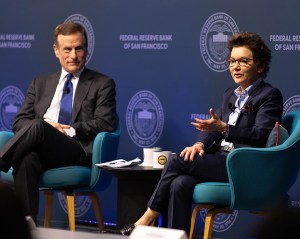
Hosted by the St. George Area Chamber of Commerce, Mary C. Daly, president and CEO of the Federal Reserve Bank of San Francisco, delivered keynote remarks. Afterwards President Daly joined Chip Childs, President and CEO of SkyWest Inc. and Chair of the Head Office Board of Directors for the Federal Reserve Bank of San Francisco, for a moderated conversation about the economy, monetary policy, and more.
Sign up for notifications on Mary C. Daly’s speeches, remarks, and fireside chats.
About the Speaker
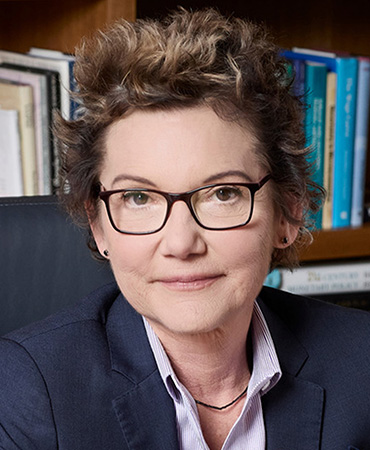
Mary C. Daly is President and Chief Executive Officer of the Federal Reserve Bank of San Francisco. In that capacity, she serves the Twelfth Federal Reserve District in setting monetary policy. Prior to that, she was the executive vice president and director of research at the San Francisco Fed, which she joined in 1996. Read Mary C. Daly’s full bio.
Related: