Friday, Apr 17, 2026
8:30 a.m. PT
Artificial IntelligenceBalance SheetEmployment & UnemploymentFederal Open Market Committee (FOMC)Interest RatesMacroeconomicsMonetary PolicyU.S. Economy
Transcript
The following transcript has been edited lightly for clarity.
Alex Mehran Sr:
Well, Mary doesn’t really need any introduction. This is your third visit to the Fisher Center for Real Estate and Urban Economics. Welcome back. Thank you for-
Mary C. Daly:
Thank you.
Alex Mehran Sr:
Mary and I go back a long way, and we’ve gone through a number of different ups and downs at the Federal Reserve, and we’ve had a good friendship. That’s the most important thing –
Mary C. Daly:
Absolutely.
Alex Mehran Sr:
… our time together. And you’ve been there for how long now?
Mary C. Daly:
Do I have to say?
Alex Mehran Sr:
Yeah.
Mary C. Daly:
30 years. I started in 1996.
Alex Mehran Sr:
And the president of the SF Fed?
Mary C. Daly:
2018.
Alex Mehran Sr.:
2018. Yeah. So it’s been a nice run.
Mary C. Daly:
I could have just gotten away with 2018, I realize.
Alex Mehran Sr.:
Yeah, exactly.
Mary C. Daly:
I didn’t have to say 30, but I started young.
Alex Mehran Sr.:
But Mary’s been a great president of the San Francisco Fed. And what’s little known about the Federal Reserve System is there are 19 people who are at the table, the seven governors and the 12 regional presidents. And there are a handful of voices that are predominant, and Mary’s is one of those voices. So thank you for that.
Mary C. Daly:
Thank you.
Alex Mehran Sr.:
So today, I hope at the end of this hour that we will have some insights on three things. One, where are we going directionally on interest rates? Two, what’s going to happen with the kind of regulatory requirements freeing up capital for the banking system? And lastly, what does the post-Powell Fed look like? But to begin with, Mary, let’s go through an economic dashboard. Where do we stand in terms of the basics of our current economy?
Mary C. Daly:
Sure. And when I think about the economy and the outlook, I always start with economic fundamentals. Let’s move away from the shocks and the uncertainty, and let’s just talk about the fundamentals. So the fundamentals of the economy are quite solid. Business investment is strong. Businesses are cautiously optimistic. If you look at surveys, or we spent a lot of time as regional Fed presidents talking to CEOs out in the world, and cautious optimism is what I hear.
Then you think about consumers. Despite the fact that they’re a little more or a lot more uncertain about their jobs, and they feel nervous about the state of the economy they find themselves in, they’re spending. They’re not giving in. They’re continuing to be out there. And so those are strong pillars of how our economy goes forward. And you see productivity growth is rising. It’s above what is our normal historical trend. That’s a good thing for the economy.
So those are the fundamentals. And I would say prior to the conflict in Iran and then the oil price increase, we had inflation coming down towards to our 2% target, making good progress there, and the labor market had stabilized itself. So that’s the backdrop.
So then of course, we get the conflict in Iran, and we get the rise in oil prices and the uncertainty about how long the conflict will persist. And that has caused a lot of what I think of as scenario analysis, because the world is so uncertain, it’s depending on how long the conflict lasts, and whether the oil price rise is a persistent increase, or continuing to go up, or whether it comes back down to its pre-conflict levels, and the economy goes back to those fundamentals. And that’s where the outlook is right now.
It’s the good fundamentals, but a lot of uncertainty about what really persists. And ultimately, that creates scenarios for monetary policy, making us unable really effectively to say, “We think we will do this by the end of the year.” You can say, “Here’s what we would do if this happens. Here’s what we would do if this happens. Here’s what we would do if this happens.”
Alex Mehran Sr.:
So immigration has been a big driver of growth, and that has changed. So trend growth is a simple calculation of immigration, population growth, and productivity growth. Let’s talk about the impacts of the change in immigration policy on the economic outlook.
Mary C. Daly:
Sure. So as you said, Alex, that the way we think about potential output growth is just the labor force growth, how many people are going to come in and work, and then the productivity growth. So productivity growth has been good. It’s been above its historical average, but labor force growth, if we just think of the domestic population, we’re heading towards zero labor force growth per year. And at the outer decade, it can even fall to be negative. And that’s simply because we have smaller birth cohorts that are coming in, and we have the aging of the baby boom, right? And they’re moving out. So that’s going to be domestic labor force growth of near zero. We have been augmenting that, essentially, with strong immigration growth, which is meaning, if we can’t find workers here, then we go and get them from abroad, and that creates that labor force input.
So with immigration now at almost zero, and many people even leaving, that just means we’re close to this zero level of labor force growth. So what does that mean first for the job market? It means that when you see a monthly number that is even zero, it isn’t necessarily a sign that we have a recessionary dynamic forming. That might be our new steady state. Benchmarks, depending on who’s estimating them, are around 20,000 jobs a month is normal. But if you have any statistical fluctuations, you could easily end up negative or a little bit above that. So the benchmarks have to change.
The other thing, of course, is if we don’t make it up with productivity growth, then our potential output growth will fall. Now right now we are making it up with productivity growth. So we’re still, have trend output growth of two or a little bit above, but it could easily slip if productivity growth goes back down to 1.5.
Then we’d have a 1.5 potential output growth, because we’d have zero labor force growth. So the absence of immigration really does matter for that arithmetic calculation. And it really matters that businesses are investing in productivity-enhancing technologies so that they can augment the workforce we have and then move forward. I mean, the only lever we can pull if we don’t have immigration is labor force participation. How many of us of working age actually participate?
And there, there’s a lot of room because we have one of the lower labor force participation rates, especially for males in the industrialized world. So that’s a problem that policymakers, not the Fed could work on. And I think there’s some interest in doing that, but that is a lever that still remains, that is something that could be changed, but that takes work.
Alex Mehran Sr.:
So immigration has kind of a virtuous cycle to it. Do you believe if we had a more open immigration policy that we would have more growth or more unemployment?
Mary C. Daly:
Well, what has happened so far, and this is, let’s use just what happened recently as an indicator. That is a complicated question to answer. It really depends on the time, year, where you are. So we had a lot of immigration right around the pandemic and after, and we absorbed all of those workers and all the workers who were domestic workers who wanted to work, because the labor market was extremely strong. At some points when we would go out and do our roundtables, the CEOs would call it frothy. You probably remember this in your own business. It’s really hard to find workers in that environment. And so we could absorb all the workers. As the economy slowed, we saw something else. So immigration slowed, and those workers went away and there was a concern, if you remember, that this was going to raise wages and make the labor market frothy again, but it didn’t, because the economy slowed at the same time. So that doesn’t have to happen. It could be that you’ve got strong labor demand and you have limited number of workers, and wages rise, and there’s tightness, but that didn’t happen this time. So it really depends on what’s happening elsewhere in the economy, and again, whether you can make up the difference in productivity.
So one of the things I am very curious about is how do businesses that have relied a lot on immigration to fuel their labor force, what are they doing? And so a place where you see this a lot is leisure and hospitality. In leisure and hospitality, I don’t know if you’ve noticed this, but there’s a lot more technology doing things for you than people doing things for you. And you end up ordering things on your phone and things. That’s a response to a tighter labor market and technologies that are available to make that all easier.
And so that’s how the economy typically evolves and adjusts to whatever the inputs are, but this is a transition dynamic that we will continue to have to face if immigration policy stays.
Alex Mehran Sr.:
Constrained. So do you believe, if we had, in these economic circumstances, if we had greater immigration, that we would have higher unemployment or not?
Mary C. Daly:
It’s really hard to say, because it’s- I’m
Alex Mehran Sr.:
Going to ask it again.
Mary C. Daly:
Okay. I’m going to tell you, okay, I’m going to give you my … I mean, I am, Alex, an economist, after all. Clarity before certainty. Okay. So here’s how I think of it. If immigration came in, we had more immigrants, and businesses responded by saying, “Well, now that I have more labor, I don’t have to invest in labor-saving technologies,” then that wouldn’t cause a rise in unemployment.
If they said, “I’m not going to do that. I’m still going to invest in labor-saving technologies,” then you might have a rise in unemployment. But here’s the dynamic that I think is underappreciated. Immigration doesn’t usually rise in a time when our economy isn’t very robust, because immigrants come, oftentimes, for work. And so if they come for work, and they see that the economy’s not very good, they go back home to the home country.
So it is a self-equilibrating dynamic in many ways, and that’s been true historically. It’s not always the case, but it is often true. So I think that nexus between unemployment and immigration is just harder to find in the data than it is in our sensibilities, historically.
Alex Mehran Sr.:
But I think at our last annual Fed meeting, there was a presentation on immigration, and they said that, I think it was two-thirds of immigrants go back to their home country when they retire.
Mary C. Daly:
They do. Yes.
Alex Mehran Sr.:
Kind of remarkable.
Mary C. Daly:
No, this is why other countries, not our country, has had guest worker programs because you come during your work life and then you return other places. So there’s a lot of ways to solve this problem. The problem that all these countries are trying to solve, really, is, not just ours, is how do you get enough workers to meet the demands of business? Or in the other case, you can do it, how do you get enough technology to meet demands of business? That works together. You can use capital or you can use people, but either way, you’re trying to produce output.
Alex Mehran Sr.:
So let’s talk about technology and artificial intelligence and the potential impact of AI on the economy. There are several different points of view being voiced. What’s your view?
Mary C. Daly:
I’m very interested in history. So I go all the way back. You think about the Luddites. They didn’t want technology, and they thought that if they didn’t want it enough, it wouldn’t actually happen. But honestly, technologies are just coming, and the best thing for humans to do is embrace them and use them effectively, as opposed to letting them run.
I think of technology as a tool, and we are the deciders of how to use that tool, but I’m actually fairly bullish on AI. And here’s why. It has the power to transform in a way that electrification had the power to transform. But if you ever looked at the history of electrification, that was a hundred-year process of discovering electricity, harnessing it, finding ways to create it yourself. And then, ultimately, what transformed was that the factory floors got redesigned built on electricity. If you think about how it started, it began with electric motors replacing steam motors, but the power lines or the factory floors worked exactly the same.
The increase in productivity was very modest, but it was only when they basically redesigned the entire factory and said, “We can have little electrical motors all over the place and the factories can run much more efficiently. They don’t have to be on one steam line,” that everything changed.
So what I see right now, and this, I say all that because I’m seeing something happen. Three years ago, there was a lot of interest in AI, but businesses were trying to catch up. They saw other people using it or their employees using it. They’re like, “We got to get ahead of this.”
Then last year there was a little bit of like, “Let’s figure out if we can be productive.” And now they’re saying, “Let’s stop what we’re doing and figure out what AI can really do. And then let’s build our business processes around that. Let’s figure out what skills we’re going to need to harness that going forward.” That’s the beginnings of this kind of transformative productivity-enhancing use that is there.
And I will say, I say this a lot. People get comforted when I say this, especially if they’re young, no technology has ever reduced employment on net, ever. But what does happen is it changes who gets employed, and more importantly, it changes what skills get employed. So the thing that is going to be important in the transition dynamic is for the workers who were trained for the other economy start to learn and grow in the new economy. And that’s the piece that we have not always been perfect at. We are just not good at helping people reenter in a new technology. And I think that’s ultimately, if you go back to the lessons of the Luddites, that’s ultimately what they were afraid of. They knew how to do one thing, but they were worried about being displaced in a new world.
And that’s the piece that I think the Fed can’t do. That’s not the policy lever we have, but I think it’s an obligation of society to help in this way, or else we’re going to find a lot of workers who were not able to make that transition.
Alex Mehran Sr.:
So do you believe that AI will increase productivity, and therefore reduce the neutral rate of interest?
Mary C. Daly:
It’s interesting. So there’s an argument, if you look at all the theory of economics, Alex, and you know this yourself, is that it’ll tell you that when you invest in AI, or productivity’s going up, investment goes up, and you have the same amount of savings. And so the neutral rate of interest should rise, not go down.
But we don’t have many periods of history where that’s been true in the data. And so that could be because other things are going on. So I think it’s really hard to directly tie an increase in productivity growth to the neutral rate of interest with any certainty, but it’s certainly something to watch on both sides.
Where I do think a lot of work is being done, where I’ve done a lot of work myself, is thinking through if productivity rises, does that give us ability to expand the pie much more quickly, which would allow inflation to settle down, right?
Because we’ve constrained supply, and constrained supply against strong demand, inflation goes up. I’m looking for something that helps us with disinflationary pressure, and I think that productivity growth can do that. Whether we can see that in the next year is hard to tell. So I think it’s a possibility to watch, but it’s not something we can just count on. And with the oil price shocks pushing inflation up, that dynamic’s going to dominate the productivity one. But I came to work with the Fed in 1996. One of the first things I had to do, which you know, and many maybe do know, was work on how the productivity growth coming from computerization and the internet was going to allow policymakers at the time not to raise the interest rates.
It’s really interesting if you think about it, inflation was 3% back then, and there was a lot … And the labor market looked tight. And there was a lot of concern that if policymakers didn’t raise the interest rate, they would find themselves behind the curve.
And Chair Greenspan kept that at bay, in part because he saw productivity growth everywhere except in the data. And we’re seeing that a little bit now. We see a little bit of productivity growth in the data and that’s a good thing, but there’s probably more green shoots of productivity growth out there in the business world than we are currently measuring. And so that’s the thing to think about. But I think there is a possibility that it puts some disinflationary pressure on. The R-star question, R-star is one of those variables we know very little about.
Alex Mehran Sr.:
Let’s remind everybody about R-star, then go ahead.
Mary C. Daly:
Go ahead. Okay. So supply of savings-
Alex Mehran Sr.:
My favorite number.
Mary C. Daly:
You do love it.
Mary C. Daly:
Okay, so supply of savings-
Alex Mehran Sr.:
With my favorite number.
Mary C. Daly:
You do love it, R-star. There’s only two things you love about the Fed more than me, and that’s the balance sheet and R-star.
Alex Mehran Sr.:
That’s true.
Mary C. Daly:
Those are the two things. I mean, it’s like… Completely. Okay. So, R-star, R-star is just the neutral rate of interest. The neutral rate of interest is the price at which supply of savings and demand for savings settle. Right? So we have, in the savings glut, which we had a decade ago when Bernanke… or more than a decade ago when Ben Bernanke was chair, that would push R-star down. And, of course, now, there’s a lot of conversation about maybe we don’t have enough savings and we have a lot of investment demand, and so that’s going to push R-star up. So productivity growth gets in there because, when people want to gain, grow investment, then that’s just going to move investment up and R-star is going to rise in theory.
But, again, when you look historically, you just don’t see these movements as clearly as the models would tell you. So I think we have to be very open-minded in this era and not reflexively just say, “Well, it’s going to go up, so we need to keep the policy rate higher.” So many other things go on in the economy that would matter for that. So, R-star, to just go where I was headed, it’s a theoretical concept. There is a price at which supply and demand for savings settle, but it’s a longer-run concept. It’s not something you would ever make policy decisions on in a short… it doesn’t… Looking outside and saying, “Oh, there’s going to be productivity growth, so R-star is going to be higher or lower in a quarter,” that just isn’t going to be helpful. We’re going to give it more precision than it deserves.
Alex Mehran Sr.:
So I’m going to come back to this in just a sec, but let me-
Mary C. Daly:
Of course.
Alex Mehran Sr.:
… go through the other categories, so let’s talk about the impact of the conflict in the Middle East right now. What impact do you think that’s having on interest rates?
Mary C. Daly:
So, right now, let me speak… Just to make sure everybody knows I’m only speaking for myself, right now, for me, I think of this as it’s too early to know whether this is a longer-run, persistent shock or a short-run shock that will dissipate and the conflict will end. So, ultimately, it depends on the duration of the conflict. If the conflict ends more quickly, then oil prices go down, and we’re back on that path with interest rates that we were before and there’s not any lasting, persistent damage to that relationship where we were before.
Of course, if it persists, well, then, at some point, you start to have infrastructure issues. You start to have… Oil production is not a light switch. You don’t turn it off and then turn it back on. It takes some startup time, and so, at some point, you’re going to have all of that. And that means a more persistent shock. And that means that there’s more inflationary pressure for a longer time. And it’s interesting, typically, you would think of an oil price-shock having both inflation and growth effects. But we’re not that energy dependent in the United States, and so it’s probably less on the growth effect and probably more on the inflation effect because consumers are already paying higher prices at the pump. The piece that I worry the most about in this is that consumers are already facing a lot of things. They’re vulnerable. Persistently high oil prices chip away at their disposable income. And that means that, at some point, they’ll have to give up on other goods and services. And that means that you get into this dynamic of a slowing economy, slowing demand.
So those are the things we’re watching. I haven’t seen those things form yet. You just see a little bit of indication. But consumers are still out there. And most businesses we talk to, we just had a variety of meetings this week, think this is going to be done quickly, and they’re optimistic about the second half of the year. We’ll see.
Alex Mehran Sr.:
Okay, so take us into the boardroom at the Federal Reserve at the next meeting. You’ll be talking about AI. You’ll be talking about the war. You’ll be talking about productivity. You’ll be talking about the labor force participation, all of those factors. How does the discussion go and what is the conclusion? And let’s start with the neutral rate. What is the consensus on where the neutral rate of interest is today?
Mary C. Daly:
So the-
Alex Mehran Sr.:
And build from there.
Mary C. Daly:
Yeah. So, the neutral rate of interest, I think that, if you look at the summary of economic projections, which is a good reading on where people think that… It has a question about the longer-run rate of interest, and that’s a good reading. And, if you just look over the last five years, you can see that the estimates of the neutral rate have moved up. And I’ve moved my own up. So I came in at… She thought the neutral rate was 0.5 before the pandemic. Now, it looks more like one or maybe a little higher. And you add 2% inflation to that, and that’s a 3% or north of 3% neutral rate of interest in the nominal terms. And that’s where the consensus of the committee is. Some would have a higher neutral rate. A couple would have a lower neutral rate if you look at the dot plot. But, essentially, around 3% or a little north of 3% is a good indication of where the neutral rate is.
Alex Mehran Sr.:
So Fed funds are about neutral right now?
Mary C. Daly:
A little bit.
Alex Mehran Sr.:
It’s just slightly restrictive.
Mary C. Daly:
Yeah, slightly restrictive. I’d say slightly restrictive is where I think we are because we’re above that 3% area. But we’re right on the cusp of completely neutral.
Alex Mehran Sr.:
Yep. You’re in the range.
Mary C. Daly:
We’re in the range.
Alex Mehran Sr.:
So, given all these factors that we’ve just talked about, what do you project will be the consensus on where rates are going, short-term rates are going?
Mary C. Daly:
If you think about the commentary you’re hearing and just… But let me talk for myself. So think about the commentary you’re hearing, and then let me speak for myself, and you can put it all together. I don’t speak for my colleagues. That’s one of the beauties of the Federal Reserve is we each speak for our own views, and then we come together and meet, and then you see the determination of the meeting after we’ve debated, discussed, and made a decision.
So how I think about it is I came in thinking… Before the oil price shock, I thought, “Well, okay, we can continue to adjust the rate down to neutral,” so that would be one or two cuts as the economy’s fundamentals continue and inflation continues to come down. At this point, we’ve got oil prices up and inflation sprinting higher. And what I’m looking for is “does that spill into other goods and services”. Hasn’t yet, but I think, right now, policy’s in a very good place, slightly restrictive, not constraining the economy so much that the labor market’s faltering, not letting go of the reins completely so that inflation has no bridle. And that’s a good place to be. So being in a wait-and-see-the-data mode and wait and see how the conflict resolves is a really nice place to be, and so we’ll see.
The scenarios are we could leave that completely like it is this year, and that would be a good restraint on inflation, but not so restrictive to hurt the labor market. We could find ourselves, if inflation really took off, not my modal outlook, but if it did, then we’d have to adjust the policy up. If we found that the labor market was faltering or that this conflict ended quickly and the inflation started to come back down, we could adjust like we had planned in the SEP. I think there was one cut that was penciled in for in the March SEP. Policymakers, the median of the policymakers, one cut for this year, that’s about where I was in March. At this point, I think I wouldn’t be surprised if the market pricing is for zero cuts this year, and that’s really taking on board the fact that the oil price shock persists at least for the end of the year.
Alex Mehran Sr.:
So that’s the short term. What’s your view on the long term, where the 10-year ends up?
Mary C. Daly:
The 10-year rate?
Alex Mehran Sr.:
10-year T-bill.
Mary C. Daly:
T-bill? Oh, yeah, well, that’s got a variety of factors in it, so I would be… I don’t… I really –
Alex Mehran Sr.:
Come on. Come on. Come on.
Mary C. Daly:
Clarity. Clarity above certainty. But, seriously, I think that there’s a lot of factors pushing the 10-year up. And one of those factors is our policy. The other factor is a lot of concern about where all of these things are headed, what’s going on with inflation. A lot of it is just how financial market regulation is changing, the global, the geopolitical risk. And so, at this point, I think what… I’ve always cautioned people not to use the 10-year as an indication of just inflation expectations. There’s also a term premium, lots of other things in there, and a risk premium. And, I think, when there’s a lot of uncertainty, it tends to move that in a way that doesn’t align completely with our policy.
What I would look at, if you want to know how… I mean, this wasn’t exactly your question, but it’s an important question to me. Do people still believe we can achieve 2% inflation? And, if you look at medium and longer-run inflation expectations, they’re well-anchored and haven’t budged in the oil price movement. But what has moved is short term. But that’s logical, right? People are already paying the higher price at the pump, so, of course, their short-term inflation expectations have gone up.
Alex Mehran Sr.:
And tariffs?
Mary C. Daly:
Tariffs are still uncertain. I mean, we’re hearing more and more as we talk to firms that they’re already starting to think about how to get the monies that they spent on tariffs return to them. They’re moving forward with their goods and service deployment. But there’s a lot of uncertainty about what a different policy might be. I think Secretary Bessent said, “Well, we’ll know more in July,” and so we’ll wait until the administration announces the next piece. But for us… I mean, for me, and let me think about and also how most of my colleagues have commentated this. Tariffs, generally, in economics and policy, would be thought of as the tariffs come, they move price levels up, but they don’t keep raising inflation. And so those would have been rolling off at this point anyway. And then, with the reversal of some of the tariffs, they’ve rolled off a little faster. But then, of course, the next thing that came was the oil-price shock, and so the inflation in goods and some services remains elevated all the same.
Alex Mehran Sr.:
So, to conclude on the interest rate side, your view is stability with some upward pressure on the long term based upon circumstances?
Mary C. Daly:
Yes, I think that’s right. I do think there’s reasons to move it up because productivity growth has risen. I just wouldn’t move it up dramatically because we just don’t have enough evidence to suggest that’s true.
Alex Mehran Sr.:
Got it. So let’s talk about capital requirements, and the banking system, and deregulation. What’s in the forecast?
Mary C. Daly:
So first thing is that’s the Board of Governor’s responsibility and, in particular, Vice Chair Bowman’s responsibility, not regional Fed presidents. But one of the things that…And I’ll leave it to her and her colleagues and also the other regulators to work through the determinations of what we’ll have finally as a capital plan. But one of the things that policymakers of any era of balance is how do you put more money in the banking system to promote more lending and financial intermediation while you’re creating safety and soundness for the system? And I think we’re… That recalibration is always going on. There is no perfect system. You’re always recalibrating, so we’ll see what happens.
One of the things that’s true though is that it looks like there’ll be more capital in the system than there was in the previous five, four years. And that’s something I think many are getting… certainly in the banking industry, are excited about, but also in the business world excited about because it just allows more lending to take place. For the Fed, it means that there might be less demand for reserves, and it would allow our balance sheet to come down a little bit in terms of its overall size because our balance sheet is it’s 6.7 trillion. So 3.7 of that is roughly things that we have to have to meet our non-reserve liabilities. The other are just the reserve demand. And so, as reserve demand would fall because of capital requirements changing, then you might see that footprint shrink in terms of our balance sheet size.
Alex Mehran Sr.:
So give us some sense of dimension. So what kind of dollars are we talking about?
Mary C. Daly:
It’s really hard to say because the capital plans aren’t finished, and so I think… I really feel hesitant to front run Vice Chair Bowman or any of her colleagues as they finalize these plans. But I think that, just getting that sensibility that, as reserve demand comes down, as capital requirements change, reserve demand could come down. And that would mean that an overall balance sheet size would fall at the Fed. But it’s early days. We just don’t know yet. And banks can demand reserves for a variety of reasons not just the capital requirements.
Alex Mehran Sr.:
But, in terms of percentage, do you have a sense of what those would-
Mary C. Daly:
Not yet.
Alex Mehran Sr.:
Okay.
Mary C. Daly:
No, we don’t.
Alex Mehran Sr.:
When do you think you’ll know that?
Mary C. Daly:
I think Vice Chair Bowman and her colleagues and other regulatory agencies are working hard on this. But I don’t know what their plans are for announcing that.
Alex Mehran Sr.:
And do you think they will get into capital set-asides and all that?
Mary C. Daly:
It’s early days and hard to say. And, really, if you learn one thing in the Fed, it’s very dissatisfying, I know, Alex, but it’s you don’t talk about things that you don’t have decision rights over. And I really want to defer to Vice Chair Bowman and give her the room to make these decisions for the Fed, but also work with the other regulatory partners.
Alex Mehran Sr.:
So we will have reduced capital requirements, the degree of which-
Mary C. Daly:
That’s what she’s talked about.
Alex Mehran Sr.:
… we just don’t know.
Mary C. Daly:
Yeah. Exactly.
Alex Mehran Sr.:
We just don’t know.
Mary C. Daly:
That’s what she’s talked about. And I think there’s enthusiasm for that.
Alex Mehran Sr.:
So is there a discussion in the boardroom about real estate?
Mary C. Daly:
There’s always discussion about real estate not just here. But one of the things that I have found is that, if you talked about what are the hot topics, and if you look at the minutes of the FOMC and things, if you look at the hot topics ’23, ’24, it was real estate, what’s going to happen with commercial real estate. At this point, those hot topics have been replaced by AI. So one reason is because AI and other things are… the technology boom, et cetera, but also, commercial real estate, the worst case scenario did not materialize. Right? The worst case scenario was we were going to have an unhealthy and spiraling adjustment process. And the best-case scenario was there was going to be an adjustment process and some investors were going to lose money as things repriced because office demand just wasn’t what it was prior to the pandemic, but that wouldn’t be disorderly.
And so we’ve kind of been working through this in an orderly fashion where things can get… And you know this in your own business, Alex. You know that just… Things have been more orderly even if they’ve been painful, and those adjustments that are orderly, if not… it may even… if painful, they really don’t create stability issues for the economy. So I used to have, in my list of worries, commercial real estate. Now I just don’t have commercial real estate in my list of worries.
I still see empty buildings in San Francisco and around, but a lot of that is… You start to think how that gets absorbed. How do you redo it? How do you repurpose it? And it’s just not… I mean, you can tell me if I’m wrong, but it doesn’t feel as alarmingly worrisome as it did a couple of years ago. And I see kind of new things taking hold and being the key risks that we face going forward.
Alex Mehran Sr.:
I worry about empty office buildings.
Mary C. Daly:
Well, I hope so. You worry about empty office buildings like I worry about oil prices. But they seem less empty. I mean, I walk around San Francisco all the time, and what I… And I travel a lot like all of us do. And, at some point a couple of years ago, you wondered whether San Francisco was going to really get back. I’m always an optimist, so I knew it would. How can it not? But I didn’t know when. But I’m seeing the streets are fuller. The buildings are starting to be repopulated. Businesses are opening, and I think that’s just a-
Alex Mehran Sr.:
It’s better.
Mary C. Daly:
… part of the healthy sign.
Alex Mehran Sr.:
It’s better.
Mary C. Daly:
It’s healthy. It’s better.
Alex Mehran Sr.:
So let’s switch to the post-Powell Fed. First of all, Mary, you’re good friends with Jay. What’s your view on the Powell legacy?
Mary C. Daly:
Been thinking a lot about this because his term is about to end, but… Jay is the fourth chair I’ve worked with. I had that privilege and honor of working with Greenspan, and Bernanke, and Yellen, and now Chair Powell. And what I’ve seen in Chair Powell that I will always admire-
Mary C. Daly:
What I’ve seen in Chair Powell that I will always admire and try to follow is just a willingness, no matter what, to hold to the commitments that he made when he took his oath, which is, “We serve the American people. We implement our congressionally mandated responsibilities.” And I’m always proud when he says at the beginning of his press conference that, “Our work is always about Americans,” that that’s what he’s done. And so in times when… I mean, we had a pandemic, we had a banking stress, we’ve had high inflation. And the ability for the chair to walk up and go to that press conference every day and look Americans in the eye and say, “Our work is for you. And here’s where we’re got a lot more work to do. And here’s where we think we’re making progress,” and then take those questions, to me, that is something to admire.
I think the people I admire most in my life are people who can be steady in times of stress. And he has been a steady hand in times of stress. History will tell their stories about periods of high inflation or whether policy was perfect, but I think the steady in stress and always attending to the principles that you vowed to serve, that will, I think, be his honor.
Alex Mehran Sr.:
And let’s talk about the post-Powell chairmanship of the Fed. So let’s assume that Kevin Warsh is confirmed by the Senate. You’ve worked with him. Tell us a little bit about Kevin and about his policies and how you think he will lead the Fed.
Mary C. Daly:
So Kevin Warsh has been at the Fed before. And should he be confirmed, he’ll be the fifth chair, which I assume he will be, but he’ll be the fifth chair I’ve worked with. And the first thing I’ll say is working with all of these individuals, I know one thing above everything else, they all take the same oath, they all have the same responsibility, and they all cross the threshold of that job. And their first and foremost responsibility is to serve the American people in the way that Congress has written down and given the responsibilities. And I’ve never seen anyone do anything but that who’s been a chair in my tenure. And I actually had the privilege of knowing Volcker too. I didn’t work with him, but I knew him. And all of them are the same in that regard. I know Kevin well, and I know him well enough to he will absolutely hold to those responsibilities of the job.
In terms of the post-Powell Fed, ultimately, if you go back and look at the Greenspan Fed, the Bernanke Fed, the Yellen Fed and the Powell Fed, if you asked any one of them, I believe this is true, if you ask any one of them if the Fed they thought they were going to be presiding over was the Fed they actually got, they would say, “No.” Greenspan didn’t know that he would be presiding over a productivity boom and the things that were going on. Bernanke certainly didn’t know that he would be presiding over the worst financial crisis since the Great Depression. Yellen didn’t know she’d be trying to bring an economy back after a long and persistent shock like a financial crisis. I mean, I’ve worked with Jay this whole time he’s been a governor and then the chair, he absolutely did not know we would have a global pandemic. And so I mean, he’s prescient, but not that prescient.
And then we got high inflation, and then we’ve had a variety of other things we’ve had to manage. And each of those… So I think Kevin Warsh will be the same. He’ll come in with an idea of what he would like to think about and do, and then the economy will deliver what we actually work on. And that will be the journey of every Fed chair and all the Fed policymakers and all the Fed employees. You work with the economy you have, and you plan for the economy that we’re supposed to achieve. And that’s always been our work, and I think it always will be. So then what do you need if you’re going to be a Fed chair or Fed policymaker or a Fed Reserve employee? You need a commitment to the values of the Federal Reserve, serve the American people, and you need a commitment to the responsibilities of the Federal Reserve, which are the ones you know; monetary policy, the dual mandate goals, safe and sound banking system, safe and sound payment system.
Alex Mehran Sr.:
So what do you think the relationship between Treasury and the Fed will be in a Warsh administration?
Mary C. Daly:
That too is, I think, something that has evolved over time. I tell you I’m a student of history because I find history useful and comforting. So if you go back over the Fed and the Treasury’s relationship, it’s been varied over time. And sometimes it feels closer, sometimes it feels farther away. The truth is we’re all trying to accomplish the same thing. Everyone’s a public servant trying to accomplish the same goals. And the Treasury is important on… It’s the backstop. If you think of any of the facilities we open in times of crisis, or when we’re doing lender of last resort but we need to go outside of just our small purview, then the Treasury plays an important role in that backstop. And they are also issuing a lot of Treasury securities. And so being connected to them is important. And I will leave it to Kevin Warsh when he comes and other policymakers as they decide what we will exactly do.
But I think evolution is in itself not dangerous. It’s really just about making sure that two things are true, that the responsibilities of the Federal Reserve are attending to what Congress gave us and that we can do our monetary policy independently, like the Federal Reserve always has. And that’s really just something that we know; independence of monetary policymaking is critical in history and across the globe, in terms of ensuring that you can have a stable conditions for the economy and that people, businesses, households, et cetera, can plan through changes in administration.
Alex Mehran Sr.:
Historically, there have been times when the Treasury Secretary and the Chair of the Federal Reserve have met on a regular basis to discuss their mutual interests. That hasn’t been the case in recent times. Do you think that that’s a threat to the independence of the Fed?
Mary C. Daly:
I do think that policymakers at the highest levels of our country meet on a regular basis. I’m not sure they don’t meet. I’m not Jay’s keeper of his calendar, nor Secretary Bessent. But I do think policymakers regularly converse with each other. And I think that’s a good thing in a nation. What’s important though is that people understand, the public understand, that just because people meet, doesn’t mean that the roles are changing. And I think that’s the piece that’s hard. And so maybe more communication about what meetings are about and how these things go and what the relationships are is important.
And maybe what we’re really hearing now, and I hear this a lot, is people are more interested. The public is more interested in what’s the relationship between the Federal Reserve and the Treasury and the President. And I think the burden is on us as policymakers and heads of these organizations to just be more transparent with the public about what this means and what it doesn’t mean. And I think that’s the go forward piece that I believe could be improved.
Alex Mehran Sr.:
Well, I think it’s fair to say that there’s been a certain degree of tension between the administration and the Fed in recent days. And do you think that that tension will be reduced with the Warsh appointment, and how is that going to play through in the Federal Open Market Committee?
Mary C. Daly:
I will tell you what it’s like to be in the Fed as opposed to outside the Fed reading about us. In the Fed, this doesn’t seem out of the ordinary. Maybe because there’s social media or there’s just media attention to it, it feels out of the ordinary. But just again, history is important because history will show that at many, many times in our history, there’s been a tension between the administration and the Federal Reserve. Because administrations of any type anywhere don’t tend to love high interest rates. So that’s okay, right? But that’s why monetary policy is independent, because the job isn’t to particularly make an administration feel content with the interest rate path. The job is to do what Congress said, price, stability, and full employment. So I don’t personally think of that tension as a barrier to doing good policy work.
And I think that’s one of the things, that’s one of the vows you take, is that you do your work… And we were talking about Jay’s legacy and others, people’s legacy, you do your work regardless of any criticism about it, as long as you’re… You’re not immune to the concepts of why people criticize it, but you don’t take it personally and you just do the work independently. That’s the most important thing. Because otherwise, you’re not holding up to the responsibilities that you told Congress you would hold up to and you vowed to the American people you would achieve.
Alex Mehran Sr.:
So let’s first educate the audience on the structure of the Fed. Go back to 1913 and the founding of the Fed-
Mary C. Daly:
We are really going through history. I love this, Alex.
Alex Mehran Sr.:
… the founding of the Fed, the principles of the regional banks and the Board of Governors. Just give us a sense of what the order of the legislation was, how it evolved, and where we are today with respect to the structure.
Mary C. Daly:
Sure. I mean, it’s something that people have moved from not that interested in to highly interested in. And so in a nutshell, and if you want more than a nutshell, we have countless policymakers who will give you long dissertations on this, but it’s a really interesting structure. So the original, the first and second central bank of the United States failed. And one of the reasons that they failed when you go back in history is because they didn’t have regional presidents. They were really highly located in DC and New York. And people thought, “Well, that’s Wall Street, not Main Street.” And so the third attempt at a Central Bank, which is the Federal Reserve in the United States, was recognizing in part that. So there’s a Board of Governors in Washington DC. And that seven member board is nominated by the president and confirmed by the Senate. So you get the DC focus and you get the going through the elected officials focus.
But then there was a nod and an important nod, or recognition, that really just being politically elected officials doing it would leave you more vulnerable to changes in administration. So what you want to do is also have private-sector input. And so the 12 regional Feds were both regional—they were located in regions of the United States. And then their leadership is chosen by a private-sector Board of Directors, which sits in each Federal Reserve Bank, which Alex was the chair of the San Francisco board. But all the boards across there have business leaders and community leaders on those boards. And they select the president. Of course, that president now is also approved or endorsed by the Board of Governors as another check and balance.
So if you look over the Federal Reserve system, it is a fairly elaborate set of checks and balances that do two things; make sure that there are many voices that make a difference for the policy setting body, the FOMC, so the private-sector voices and the elected official voices, and that the regional coverage is there. But we also recognize that this governorship in DC is important. And you put those two things together, and it just gives you more confidence that monetary policy can actually be separate from just the changes in political process or changes in administration, but that it will always be of the people. Because ultimately it’s hard to serve the American people if you’re not with the American people. And I think that has been a structure that has endured and one that is unique really to how we do our work in the United States, and one of the reasons I think we’re admired across the globe for having a central bank that not only delivers on its goals, but actually has the capacity to endure changes in the economy, changes in administrations, and also just changes in the dynamic of the globe.
Alex Mehran Sr.:
Talk a bit about the dispersion of responsibilities within the regional banks.
Mary C. Daly:
So one of the things that also is little known, there’s a lot of little known facts that people are very curious about now, and I love that they’re curious, is that most of the people who work at the Federal Reserve regional banks actually work in our operations groups. And those operation groups include supporting the payment system. So whether it’s about cash distribution, which is done at the Reserve bank level, because if you’re managing a business that people need a physical asset you want to be close to the people who need it. And then we also have the electronic payment system and check clearing. So you have all of those services distributed across the United States. And that’s a big portion of the people who work at the Fed supporting those services. Of course, we also have bank supervision. So Vice Chair Bowman at the board manages the bank supervision. And she sets the tone for supervision and all the guidelines. But the reserve bank themselves house the employees who work on that.
So that’s most of our employment, is in that service delivery. And only a small fraction work on supporting monetary policy. My current board chair at an event I did in St. George last week said, “When I started at the Fed, I thought that all of the people who worked at the Fed were economists. And I found out it was like 25 of you.” And so there’s more than 25 of us in the system, but there’s not that many more than 25 at the San Francisco Fed. And it’s because ultimately the monetary policy is just one part of what we do. And then another thing that’s really important is the world doesn’t look like it did in 1913. And as it’s evolved, so have the regional Feds. And so we work much more together now.
In fact, most of my days I’m spending time talking to my other Federal Reserve leadership colleagues thinking about how to do our work constantly in this way. Efficiently, so we are stewards of taxpayer dollars. But effectively, we don’t want any of our services to be disrupted when they’re serving such critical needs for the American people. And then resiliently, making sure that if one system isn’t working, the other system can pick up. And so it’s like running a very big business. I always tell, and you know this, Alex, I’m a CEO running a business, and I’m also a president working on monetary policy.
Alex Mehran Sr.:
Well, I encourage you to go to the San Francisco Fed and visit their cash office. San Francisco Fed is responsible for all the cash.
Mary C. Daly:
We are.
Alex Mehran Sr.:
So there’s what, $2.2 trillion worth of cash out there?
Mary C. Daly:
$2.4 now.
Alex Mehran Sr.:
$2.4 trillion worth of cash at the San Francisco Fed.
Mary C. Daly:
I looked that up before I came because Alex asks me that question every time, and I’m like-
Alex Mehran Sr.:
Well, that’s an important-
Mary C. Daly:
… I want to know to the day… I want to know today.
Alex Mehran Sr.:
… it’s an important number because that’s part of the $6.6 billion worth of reserves, which you have to have that because that’s a liability.
Mary C. Daly:
It is. Absolutely.
Alex Mehran Sr.:
So that’s the foundational part. But I do encourage you, it’s a very interesting tour. It’s open to the public. And it’s fun to walk in there and see piles on piles of $100 bills.
Mary C. Daly:
They’re not in piles. Just so we don’t have a misinformation, we don’t have piles, okay?
Alex Mehran Sr.:
They’re packaged.
Mary C. Daly:
They’re counted.
Alex Mehran Sr.:
They’re packaged.
Mary C. Daly:
They’re packaged.
Alex Mehran Sr.:
Packaged goods.
Mary C. Daly:
They’re vaulted. There’s a lot of security. You can’t get in. Let’s just level set the tour here. There’s no pile.
Alex Mehran Sr.:
But it’s cool. It’s very cool.
Mary C. Daly:
It is very cool.
Alex Mehran Sr.:
You can watch the machine, and the dollars are going, these $100 bills are going through the machine and it spits out the ones that are mutilated and not good for recirculation. And it’s a very interesting tour. And then you-
Alex Mehran Sr.:
… not good for recirculation. And it’s a very interesting tour. And then you have other reserve banks that are responsible for wholesale payments, some for retail payments. So, the system is dispersed throughout the technology. Atlanta is technology; is that right?
Mary C. Daly:
Well, we do it in a variety of different ways now. And it’s actually evolved even since you were board chair, is that at this point we realize that there’s a big portion of what we do that is customer facing. And then there’s a part that you think of as the plumbing, how it works. And so, different reserve banks are taking up leadership, in terms of some work on the plumbing, some work on the customer facing. And I guess, the way to think of the Fed’s evolution of its operations is we’re just like any other business. We’re always striving to be as efficient as we can be and as effective as we can be. The misnomer would be that we’re doing the same thing 12 times in all of our activities. We’re actually working hard to do the same thing one time and then share it with all of our colleagues.
And we’re always on that journey to see where do we need to be different because we’re serving very different regions in the United States, and where can we be the same because we’re actually doing the same thing. And when we can be the same, let’s centralize some of our functions, let’s standardize lots of our functions. And then let’s remember, though, that we are serving different regions. And let’s not minimize the importance of being regionally available to the communities and customers we serve, just because we all want to have the same way of doing things. We can be standard, but we don’t have to be the same.
Alex Mehran Sr.:
Do you believe that the post-Powell Fed will have a revisitation of the role of the regional banks?
Mary C. Daly:
That’s not the thing that I think about right now. I mean, I don’t have any sense that that’s where we would head. I think most of the Federal Reserve policymakers, all the leadership, anybody who’s studied the Federal Reserve knows that that regional variation in how we collect information. The important information we bring back to the FOMC, the fact that we’re in people’s communities providing our services, that’s a strength of our system that I don’t see as a top priority for trying to change it.
I think what’s more important would be just being more accountable, more transparent, making sure that we’re good fiduciary stewards of public funds, and we’re equally good fiduciary stewards of public trust. People talk about balancing the things. That’s the real balance, is you want to be balancing fiduciary stewards of funds and trusts simultaneously. If we’re doing neither of those or if one of them is not effective, then we’ve not achieved our goals, in my opinion.
Alex Mehran Sr.:
Great. Johnny? Thank you very much.
Mary C. Daly:
Yes, thank you. Johnny, you’ve been eager, so I’m ready.
Audience Member 1:
Would you guys talk about the elephant in the room? And that’s Ken tells us about raging deficits and Congress is not paying attention. We all know historical perspective that all systems fail and they fail for mostly because they can’t pay their bills. There’s such unfunded liabilities. Huge deficits are increasing. How does it end? Do you ever talk about that? Give us some enlightenment over the long term. If we’re not going to make it, when?
Mary C. Daly:
So, we take the economy we’re given, and that’s an elected official responsibility, that the elected officials are in charge of managing our budget. We don’t make allocation decisions. We just facilitate liquidity. But like any other thing that we have to think about in the economy, if we get to a point where there’s tremendous deficits and lots of debt, then that’s the government participating a lot in the economy and in the way that the private sector can be crowded out from. So, those are the things you worry about. And then you also worry about just the, how will we pay our bills?
But ultimately, sovereigns are different than businesses. I mean, you can go through the common sense exercise of you have to at one point pay your bills. And that is true, but sovereigns are different, in that they can tax their populations in order to meet the spending demands. But they can also change the obligations over time to meet the money and the things we have. So, what I think most about is this, that every time we spend today, we limit the ability of our future generations to make decisions about how they spend tomorrow. In an economy that’s dynamic, that can be putting them behind the eight-ball.
So, I think of it as our responsibility to support our elected officials and get to a better place, but the Fed has no role to play in it, so we study it. But I’ve been studying it for 30 years. And what I’ve learned is that a lot of things just affect it, that just make it harder and harder each year to make the changes that are important. I’m going to tell you a story about a different country, because I think it’s useful to realize that we’re not the only country that struggles with this. So, I was in Ireland in 2019. No, actually, 2020, right before the pandemic began. And Ireland said, we’re never going to spend again. They were having these fiscal things about we’re going to push our fiscal purse down. This is terrible. We came through the financial crisis, we spent a lot of money, we’re never going to do it again.
And then you know what happened? We had a pandemic. And guess what people have to do? You have to spend to support through the pandemic. And so, I think, ultimately, countries are responsible for helping their populations when a crisis occurs. And that’s going to change the spending dynamic. And then there’s all the other things that you have to do. And that takes time. And so, I think I’m not pessimistic. I do think that one day there will be… we will have to get this right. But just because it hasn’t happened today, doesn’t mean I don’t think it’s going to happen at some point. But 30 years, I’ve been in this hope game.
Audience Member 2:
Thank you. Yesterday, former Secretary of Treasury Hank Paulson was noted with saying that we need a break-glass solution for a potential failed treasury auction. And I’m curious, as you’re scenario planning and thinking how that might ripple through the banking sector, if we have a failed treasury auction, what that might do. And how do you think about that in terms of scenario planning for possibilities?
Mary C. Daly:
So, the fact that auctions can be thin and things is something that everybody watches. I mean, you can see the market commentary out there every time that people get worried, but it hasn’t happened. And importantly, there are many resiliency plans to ensure that we can weather those types of things. So, I think, I don’t know that I’m as worried about it as he is, because people have already been thinking about this, and making sure that we have the opportunity for the dealers to participate in those auctions and be fully available for that. But that’s one of the reasons people are talking about accords and other things between the treasury and the Fed and thinking through this. So, there’s a lot of work to be done there, but I don’t think that’s… If you look at market worries, if you do surveys, that’s not one that they’re particularly worried about right now, relative to the other things they might think about.
Alex Mehran Sr.:
Rod.
Audience Member 3:
Can you talk a little bit about cryptocurrency, whether this is part of the Fed’s thinking, how it impacts… Is this part of the money supply? How does it affect your thinking?
Mary C. Daly:
So, we have the GENIUS Act about stablecoins, and so that’s actually starting to filter through work. And we at the Federal Reserve are working on a master account access project. It’s not announced or done yet, for institutions to have some ability to be within the payment system. So, when you think about crypto, I actually think about just digitization of things, tokenization, et cetera, the whole world. And I would put crypto as a small component of this. And put the financial intermediation from using these digital assets as the primary thing that the Federal Reserve would be interested in. How is the world of financial intermediation modernizing? What are the use cases that people are looking for cross-border transactions, tokenized deposits, the ability to not shift physical assets or paperwork, you can just tokenize things. Those are all the things that the Fed is very interested in, but I would say the private sector’s very interested in.
And the private sector’s working on these types of things, and we’re very aware of that and working on it as well. But ultimately, we do things that support financial intermediation. We don’t things to invent financial intermediation. And so, I guess I don’t see crypto as the biggest part of that puzzle. I think of the other parts of this, the stablecoin, the use cases. I boil everything down to use cases, because otherwise the language of crypto, stablecoin, et cetera, blockchain, it gets very, very confusing. And because people are talking about different things, they mean different things. What I really think about is what are the use cases people are looking to solve that will create more efficiency and less friction in the financial system, allow intermediation to take place more quickly and easily. But also, allow us to maintain the security and the privacy and all the things that… the safety and soundness of the payment system.
So, that’s the type of thing we’d be working on. And I know Vice Chair Bowman’s thinking about this. Governor Waller, who is… he oversees the work in the payment system for the Federal Reserve. They’re both thinking about this along with all the Federal Reserve presidents and all the people who are doing the work on the payment system. So, that’s how we think about it. I think crypto is something that people worry about for a different reason. And that’s mostly because they worry that they don’t understand it. It’s a little bit like private credit. You know it’s out there, you know it’s important, but you don’t know how big it is or where it’s located. And so, I think that’s why it makes people a little bit nervous, but we are studying it for sure.
Alex Mehran Sr.:
So, last question to Ros Payne.
Audience Member 4:
So, first, thank you very much for your insights and sense of stability here. So, two part question. First is, could you comment on how you feel now about the data that you’re receiving from the federal entities and the quality of that or the lack thereof? And the second of all, you were touching on, in terms of systems of payments. Could you comment on the role of remittances within the world coming out of the labor market here in the United States?
Mary C. Daly:
So, let me take the first question. On the first question, the data are more criticized than I think is warranted right now. So, it is true that the people responding to surveys, in the government surveys, that percentage has gone down. There’s a great piece at the San Francisco Fed written by a couple of our economists, that shows that the number of revisions that the data are having right now are no different than they historically are. What’s really important is that in times of a lot of volatility or turning points in the economy, the data always get revised. So, what you have to do is you have to go back and compare it to history and say, “Is this more than before?” And you just don’t find evidence of that. So, I’m still very confident in the data we’re getting, but you never can use one data series as a single indicator.
You have to look at the whole range of data series, put them together, form a preponderance of evidence view. And you asked me right out of the gate, Alex, about the dashboard. We’ve been working with a dashboard of data since the financial crisis, really. Before, you might have been, oh, you knew the unemployment rate and you knew GDP growth and you knew inflation. You felt pretty comfortable. But seriously, we’ve had a dashboard before and we use private sector data, public sector data, and then importantly, the data we collect qualitatively from all of our contacts. On remittances, I don’t have the details on the remittances. And so, is there something specific you wanted to know from that question?
Audience Member 4:
Well, it just seems to me that in the world of labor, that the magnitude of remittances, especially coming out of the United States, going into Latin America or other parts, as well as remittances. If you look at the labor markets in the Middle East, for instance, many of those countries actually are dependent upon imported labor. And those folks work and then they send money back to whether it be India, Pakistan, Indonesia, et cetera. So, the world of remittances seems to me to be very important in the flow of funds and how that impacts economies, not only our country, but other countries in the world.
Mary C. Daly:
It’s something I just don’t have the details on, because while it can be an important part for the receiving countries in the total economy of the United States, it’s not a dominant part. And so, that’s the piece that I think I… Immigration still, while we’re talking about the movements up and down, it’s still not the bulk of our labor force. It’s not the bulk of our wage bill. It’s not the bulk of our GDP growth. And so, I’d have to look more into that. I’m happy to send you some things that might be helpful on that question, but I don’t have a complete answer to it at this point.
Alex Mehran Sr.:
So, we could go on all day long, but unfortunately-
Mary C. Daly:
We could. You have other things to do.
Alex Mehran Sr.:
… we’ve come to a conclusion. Just to summarize, to answer the three questions we started off with. It appears that the short-term rate’s going to remain pretty stable, but dependent upon how circumstances play out, it could go either way. But the base case is steady as she goes. Capital requirements will be reduced for banks. We’re allowing a little more lending in the financial institutions, which should have a reduction in the balance sheet of the Fed.
And finally, in the post-Powell Fed, the hope is that the institutional strength of the organization will prevail over any kind of transitory political whims to concentrate power or modify the structure of the organization. And overall, the Fed is in good hands with the structure that is there, particularly with respect to the regional bank. So, with that, please join me in thanking Mary Daly.
Mary C. Daly:
Thank you. Thank you.
Speaker 5:
Thank you very much.
Summary
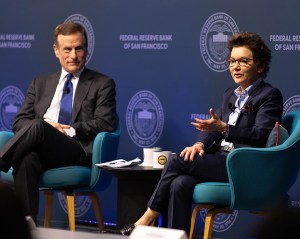
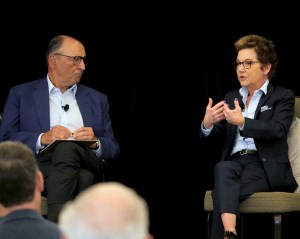
At UC Berkeley’s Fisher Center for Real Estate & Urban Economics’ Spring 2026 Policy Advisory Board meeting, Federal Reserve Bank of San Francisco President and CEO Mary C. Daly sat down with Alex Mehran, Sr., Chairman of the Board, Sunset Development Company for a moderated conversation on the U.S. economy.
Sign up for notifications on Mary C. Daly’s speeches, remarks, and fireside chats.
About the Speaker
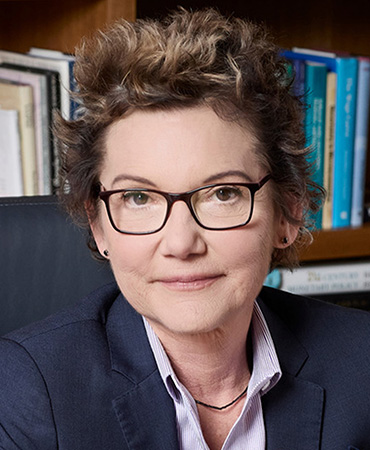
Mary C. Daly is President and Chief Executive Officer of the Federal Reserve Bank of San Francisco. In that capacity, she serves the Twelfth Federal Reserve District in setting monetary policy. Prior to that, she was the executive vice president and director of research at the San Francisco Fed, which she joined in 1996. Read Mary C. Daly’s full bio.
Related: