Wednesday, Aug 05, 2026
Tokyo, Japan
5:35 p.m. PT
(Thursday, Aug 06, 2026, 9:35 am JST)
Transcript
The following transcript has been edited lightly for clarity.
Alan J. Auerbach:
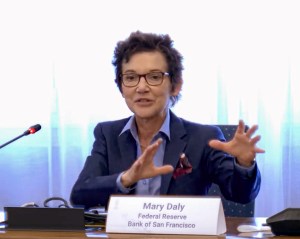
Thank you very much. It’s a great pleasure to open the conference with a keynote speech by Mary Daly. Mary is the president and chief executive officer of the Federal Reserve Bank of San Francisco, and indeed, she’s been at that institution for three decades, having started there as an economist, then become the director of research, and finally becoming the president and CEO of the San Francisco Fed. She’s an economist whose expertise is in the areas of macroeconomics and labor economics, and so she’s really an ideal person to be in this position as one of the important contributors to monetary policy in the United States. With that, let me offer the floor to Dr. Daly to make her comments.
Mary C. Daly:
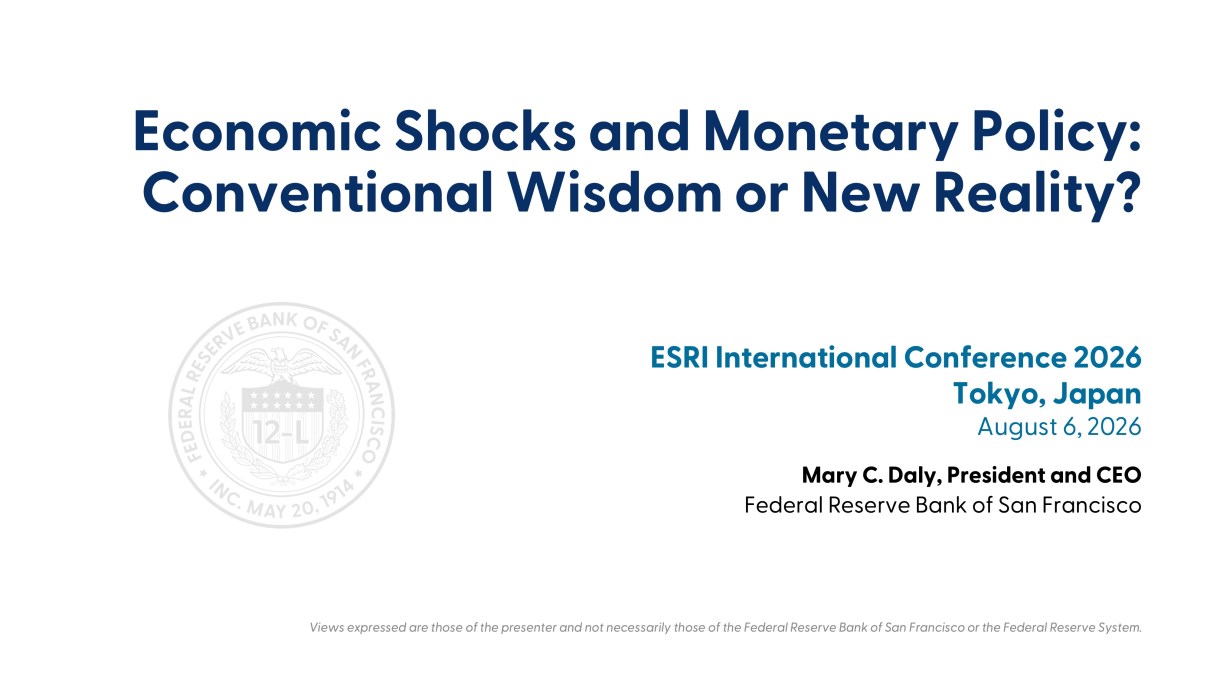
Thank you very much, I appreciate that introduction, and thank you all for inviting me here to Japan to be part of this conference. I’m very much looking forward to the discussion. I already have had many discussions that tell me just how valuable this type of conference is. As I was thinking about what topics would be important to talk about at this juncture, I chose the topic of economic shocks and monetary policy and thinking importantly about whether the conventional wisdom that holds in economics or a new dynamic, a new reality is forming in terms of how the shocks impact inflation. So, today, I’ll look through the lens of the United States, but I think that is really a challenge that every central bank and every country is facing in some capacity because we’re all experiencing the shocks that I will talk about in one moment.
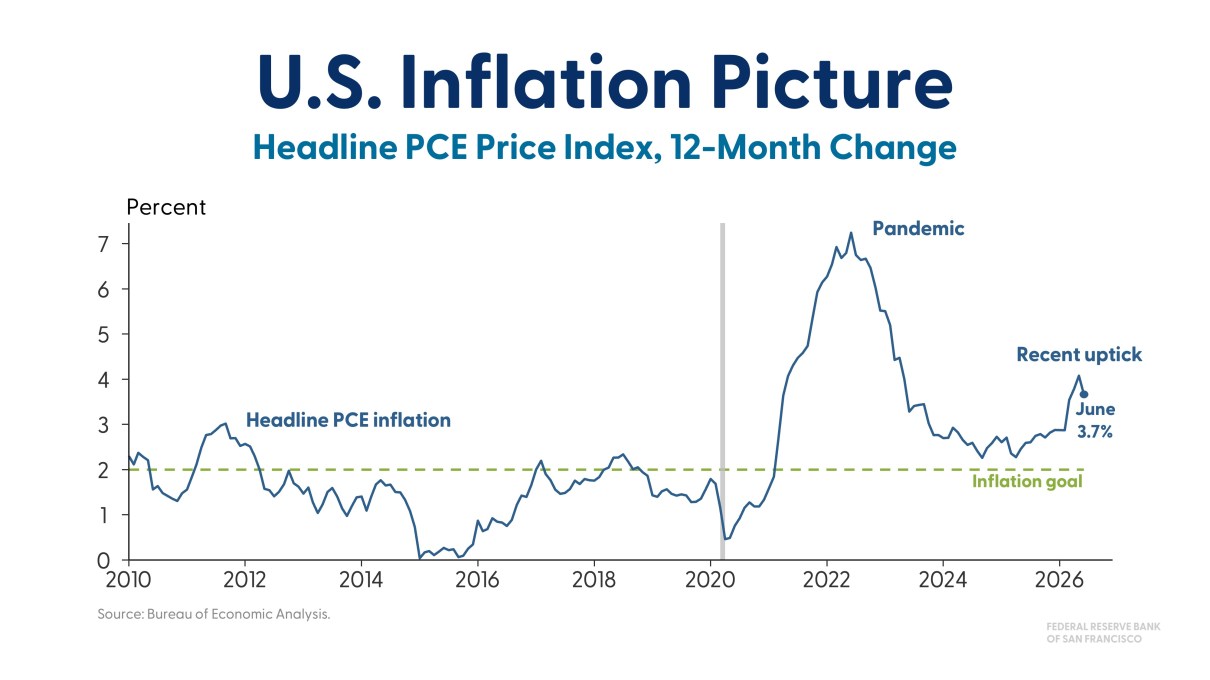
So, with that, I’d like to start with the US inflation picture. The US inflation picture is one where we have had over five years of higher-than-target inflation, but that hides some of the dynamics that are going on underneath that. After a decade of below target inflation, the pandemic brought a surge in inflation in the United States. We call it the pandemic surge. Then aggressive monetary action on the part of the Federal Reserve brought the inflation back down to something like 2.4% before a series of shocks created an uptick.
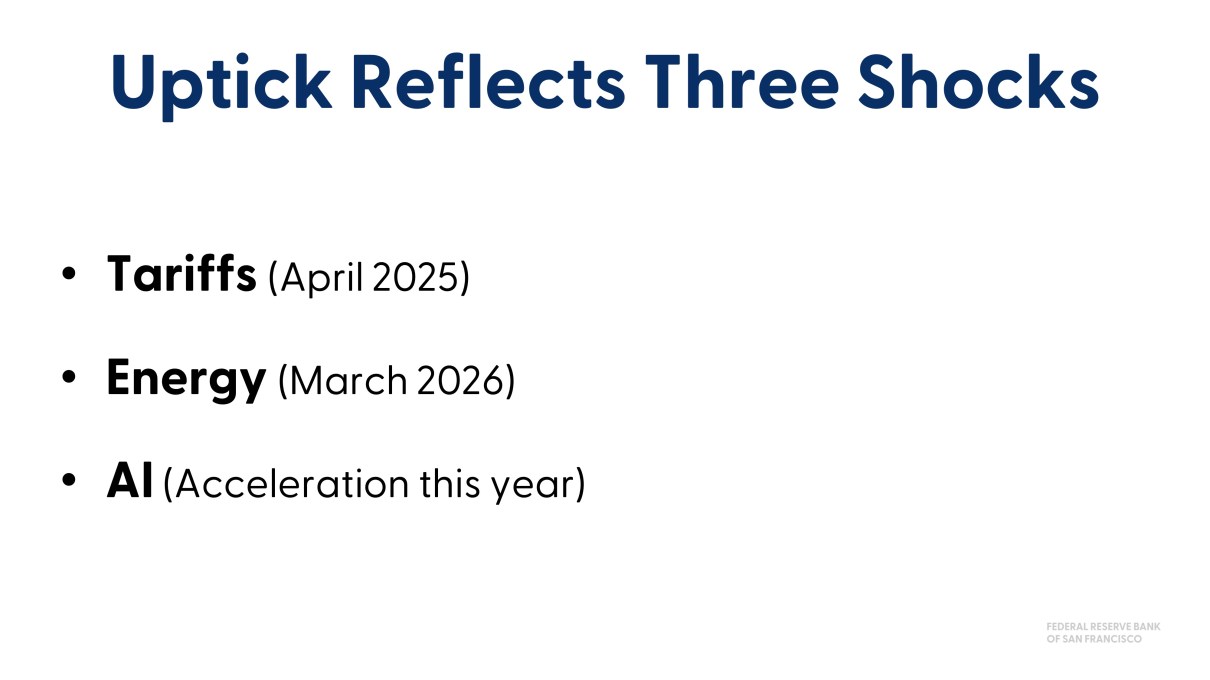
And these shocks will be familiar to you. We had tariffs starting in April of 2025, energy prices starting in March of 2026 associated with the war in Iran, and the rise in oil prices, but other energy prices, and then the AI boom, which accelerated in many ways this year because the data centers began being augmented by the real investments in technology and software and putting that into the data centers and into the model builders. So you have these three shocks, and I find it useful to just walk through what the three shocks look like in terms of the activity and then inflation.
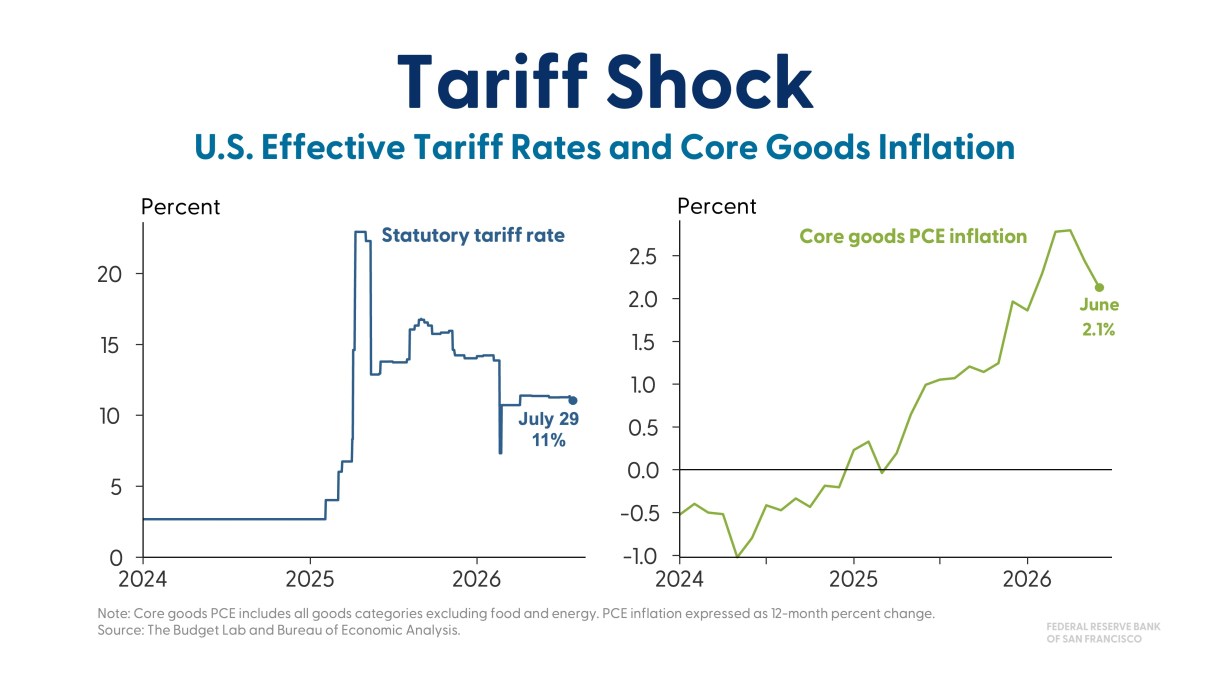
So let me first begin by the tariff shock. So a simple picture, which I think conveys the level or the rate of change that the tariffs brought to the United States and the global economy, is that we had a tariff rate well below 5%. Right after Liberation Day, it’s well above 20, and it settled out to something like 11%, the statutory tariff rate is of the end of July. So that’s the tariff shock. But then you see it in goods price inflation. So this is from PCE inflation in the United States, and you can see immediately, right after the announcement and beginnings of enforcement of tariffs, the goods prices began to rise after having been in a deflationary state, which is the normal state for goods price inflation in the United States. They’re in a deflation, they’re falling in price, not rising, and then they surge quite a lot on the heels of the tariffs.
So the conventional dynamic would be that this would be a one-time effect. The tariffs would come in, it would raise the costs, it would push inflation up for the moment, but then it would roll through, it would peak, and that effect would dissipate. And you start to see that a little bit in the chart where the goods price inflation seems to have peaked and now is coming down. It’s one month of data, but one quarter of data, but that seems to be the way that the dynamic is going.
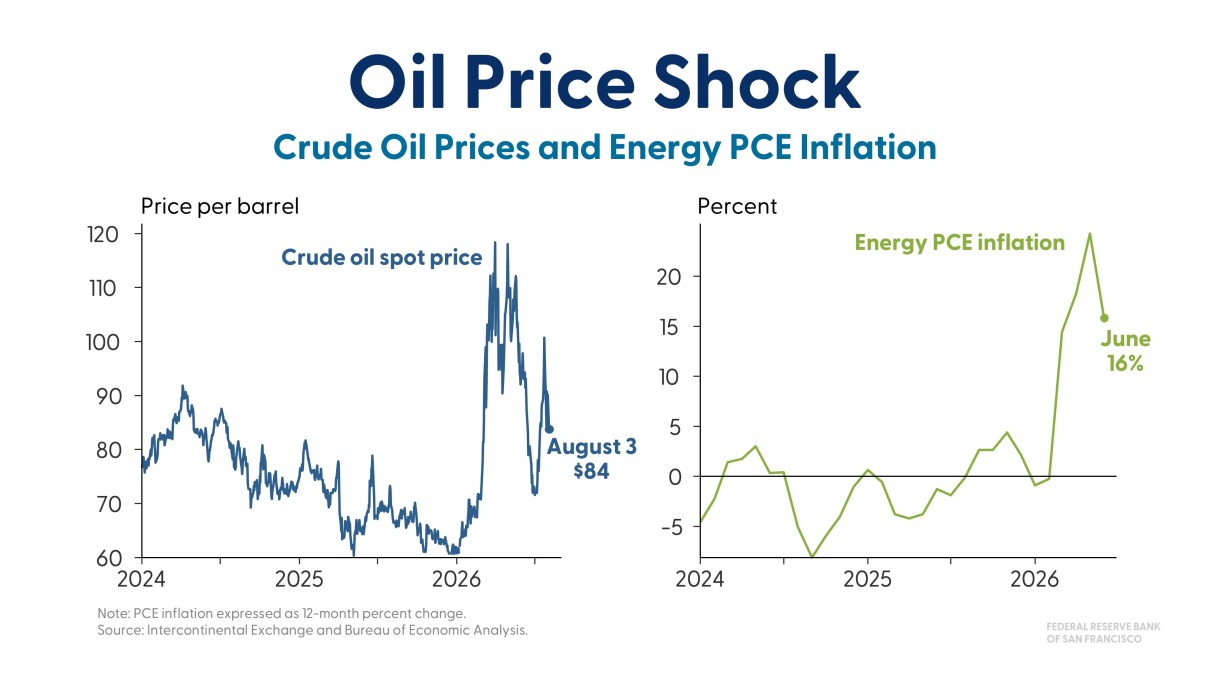
Soon we have a second shock that comes just a year later, and that’s the oil price shock. And this shock follows things that we would expect if you’ve studied this for a period of time, what happens to inflation when oil prices rise, and you see it here. The war begins, crude oil prices rise rapidly, skyrocket, I think many people said, sharply rise. And then when there’s an MOU or a peace agreement or any sense that the Strait of Hormuz moves will open, then oil prices come down. And the material part of this slide is to look to the right and see that, as those oil prices move, so does energy price inflation. So we got it at print in June, and you could see it clearly that when energy prices started to go down because oil prices settled, gasoline prices in particular fell, then so did energy price inflation in the United States.
It’s almost a one for one if you were just running a simple correlation. And that’s good news if you’re thinking about shocks because it says, “If the war ends…” Here, today, we have some positive news, but I’m going to abstract from what central banks can’t control for a moment, which is the duration of the war, but from an inflation dynamic perspective, it does seem this is still working where oil prices fall and so does inflation, energy price inflation.
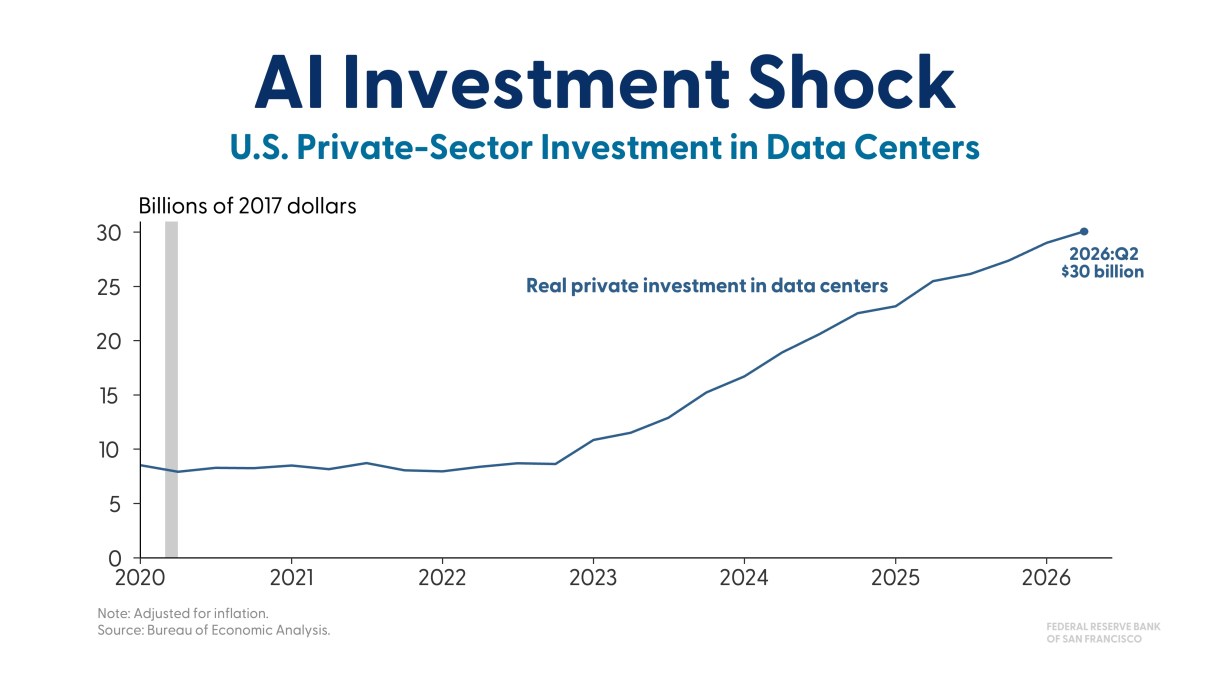
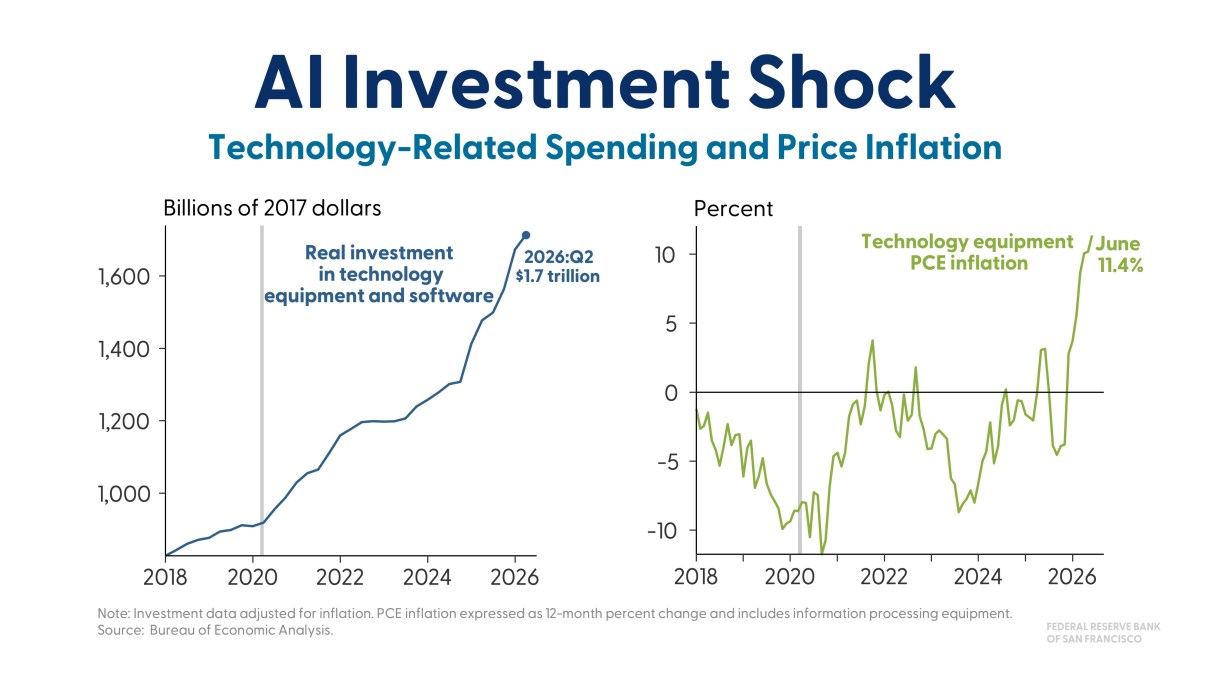
So then the third shock is the AI investment shock, and I’m going to break it down into two components, which I alluded to at the beginning. The first component is investment in data centers, and this has been going on for some time. This isn’t a new thing. It’s reaching very large proportions, but it’s not new. And you can see that from the relatively straight growth line that is portrayed on this chart. So very, very steady growth over a long period, a lot of enthusiasm about AI, a lot of building of data centers to facilitate that enthusiasm.
The real news, if you will, right now, is technology-related spending and price inflation. So we’ve seen a surge, a pickup, in investment for technology goods and software products, and that is pushing up inflation in those sectors. If you look at technology equipment, PCE inflation, it’s rising sharply this year and is contributing an outsized share to overall inflation, an outsized share from its own share in goods and services.
So that is a dynamic where I can’t show you the positive picture of its peak yet and it’s coming down. This is just something that’s continuing to go up. And it remains an open question whether this is a relative demand shock and just changes the relative price of technology equipment, which has been falling in price over time, not rising, or if it’s something broader than that because it’s competing for resources in a way that spills over into overall inflation.
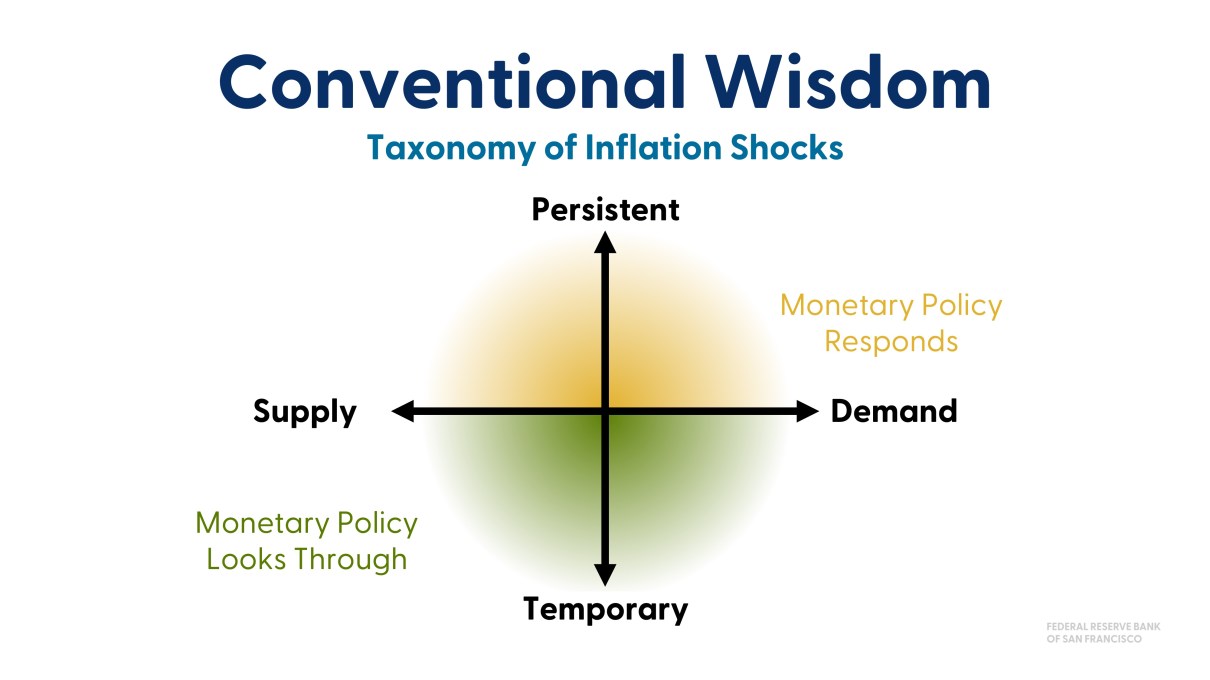
So this is where I want to bring in the economics of it. You look at the shocks, you look at the data, and then you ask the question, “How do economists, how do policymakers think about this?” Well, I’m going to put up this simple slide of conventional wisdom. So the conventional wisdom is that you first want to understand supply or demand, but mostly you want to understand persistent or temporary. And if the shock is temporary, the appropriate monetary policy is to look through it, the reason being, the simple one, that monetary policy acts with a lag, 12 to 18 months, just take that as a benchmark. And by the time you’ve raised the rate and that’s worked its way through, you haven’t affected the shock dynamic, but you’ve definitely affected the economy, and unnecessarily so. So you’re not really being effective in your tool, so you look through the shock.
If it’s of course more persistent and you can understand that, well then you do want to offset that because that can affect underlying inflation in a broader way or a more persistent way, and your tool would then have some ability to curb that. So this is what I would call the simple conventional wisdom. If you follow the FOMC conversations at all, there has been this look-through strategy that we’ll look through tariffs and we look through oil prices. And the AI remains an open question because it’s very early days in terms of how that’s affecting broader inflation.
So the other dynamic I want to bring up, because it’s at the top of my mind, and I think other minds as well, is, what if the conventional wisdom isn’t as relevant as it normally is at this time? And why might that be?
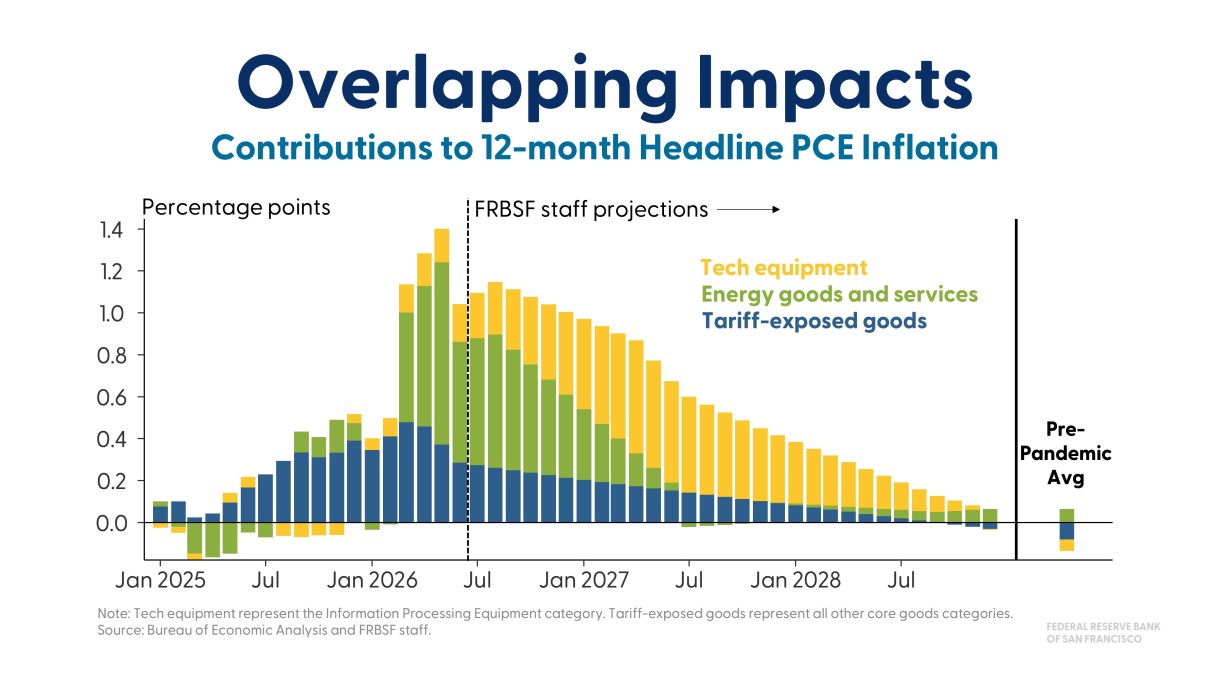
Well, this is a picture from the San Francisco Fed forecast where we’ve plot out the impacts of blue for tariffs, green for energy, and then yellow for AI, and where the impacts are coming into inflation, and then what our forecast dynamic is for those as they roll through, as those individual shocks roll through. And you’ll notice immediately that they’re overlapping, that their impacts are overlapping. So before the tariff shock is fully through the economy, the oil shock comes and puts additional pressure on inflation, headline inflation. And then before that’s fully dissipated, the AI shock comes and puts additional pressure on overall inflation.
And the question is, are these three shocks, they’re having this overlapping effect, but are they going to have a compounding effect? Is the fact that they’re overlapping and overlapping at a point in time where inflation’s already elevated, will that serve to compound the effects, interact those effects, and make this either broader or more persistent, and that they would have an impact that’s greater than the sum of its parts, so the whole impact together would be greater than the sum of its parts? So that’s the question.
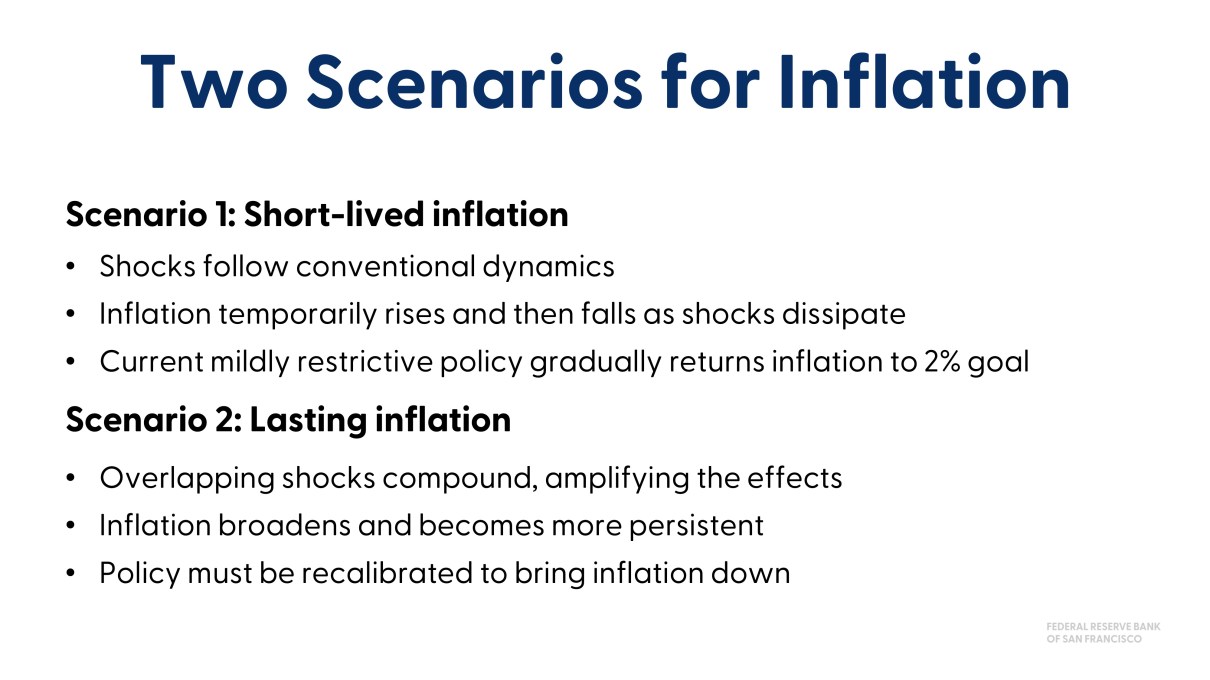
And if you take that question seriously, then you have two scenarios, two scenarios that we, as policymakers, face. One scenario is the economy’s following the conventional dynamics, the shocks work as we have often seen them work, and we have short-lived inflation. It has definitely pushed out the timeline for returning to 2%, but it’s not really impacting underlying inflation in a way that has a dynamic of its own. If that’s the case, then inflation temporarily rises and then dissipates as the shocks subside. But the current mildly restrictive policy that’s in place in the US is sufficient to gradually return inflation to the 2% target. It would just push it out a little bit, but it would still have the impact.
The more worrisome scenario, the one that would change how we would think of things, how I would think of things, is if these overlapping shocks actually have this compounding effect I spoke about and the effects on inflation are amplified because they’ve happened at the same time and they’re occurring at a point in time when inflation’s been above target for over five years. That would suggest that inflation has somehow broadened and it’s become more persistent and it’s affected the underlying inflation rate in a way that doesn’t trace back to the direct effect of the shocks on sectors that are experiencing them.
In that case, policy must be recalibrated, and not a little bit, but probably more substantially. This is not something that, in my judgment… And this is my judgment, by the way. It doesn’t reflect the FOMC’s views, I should have said that at the beginning. But in my judgment, it would be insufficient to then just do small calibrations, almost surgical calibrations on policy because you’d have an underlying dynamic that you needed to treat. And so, those two scenarios are very different.
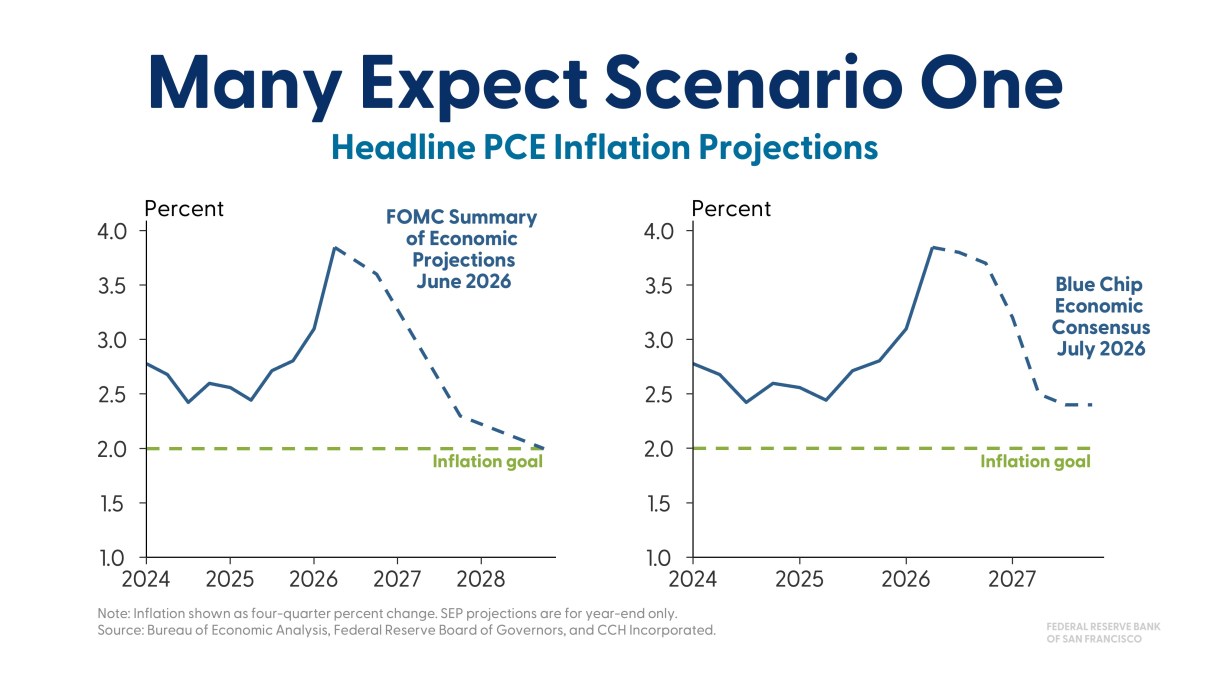
So let me make a case for scenario 1, and let me start by saying many expect scenario 1, the more benign or positive scenario, to actually play out, that the conventional dynamics hold. So this is two charts, one from policymakers at the FOMC. This is the median inflation forecast for the June SEP. And I recognize it’s slightly dated, but the dynamic has been something that held in December and other times. You just push out the time period, but the dynamic stays the same. So this says inflation peaks at the peak of the shocks, and then it comes down over time, and you’ve pushed the time it takes to get back to 2% out, but you haven’t changed the overall dynamic that current policy rates are sufficiently restrictive to bring inflation down to 2%. We have to wait out the shocks, which we can’t really affect.
A more recent survey comes not from policymakers, but from the Blue Chip forecast, which is chief economists in businesses, private businesses. And you see there that they’re forecasting the same dynamic, that inflation comes up as the shocks rise and then fall, and then it comes back down, and it reaches our 2% target, our 2% goal, sometime in 2028. Those two dynamics are reflected in a broader sense of forecasters that you could look at. Some may not think this, but the lion’s share of forecasters think this dynamic’s going to hold, this conventional dynamic will play out.
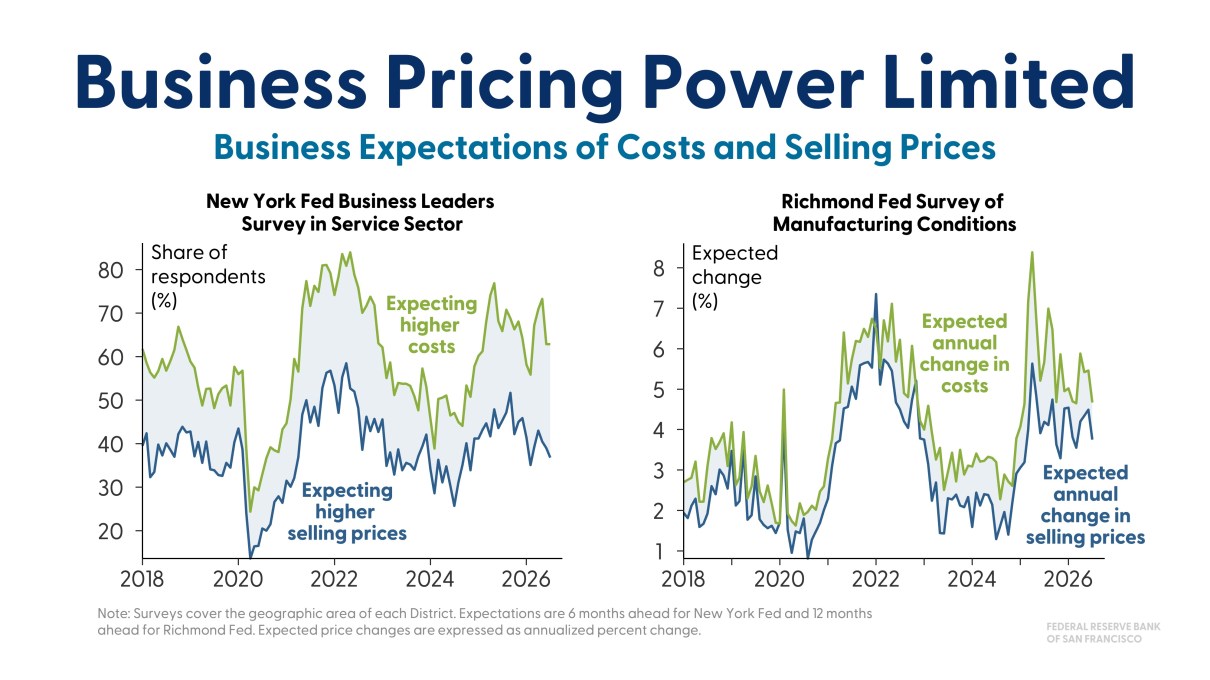
As I said, there’s some good reasons to think that’s true. And let me give you a few. The first one is that businesses in the United States have very limited pricing power. They just don’t have the ability to pass fully the cost that they’re facing onto consumers, and we see this in surveys of businesses. These are two examples of surveys, one done by my colleagues at the New York Fed and the other done by my colleagues at the Richmond Fed. And the New York Fed surveys on the service firms, service providers, and the Richmond Fed is on manufacturers. And what you see is in both of the cases, the green line, which is the one that says, “Are you expecting higher costs?” is higher than the blue line, which is, “Are you expecting higher selling prices?” So there’s a gap between what they expect to pay for their inputs and what they expect to pass on to consumers in terms of selling prices.
Now, one piece of information that we’ve received is that there is a difference between businesses that sell to businesses and businesses that sell to consumers. And you somewhat see this in the services manufacturing chart. If you’re selling an input to another business, you’re trying to figure out a little bit how to pass some of that along, maybe not the full thing, but you’re splitting those costs at least. If you’re trying to pass it on to consumers, you’re finding consumers trading down, moving on, leaving you in a way that most businesses don’t want, and the consequence of that is there’s just less passthrough from businesses, from firms to consumers. So that’s going to have a bridling effect on inflation in a way that doesn’t amplify the shocks or compound their effects.
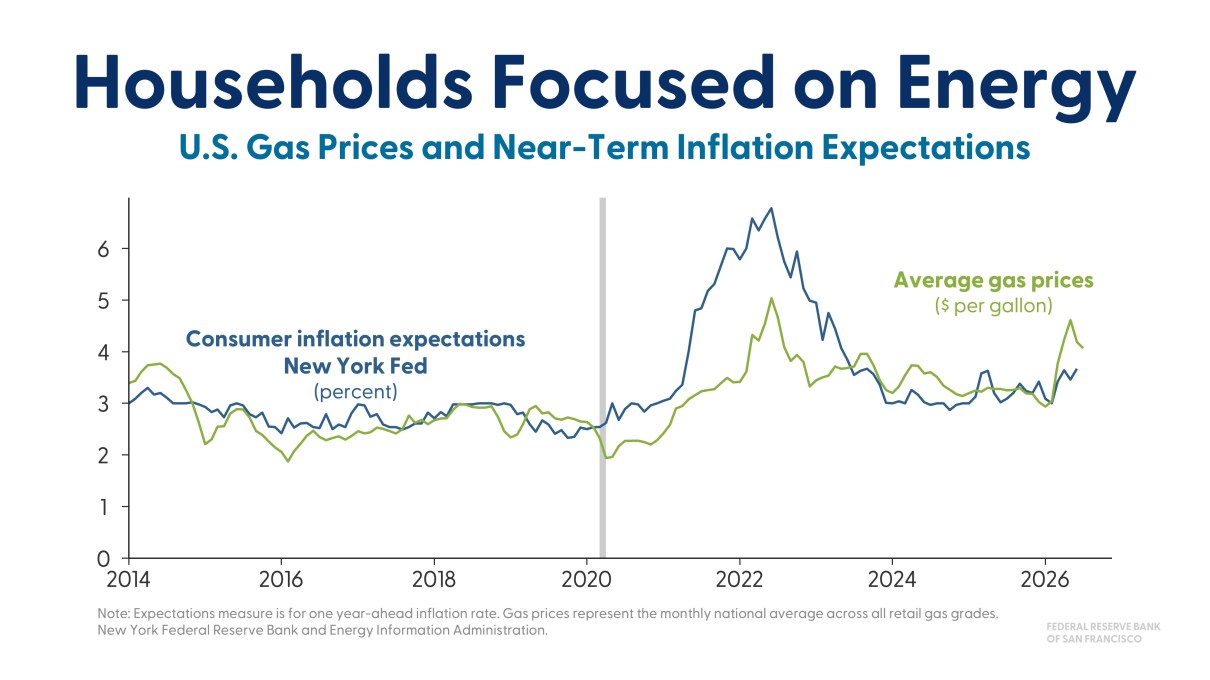
Another reason I think that you could argue that the shocks, the conventional shock dynamics will persist is that households almost entirely are focused on energy when they think about inflation expectations. This plots inflation expectations from the New York Fed. They do a survey, it’s inflation expectations from that survey and average gas prices. And the main point of comparison I want to draw your attention to is that during the post-pandemic inflation run-up, the blue line, which is inflation expectations, was far above the green line, which was energy prices. You can see the increase and then it rises, but there was a gap, and that gap largely reflected how consumers felt about broader inflation, the inflation that was other places in the economy, not just energy. And that was consistent with the larger problem we had of tenacious inflation that just wasn’t going to come down without aggressive policy action.
In the current period, you see that average gas prices are actually higher in terms of… not higher, have gone up more than inflation expectations. So inflation expectations do rise when gasoline prices go up, but they’re not going up extra. They’re not going up additionally. And you can do additional correlations and things and find that right now, gasoline prices are driving the lion’s share, the majority of the change in inflation expectations in these surveys of consumers. So that’s a positive piece of news if you think, well, the dynamic will be the war ends, oil prices come down, and consumers just shake it off and move on. And now they’re back to inflation expectations in the shorter run, which are consistent with our 2% goal.
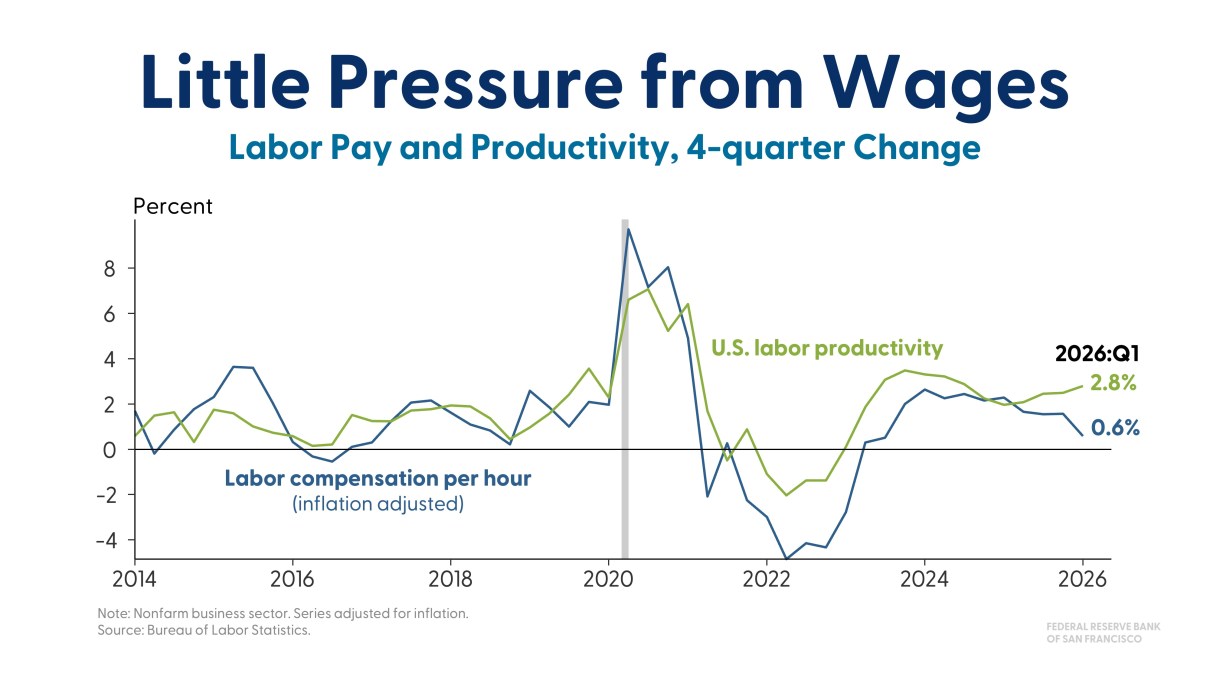
Third dynamic that is important as we’re thinking about the outlook for inflation is the labor market. And right now we just don’t see much pressure, cost-push pressure, from the labor market in terms of price inflation, and you can see this in the labor compensation per hour itself, or other wage measures, you can find the same. They’re just not going up very much. They’re not growing beyond 2% inflation and productivity. And in fact, if you plot productivity growth, you start to see a gap emerge between the productivity that’s being measured in the economy and the pay that workers are receiving, just suggesting that firms are able to handle some of the cost pressure through gains in productivity as opposed to changes in the labor market dynamic or raising prices for consumers.
We hear a lot of this when we talk to CEOs across the country, my colleagues and myself, and they really are working to change the cost profile of their firm. Some of that is being enabled by AI, but some of it’s just being enabled by just another look at business processes, trying to do more with fewer workers, trying to think about whether you really need to expand as much as you thought to meet the output demands that you face. Just trying to gain productivity, even if it’s not a long-run productivity trend, trying to gain productivity growth in this period or increases in productivity just to help maintain some of the margins because of the raise in input costs.
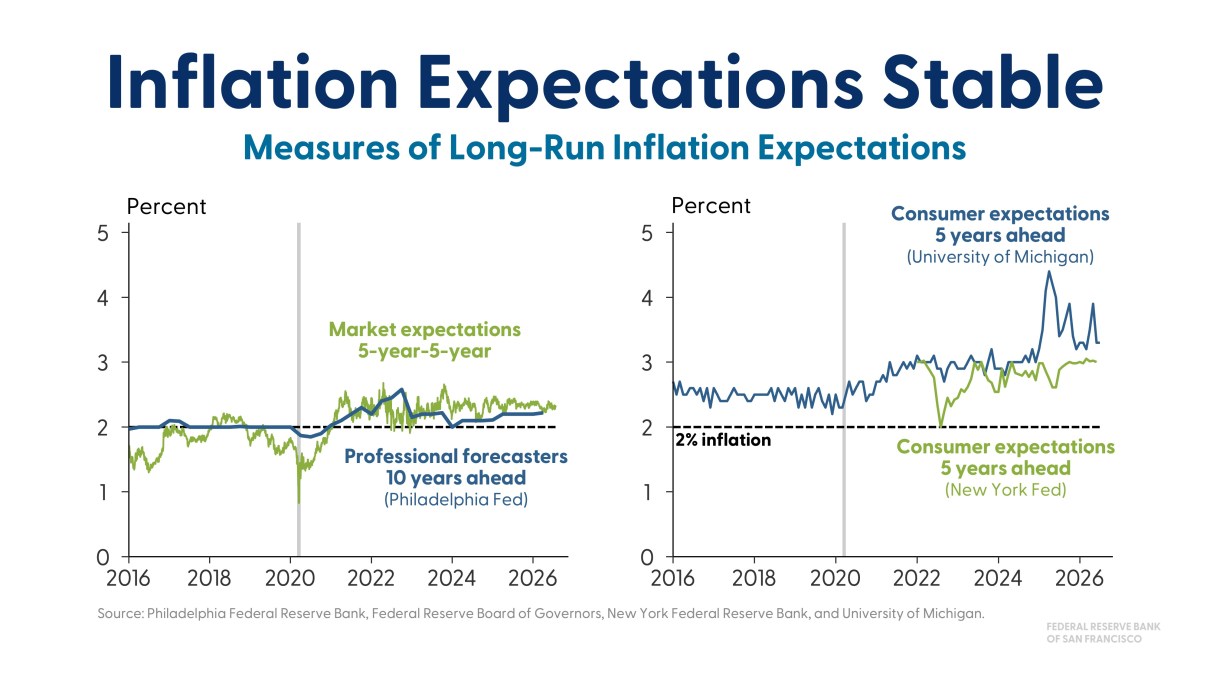
Finally, in terms of the case for a positive outlook on inflation, the one that follows conventional wisdom, is that inflation expectations in the United States remain remarkably stable. These are surveys of markets. It’s actually market expectations from pricing, professional forecasters, longer-run inflation expectations, and then on the right-hand side, consumer expectations. And what you see in the longer durations or longer frequency is that inflation expectations are remarkably well anchored. And so, if you were worried that the Federal Reserve has lost the anchor on inflation, so you need to make some additional actions to get the anchor back, to pull it back to 2%, you just don’t see evidence for that here. And I think of that as not something to be complacent about or to rest on, but to be reassured by in terms of the urgency of the decision-making that’s before us.
Okay. So what about scenario 2? If you ask me, I think scenario 1 is still my modal. But if you do the percentages of the modal versus the scenario 2, I think they’re much closer together than they used to be. And so it’s really important that we not just push scenario 2 off as a risk that goes into alternative scenario thinking, but that it becomes something we really consider and look for in the policy deliberations and our assessments of the economy.
So why might scenario 2 emerge? What would be the dynamic that would cause this to move from the conventional wisdom that I just made a case for and something much more challenging, which is a drift in underlying inflation that doesn’t directly tie back to any particular shock?
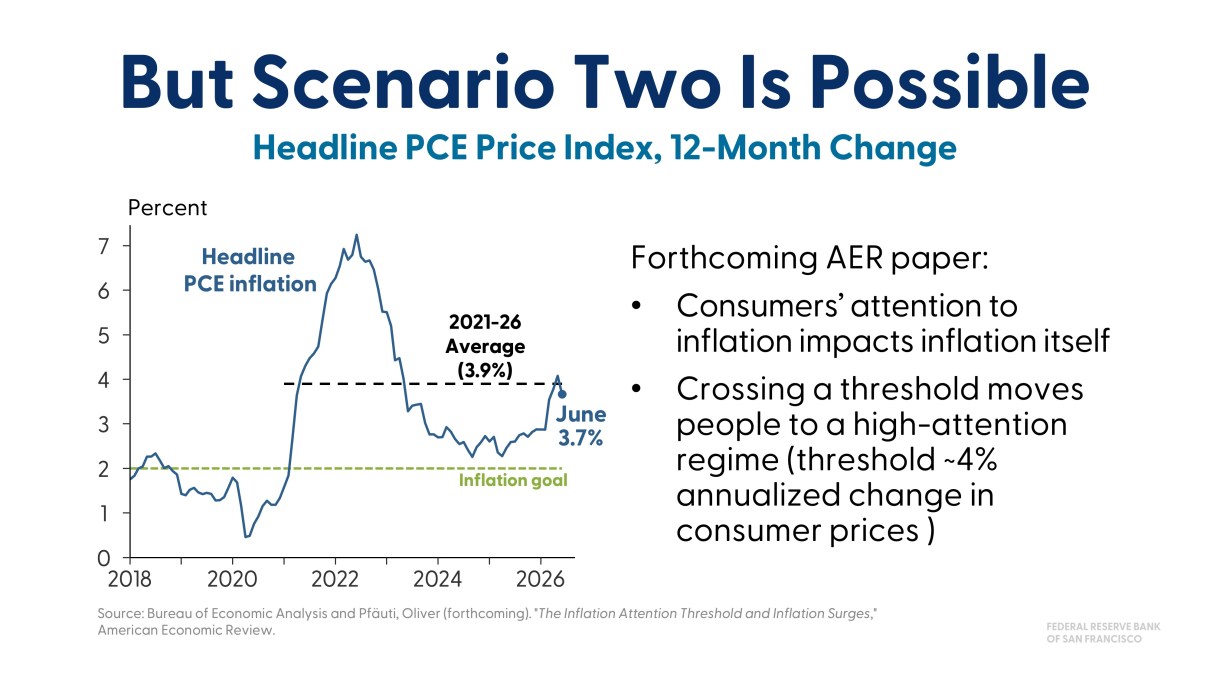
Well, I think there’s two things, and I’ve mentioned them a couple of times, but I wanted to show you some pictures here, is that headline inflation has been above our target since 2021. And if you just think how much above our target, 3.9% is the average inflation rate between 2021 and 2026. Now, that is a combination of the run-up that went all the way to 7 post-pandemic and the more modest run-up that’s come from the three shocks. But still for the average household or the average business, they may not think in shock dynamics. They might think in the terms of egg prices, chicken prices, travel prices, et cetera, and say, “Well, price level’s already high. I don’t like that. And now on top of it, I’ve got inflation rising at a rate that doesn’t give me much hope that this is going to be remedied anytime soon.” So that’s something that I think is worth thinking about.
A forthcoming AER paper actually puts a little finer point on the concern. The author argues that consumers’ attention to inflation, the attention they pay to it, impacts inflation itself. And you can think of a variety of ways that could happen, inflation expectations, et cetera. But if you’ve got their awareness, if they’re no longer rationally inattentive to inflation, if they really care, then they’re going to be focused on inflation, and that might affect their expectations of price inflation overall, might affect their wage demands, might affect their general sensibility. So that’s pressure you don’t really want to see. And this author actually estimates that the threshold where people’s attention focuses, laser-focuses on inflation is 4%, and we’re very close to 4%. We are 3.9 on average and 3.7 of late. So that certainly should get attention, that that dynamic could emerge.
The second reason to be worried about scenario 2 and thoughtful about it… And worried about it maybe is the overstatement, thoughtful enough to move it to the front of your desk. When I talk to CEOs, they always say, “I’ve got things on the side of my desk, things in the file cabinet, and things on the middle of my desk.” And so, I would say both of these scenarios are on the middle of the desk: scenario 1 and scenario 2, getting equal attention to what could possibly happen.
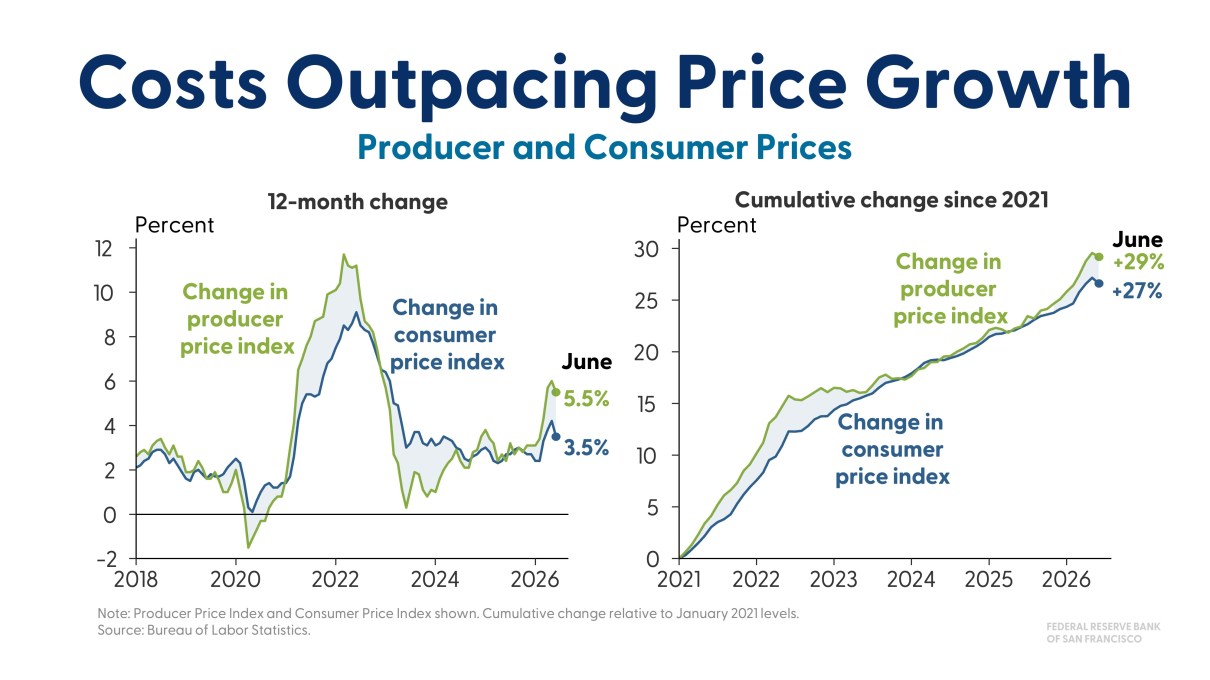
So let me talk about firms and consumer prices, producer prices and consumer prices. As I showed in the surveys, but now you see it in the measured data on inflation, producer prices are just outpacing consumer prices. You can see that in growth terms, inflation for the PPI in June is 5.5, and consumer price index grows by 3.5. It’s different than the CPE, but it’s still about the same. And if you index these to 21, you can see that the cumulative change still leaves firms behind. It’s not like they had much room. So why is this a challenge? In my judgment, it’s a challenge, because at some point firms want to maintain their margins. They don’t want to take it out of their profits. They don’t want to continue to… They may run out of opportunities to gain productivity growth until they find ways to make AI extremely useful. They would love to be able to pass these things along.
And the dynamic we focus on and ask about a lot is, if the firm across the street from me is heavily energy dependent and raising prices and the firm down the street from me is heavily affected by tariffs and raising prices, I might just get into the ethos of, “Everybody else is raising prices, why don’t I try too?” That hasn’t happened yet to our ability to discern it, but I think it’s not a risk we can just push aside and say, “Because we haven’t seen it, it isn’t there.” We really have to focus on digging deep to see how it might emerge.
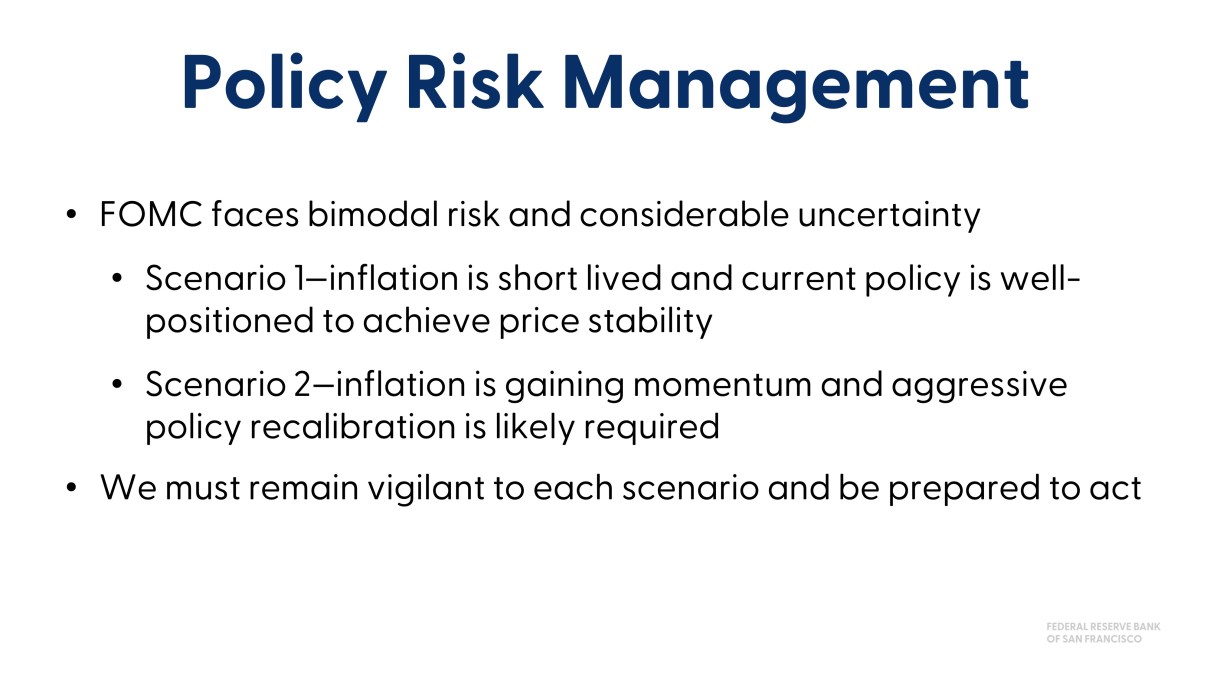
So let me conclude with what this means for policy and risk management. I think this is relevant not just in the United States, but all central banks are dealing with how do you manage the shock dynamics and the impact on inflation, and the US is just right in the center of this at this point. So I see the FOMC as facing bimodal risk, the bimodal risks I talked about. We have conventional dynamics, it gives us some version of scenario 1. In that scenario, you might fine-tune the policy level, but you don’t really need a large change to deliver on the price stability goal over time as forecast by 2028.
Scenario 2 though is one where the inflation gets momentum in and of itself. All the things that have happened, above-target inflation for over five years, a series of shocks that push the inflation rate even higher, and we just keep pushing it out, that finds a way to gain momentum, to broaden through the economy, to become more persistent. And then we need more aggressive policy recalibration to get this back down to a trajectory we have confidence in that can deliver on 2% inflation.
You might ask if you’re following what the FOMC does or what the Federal Reserve does, “Well, if you’ve got this scenario 2, what happened in July? Why didn’t you make a move? Why didn’t you think about this?” I know this is a little outside of perhaps interest in Japan, but maybe not. Maybe there’s some interest here, especially of late. I will just say that I was completely supportive of the decision to hold rates in July. We have another meeting coming up in September, which is now just seven weeks away.
And importantly, we have a lot of information we need to collect if we’re deciding between scenario 1 and scenario 2. If it was just fine-tuning that I thought we were up against, that would be a different problem. This is a problem where you’ve got one type of thing that gives you the patience or the ability to hold on and hold for longer, and you have another one that says, we’re out of position, and we need to adjust in order to make sure that this doesn’t develop a dynamic that’s harder to control down the line, and so collecting more information is valuable.
We in the United States will get a couple of inflation releases for the published data. We’ll get some additional information on the labor market. We’ll get more information about whether the positive trade numbers I showed you where goods inflation was turning down, if that continues to hold, and importantly, whether the war is really in a place where it’s stable and prices are going to come down for oil and other energy goods or if it’s going to pick back up again, and that’s another challenge for households and businesses.
And then finally, we’ll be able to spend a lot of time talking to CEOs about the AI effect. And here, I want to emphasize that that look can’t be simply what do the AI firms think they’re creating, but in fact what do the other businesses feel like they’re not getting or they’re paying more for because the AI investment boom is taking resources that they would otherwise have access, creating a scarcity problem that we haven’t seen yet, to my knowledge, in the Western United States or what I’m able to gather from my colleagues, but it is something we need to watch.
So I’ll conclude by saying these are challenging times. There’s a considerable uncertainty and risks that don’t seem near-neighbors. They’re sort of far apart in the distribution. It might require different policy actions. And the answer there is be vigilant to watch the information as it comes in, but be very prepared to take the action if the second scenario, in particular, emerges.
Thank you and I look forward to the conversation.
Summary
Hosted by the Cabinet Office of the Government of Japan, Mary C. Daly, president and CEO of the Federal Reserve Bank of San Francisco, delivered keynote remarks at the Economic and Social Research Institute (ESRI) International Conference.
Sign up for notifications on Mary C. Daly’s speeches, remarks, and fireside chats.
About the Speaker

Mary C. Daly is President and Chief Executive Officer of the Federal Reserve Bank of San Francisco. In that capacity, she serves the Twelfth Federal Reserve District in setting monetary policy. Prior to that, she was the executive vice president and director of research at the San Francisco Fed, which she joined in 1996. Read Mary C. Daly’s full bio.
Related: