Thursday, Nov 12, 2026
10:10 a.m. PT
Stanford, CA
Artificial IntelligenceFinancial ConditionsGrowth & ProductivityInflationLabor MarketsMonetary PolicyTechnologyU.S. EconomyU.S. GDP
Transcript
The following transcript has been edited lightly for clarity.
Mary C. Daly:
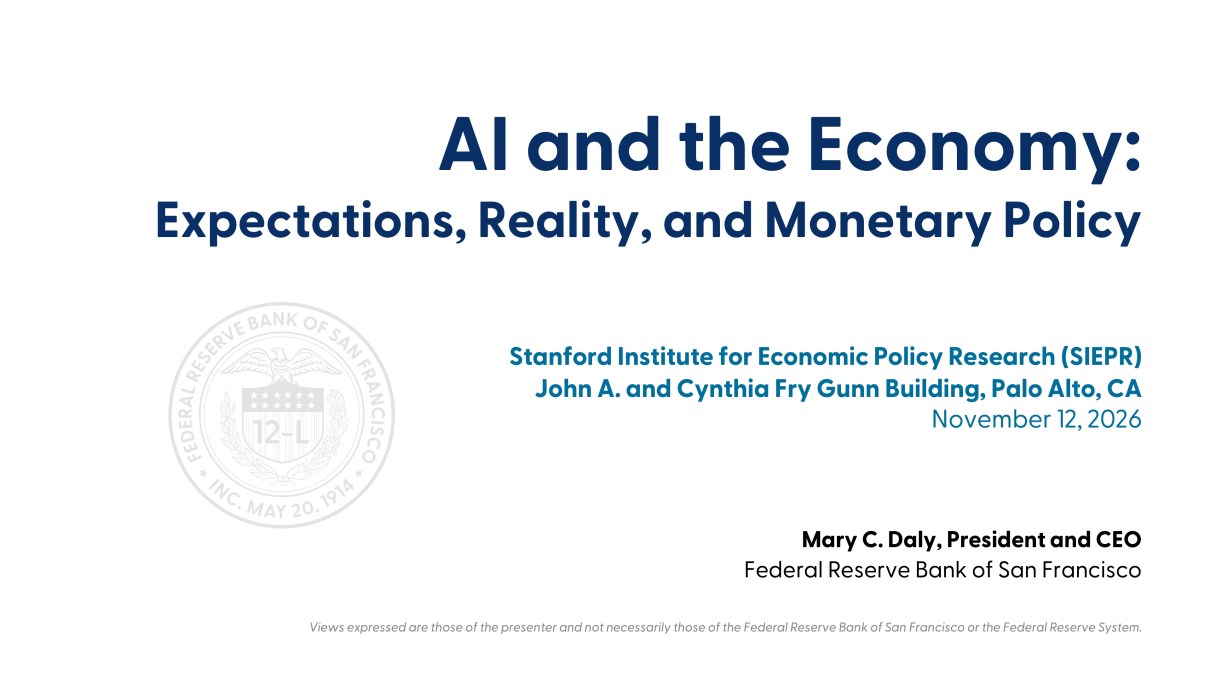
Perfect. I’m going to show some slides. I can prove that I’m an economist when I show slides. So thank you, Neale, for that warm introduction. And it’s really lovely to be back at SIEPR, it’s one of my favorite places to speak. It’s right here, close by San Francisco Fed, but also the home of so many bright and young people in particular. And I always enjoy coming to the Stanford campus.
So today, I want to talk about AI and the economy, and I want to focus on the expectations, which Neale gave us a little preview of the reality, and I mean the realities today and maybe the realities tomorrow, which could be different, and how monetary policymakers in particular have to think through this because it’s not something that we can just imagine will be great. We have to actually investigate what’s happening today, so let me start with the promises of AI, the AI expectations.
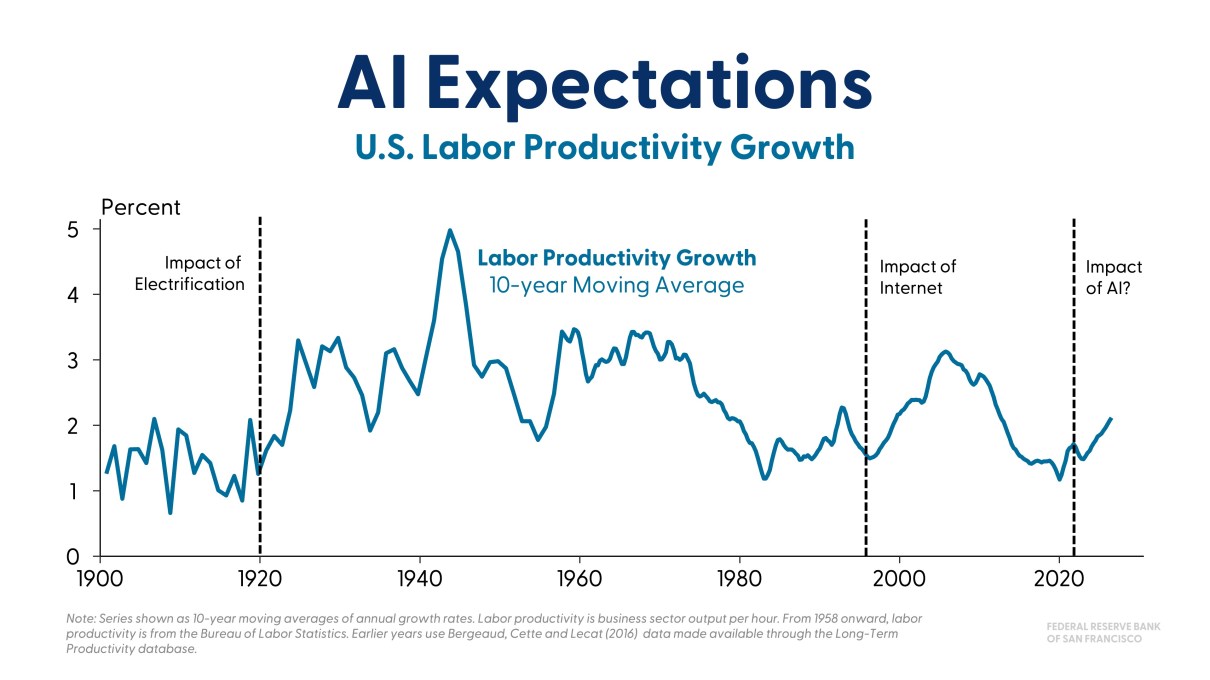
So this is a simple chart of our graph of labor productivity growth, 10-year moving average over the last century or more. And it really shows that electrification was a big boom to productivity growth for a long time. The internet was also a durable boom, but not quite as large as electrification. And if you listen to most of the enthusiasts, even three or four years ago, they were saying AI’s impact is going to supersede or be greater than electrification, and right now it doesn’t look quite there. So the question is, where are we going? And Neale put this well, we all expect this to be terrific and transformative and disruptive and all the things in that category, but we don’t know exactly when this will happen. So what I want to do is bring that vast question into a narrow window where monetary policy must look.
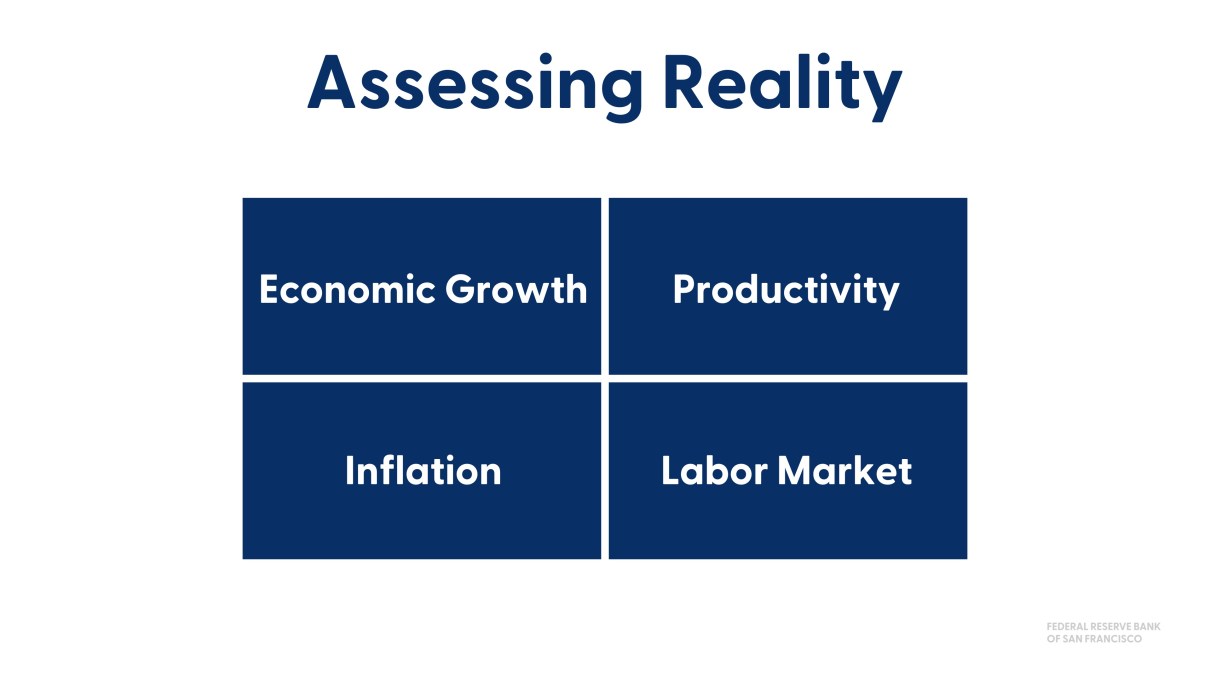
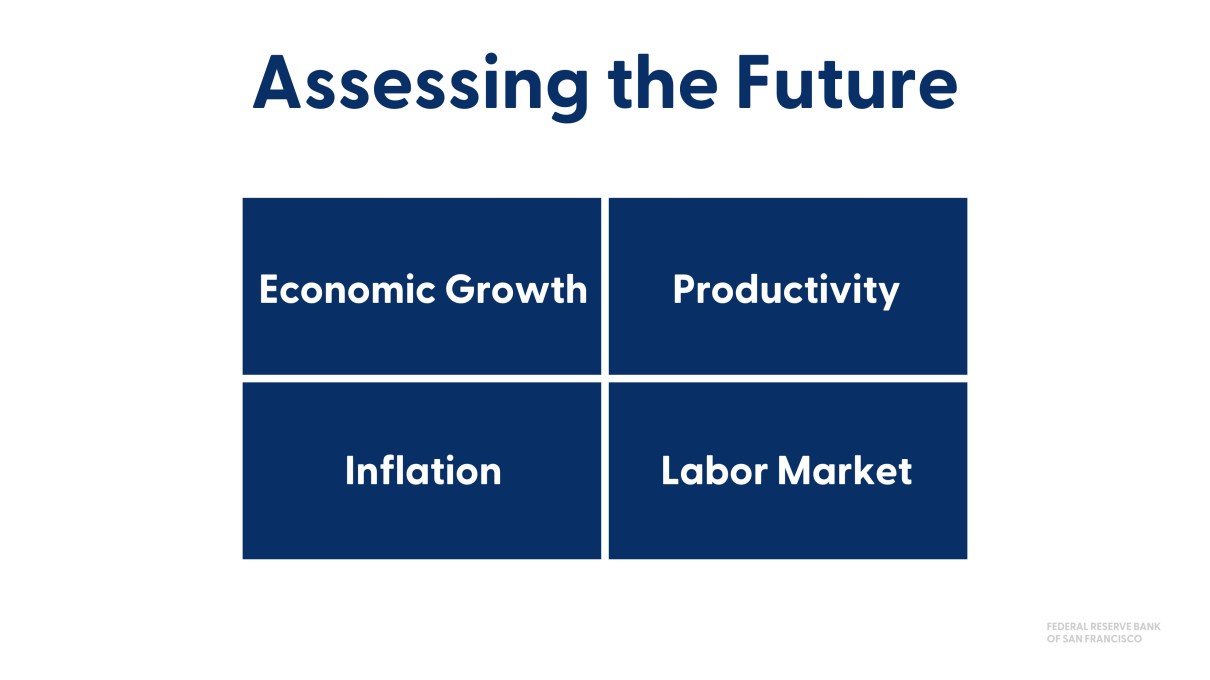
So let me start with how we think about this, how I think about it as a monetary policymaker. Also as an economist, I think, is that we have to focus on economic growth … There’s four lenses: economic growth, productivity, inflation, and the labor market. And of course, inflation in the labor market’s important for the economy, but it’s also our dual mandate responsibilities at the Federal Reserve.
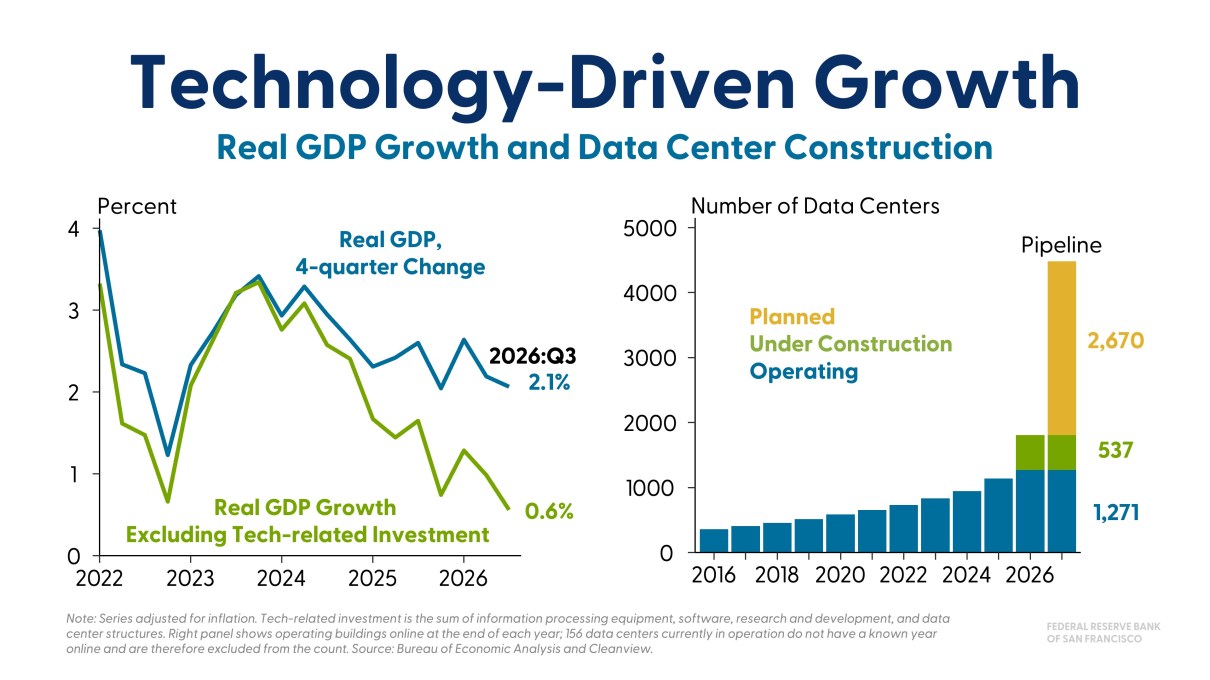
So now, I’m going to look through those four lenses and I’m going to think about what’s happening today. What do we have so far? So I want to start with growth. I’m going to put two charts together here to say one basic point. We have a technology-driven growth boom. The left-hand side of the charts shows real GDP growth, four-quarter change, and it shows that the blue line, that we are growing 2.1% over that 12 month change. That is a really good growth rate right now. But if you took technology goods out of that equation, we’d be growing at 0.6%. So when you hear people say this is a technology-led boom, they’re absolutely right. These are the points for it.
So then people get very nervous, and of course, we all want to think about this, about how long can this last? What really is going on? And especially when there’s been some market volatility on AI valuations, the natural question is, is this something we can expect to continue?
So there’s many ways I could show this, but I like to show this data center chart. And the reason I like to show the data center chart is it shows that you’re having a general upward trajectory. We have things already in play. They’re under construction, that’s the green bars in ’26. And then we have lots of things planned in the pipeline. So even if we get a pullback of data center enthusiasm or communities say, “Wait a minute, let’s slow this train down,” you still see there’s so much in the pipeline that you can expect this to continue.
Now, data centers themselves are not, they’re just large buildings. The thing that really fuels the AI boom is the materials and goods and software that goes in the data centers. And so this is a small starting point, but you can just multiply that and you get something that looks like a picture on the left. So ultimately, when we think about growth, there’s not only the growth we see, but some general appreciation for this growth will continue even if it’s not at the same pace.
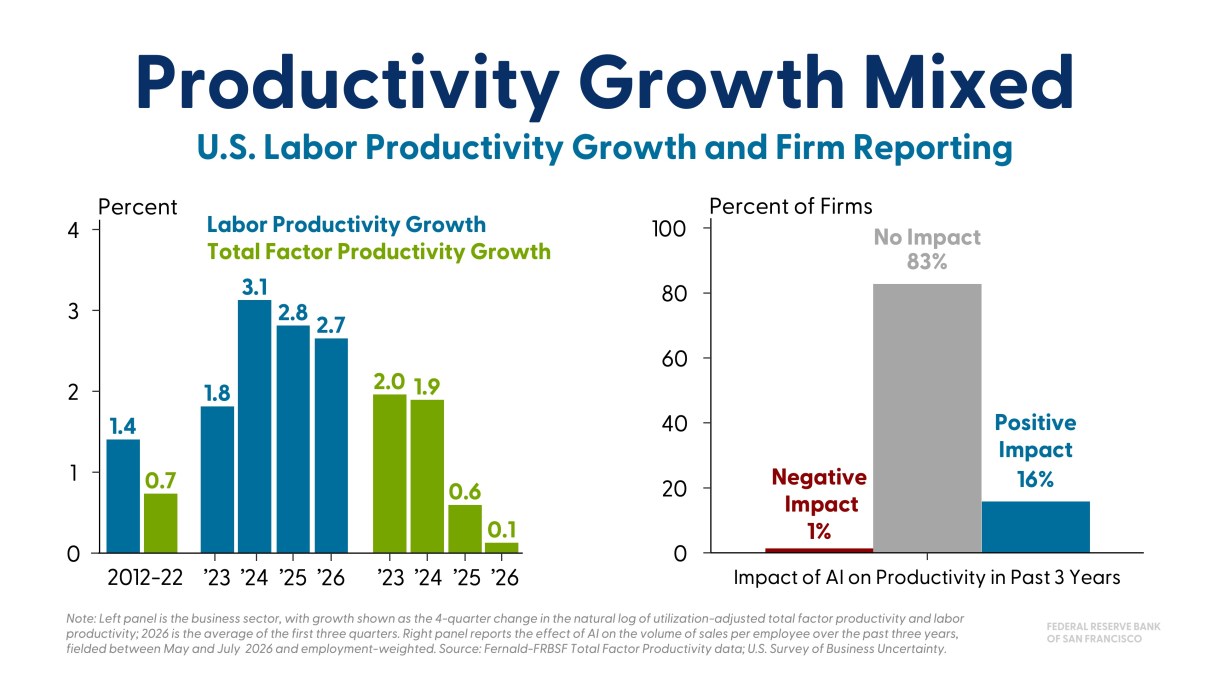
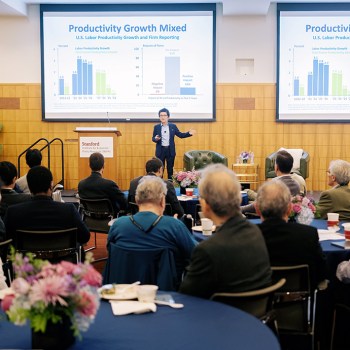
So then let’s look at productivity. So productivity evidence or productivity growth evidence is mixed at this point. And let me tell you what I mean. So if you think about labor productivity in ’23, ’24, ’25, and ’26, which is the middle set of bars, well then you see that it’s above where we were in the previous decade. The historical average is roughly rule of thumb 1.5%. That’s what we had in the previous decade. But if you look at what we’ve been experiencing, it’s much faster than that.
So there’s no doubt that labor productivity growth is quick right now. And that’s a good thing for our economy. It means the economy expands faster, people can do … The output grows, those are all good things. But if you really want to think about the impact of AI and whether to attribute the labor productivity growth we’ve been seeing to AI and whether the transformation has begun, you can’t just look at the blue bars. You have to look at what economists call total factor productivity, I think what people call the magic behind productivity growth.
It’s the part of productivity growth that has that sustainable, durable part. It’s the part about electrification that it wasn’t just you could turn on a light, it’s that it transformed everything we knew about how to live and work in the US. So that’s the piece that has been less than positive.
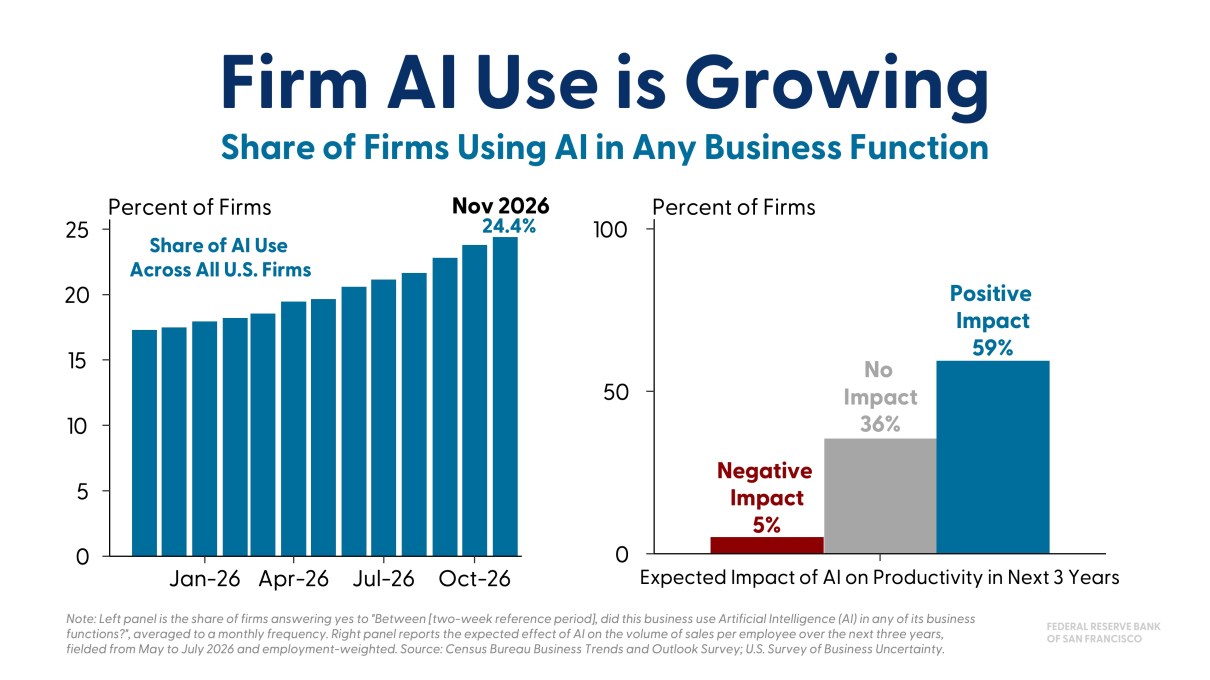
If you look at TFP, it was really strong for a little bit in ’23 and ’24, but now it’s at average or a little below average. And so we haven’t seen the magic there yet that is what the AI tools promise. That’s quite consistent with the survey of firms on the right. This is a survey by Nick Bloom and his team, and it just basically shows that over the past three years, the firms that they survey haven’t really said that they had an impact of AI on their productivity growth.
There’s some, of course, that have had a positive impact. If you go to certain industries, you’ll see a positive impact. You can certainly find case studies. You can certainly find evidence of green shoots forming, but overall in the whole economy, just haven’t seen right now the big impact that many expect, including me.
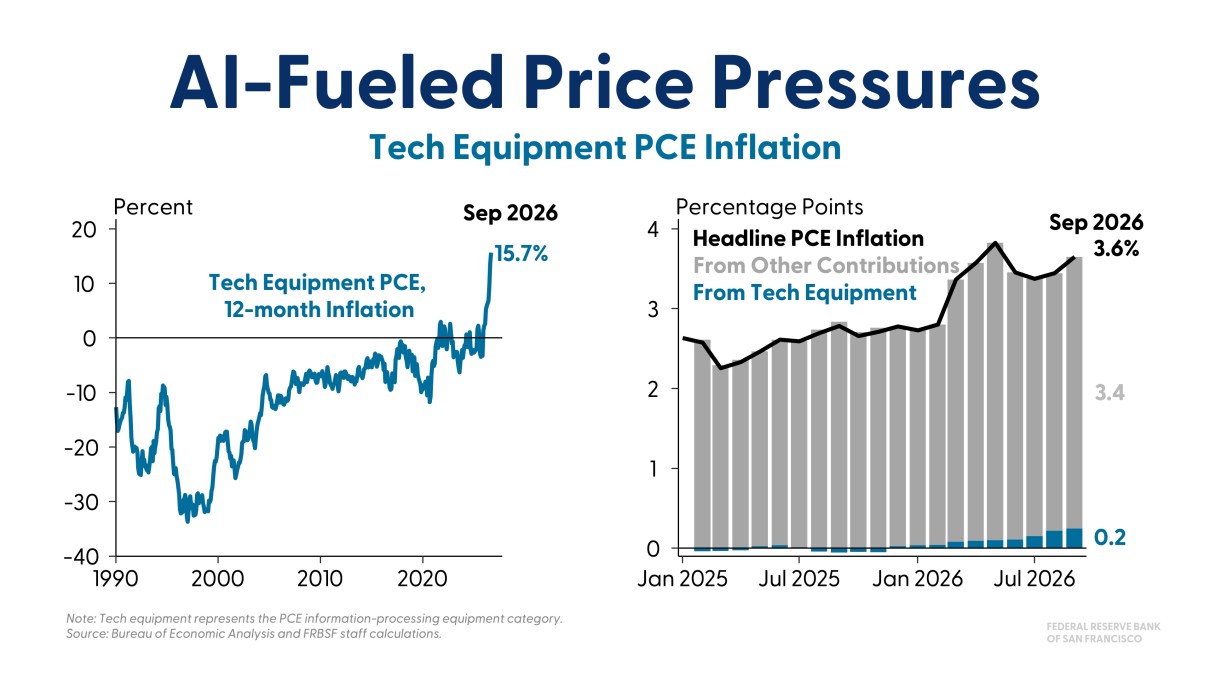
So now, let’s look at the next thing about price pressures. I said I was going to look through the lens of the dual mandate. Let’s start with inflation. There is no doubt that AI is fueling price pressures. You can see this in the left-hand chart. I think the left-hand chart is particularly remarkable because it shows that after two decades, three decades of disinflation, deflation in technology goods, we now have 15.7%, almost 16% inflation in these goods. And that is a huge reversal of price changes for an important part of our economy. And it really is reflecting the demand for those goods relative to the supply.
So then you want to ask if you’re a policymaker, I think or all of us, how much of this relative price shock, this change in the relative price of technology goods is going to spill over widely into the economy? Well, I’m going to give you two ways to think about. The first one is in this chart. One is how much is it directly contributing to overall headline inflation? And you can see a modest amount, 0.2 percentage point onto the total inflation. That just tells you that right now headline inflation is being driven by other variables, not the AI goods.
But we’re also starting to hear, and I’m sure you are, and you probably experienced this if you bought a computer or a phone, et cetera, the price of technology equipment is not just narrowly focused on those going up for data centers, it’s going up everywhere. And so certainly firms are feeling that cost. The question is, are those indirect costs rising so sufficiently that we’re going to see it in overall inflation? And so far we’re not hearing that, really hearing it’s more directly associated with just that sector. Let me get my water just in case I need it.
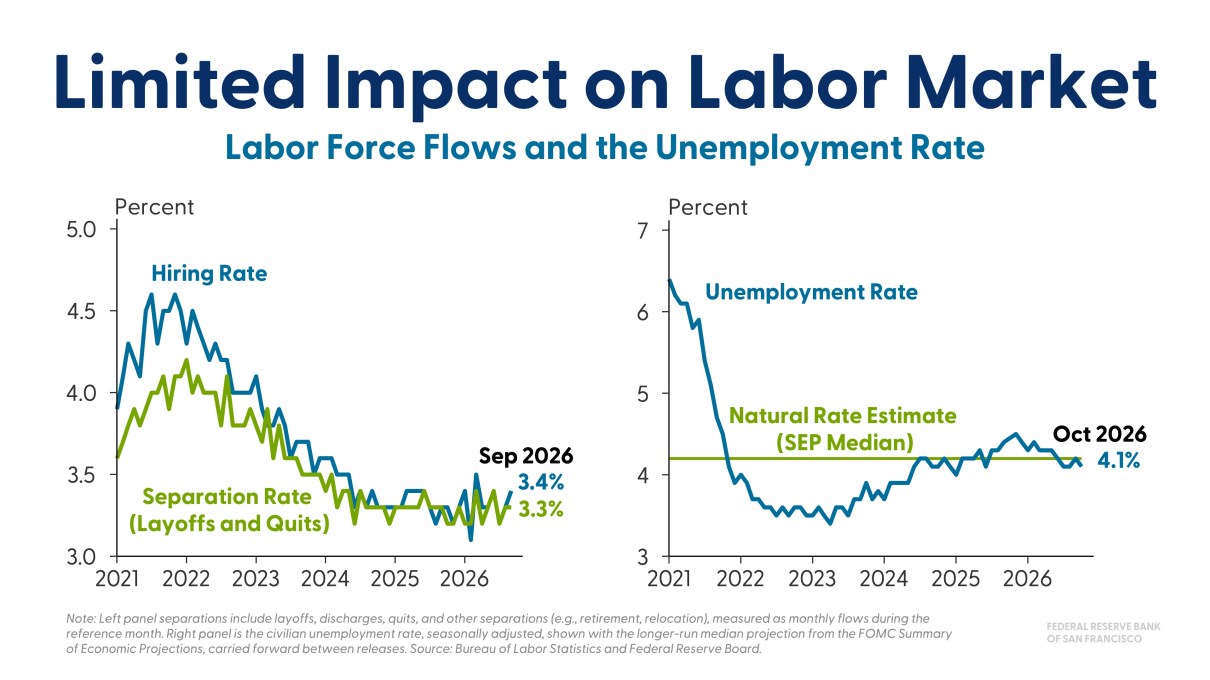
Okay, so then let’s go to the labor market, which I think is really an important question that people have been asking. And so far, we’ve seen what I would call a limited impact on the labor market. Now, that is not to say that there aren’t impacted individuals, and we’d be remiss if we didn’t say that there’s certainly individuals who are experiencing that. So that is the case. But when you look through the aggregate economy, we are seeing a limited impact of AI at scale.
You can see this in two ways. I like to show this hiring rate and separation rate, layoffs and quits. You just see that right now we’re in a low-hiring, low-firing environment. You’ve probably heard that phrase before, low-hiring, low-firing. Firms aren’t hiring a lot of people, but they’re also not letting go of a lot of people. That doesn’t mean certain firms aren’t laying off, but it does mean that there’s a little bit of hiring, there’s a little bit of separation, but mostly you’re just in a low-hiring, low-firing environment.
That means that if you look to the right-hand side of the chart, that the unemployment rate has remained really stable and at a level that’s consistent with the natural rate of unemployment that we expect, the one that just incorporates churning and other things, job search, people taking time to get from one place to another. But right now, this is a labor market that’s fairly stable and you haven’t seen a big impact of AI on the labor market.
So when I put all of this together, the point for monetary policy is we’ve got an inflation problem. We have a labor market that’s stable, growth that’s good, but we definitely have an inflation problem. Right now, we don’t have AI doing most of the driving of inflation, although there is a risk that it could contribute more. And we also don’t have productivity growth in the TFP world, that magic part in a way that’s picking up steam, but you definitely see labor productivity helping us out.
So then what do I think about for the next several years, maybe the one to three impact? So now, I’m going to look one to three years out, that’s a review of today, the health check on the economy. Now, what about one to three years out? What’s possible? You can think of these as risks, you can think of these as scenarios, but basically I’m going to look through the same four lenses: economic growth, productivity, inflation, labor market, and ask what’s coming.
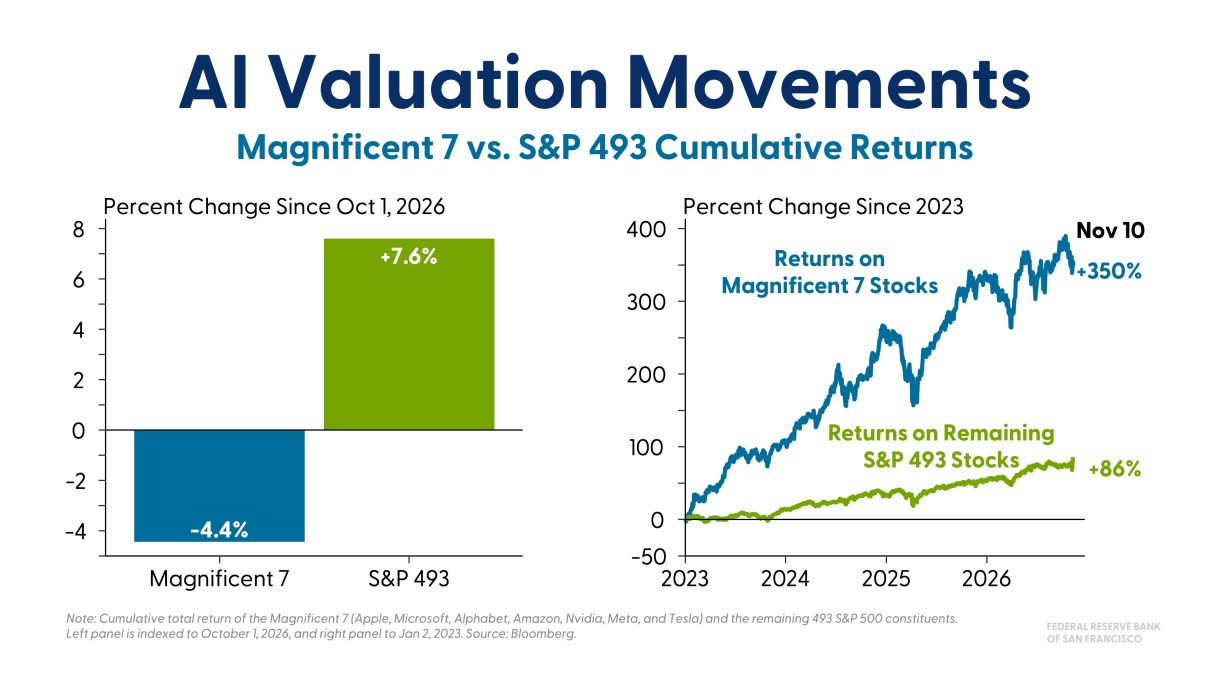
So let’s start with AI valuation movement. I think most of you read the news and you know that AI valuations have been moving around a lot. And this chart on the left is really meant to show that. The Magnificent 7 have dropped a lot relative to the S&P 493, and that’s something that everybody’s noticing. And there’s a lot of articles out there about is this the beginnings of the end, the unwinding of AI? And I wanted to put some perspective on it because I think of it, I think context matters.
So if you look next door on the right-hand side of this chart, you see that, yes, there has been some repricing, but it hasn’t eroded the considerable gains that have been going on for the last three years. So yes, there’s a repricing. No, it doesn’t seem to be the unwinding of the technology interest and enthusiasm and investment that we’ve been seeing.
So how do I read this in terms of thinking about growth? I read this as the private-sector investors, all of the market participants, many of you in all likelihood, are actually asking good questions like, “Do we think the investment strategy that these companies are using, the borrowing strategy, et cetera, is going to be as risk-free as it seemed earlier on, or are we going to price in a little more risk?” That is a good thing.
I was on a podcast with Steve Davis, and I said when the private … He and I ended up talking about this. When the private sector responds, this creates more opportunity for there to be an orderly valuation to rightsize returns with expectations. And so this is somewhat good news. But the second part of the story is that the underlying value isn’t being eroded, and ultimately that is consistent with there being some there there.
As Neale said, everybody expects this to be transformative. The question is how much and when? And you put those two things together and that single belief that this will be a transformative technology, it’s useful to invest in, useful to think about isn’t going away. And that is contributing to some of the projections you see for growth and some of my own sense that growth will continue. There’s not a risk to growth here.
So what about productivity? So if you stood there, some people have been tempted to say, “Well, look, there’s nothing happening yet.” And I think yet is the important piece. We can’t extrapolate from what’s happened so far to talk about what’s going to happen in the next one to three years. And one of the reasons is that the share of firms even using AI, just becoming familiar with it, employing it, thinking about it is growing. And I suspect that if firms fully understood what they were doing when they bought one of the big vendor programs and that AI is empowering a lot of this, you might even get a higher number. People are turning on the tools, the AI tools and normal vendor programs they use for HR and payroll, et cetera, and accounting, but they’re also just getting instances of these models themselves and thinking about what they could do with it, so it’s growing.
Importantly, if we return to the survey that Nick Bloom runs, we see that if they look out, not past what happened in the last three years, but what do they expect to happen in the next three years, firms are much more enthusiastic about how it can have a positive impact on their businesses.
We had a roundtable recently of businesses. It was just a panel of businesses, big businesses, global businesses. And I asked them the speed question at the end, which is, “Do you expect productivity gains to start to see transformation in one to three years or more like 5 to 10 years?” And each person said one to three because we’ve done all the hard work of investing, but now we’re driving for ROI. And as one of the contacts said, “When firms start driving for ROI, things happen fast.” So I think this is a positive momentum for productivity growth. I can’t say we’re going to have it in one to three years, but I can say there’s a lot of work being done to get it in one to three years.
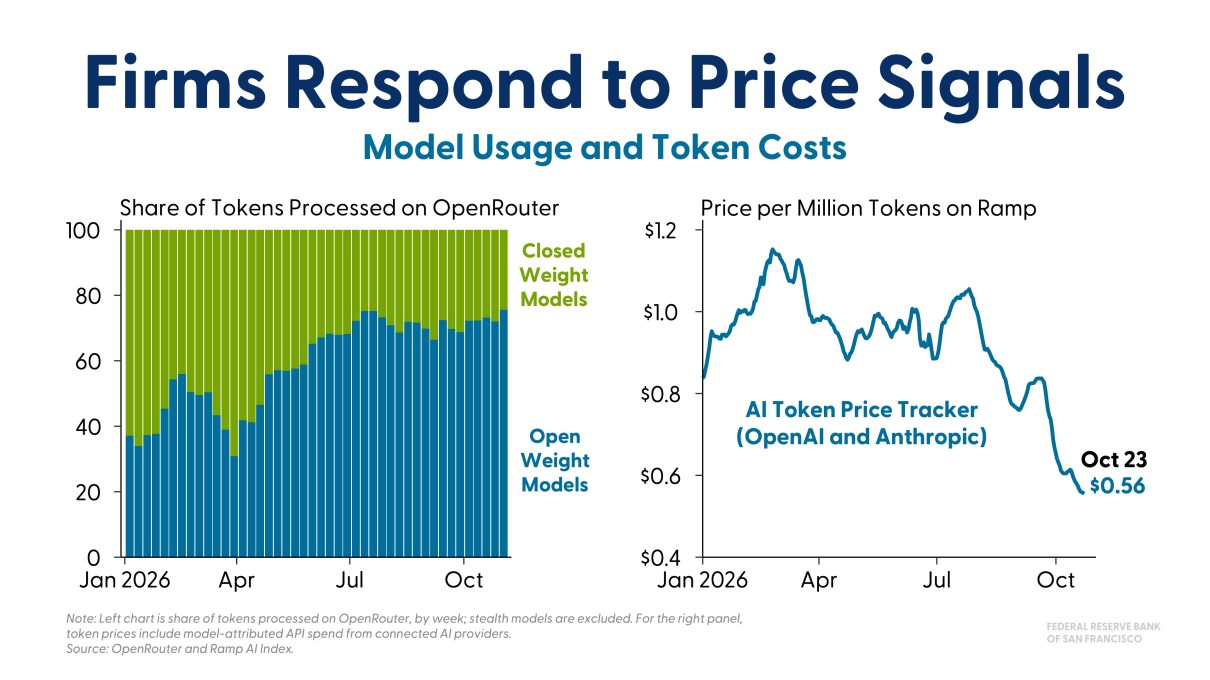
So you might worry that this inflation will never be bridled, that we just can’t catch up fast enough, and that this is something that the Federal Reserve and central banks across the globe are really going to have to deal with. And definitely, we have to think about this as a risk and we have to deal with it, but the Federal Reserve central banks are not the only game in town. One of the things you really rely on is the private sector of firms to say, “Wait a minute, maybe things are too costly.” And so this chart, sort of reassuring in that way.
So as new models became available, open-weight, not just the closed-weight models, as open-weight models became more available, firms started using those. And this is a share of tokens processed on open router using open weight-models versus closed-weight models. And you can see that open-weight models have gained a lot of ground. The share has increased quite a lot. They’re much less expensive, and that’s actually been correlated with the reduction in token prices for the OpenAI and Anthropic. So the private-sector market seems to still be working. You have less demand for your service and you shift gears in terms of your pricing.
Another thing we’re hearing about is that firms are actively, think about memory and chips, regular chips and memory chips. Firms are paying higher prices, regular firms, not tech firms. They’re paying higher prices as well for these chips. We’re hearing more and more. The companies are saying, “Is it really true that the chip depreciates every two years, or can I get more useful life out of this? Or maybe I can remodel my product line to use fewer chips or older chips and not have to rely on this. Every two years I have to buy new and compete with the highest prices.”
So that’s another, what I would say, competitive marketplace doing some of the work of disciplining this higher inflation. Doesn’t mean that the Fed doesn’t have to think about this or it’s all going to work out beautifully, but I think an underappreciated point is that the private sector is responding to the ever rising price of these items and you’re seeing prices start to respond.
The final then thing I want to say before I turn to a little bit about what this means for policy is that the labor market is one of those places you can’t extrapolate from either. You can’t say nothing’s happened so far, so nothing will happen. And I don’t think we can also say that the worst will happen. So it’s a very human characteristic to say to extrapolate from what’s happening or what you fear is happening and say the worst will happen or the best will happen. Somewhere in the middle is what’s likely to happen.
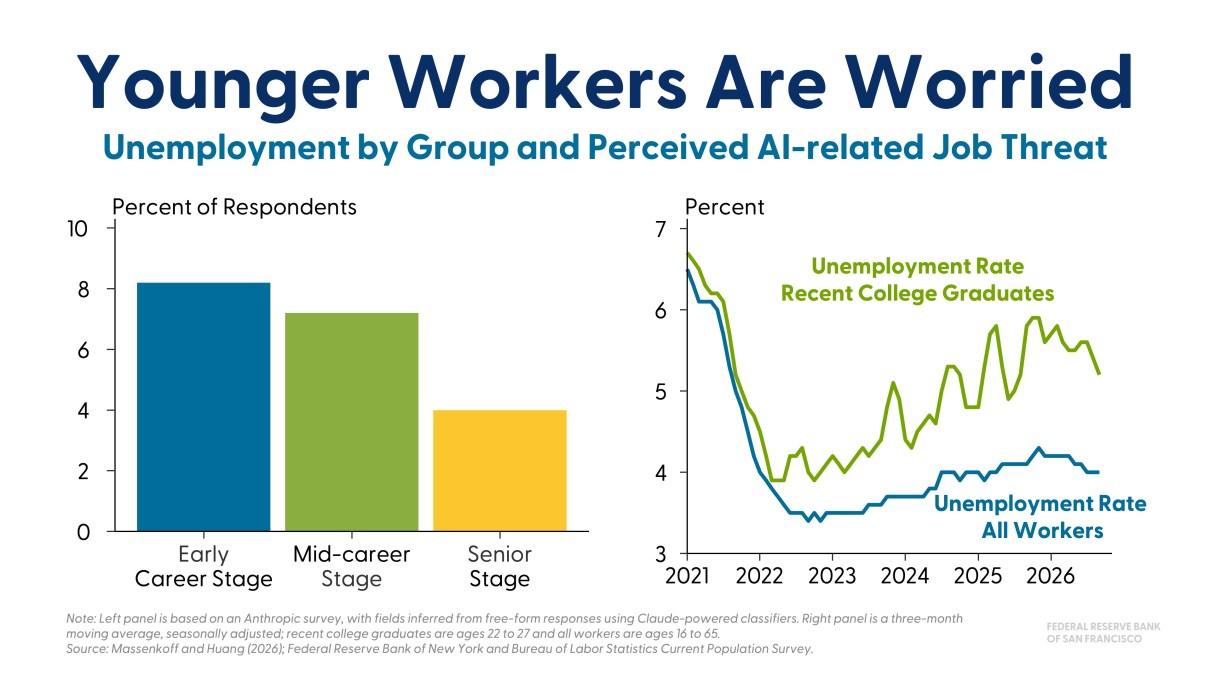
Right now, we see evidence that younger workers in particular, but mid-career workers as well are worried. This is a study out of Anthropic. They did a survey. You do see that workers are more worried at the younger part of the age distribution and earlier in career than at the more senior levels.
You also see that unemployment rates for recent college graduates are rising relative to the unemployment rate for all workers. And if I expanded this timeframe, you’d see that this is very unusual. We haven’t seen this in the United States for a long, long time. And it just speaks to the idea that the AI is changing the dynamic for younger workers.
Now, we spend a lot of time asking our teams, our CEOs, our roundtables, “Why is this?” And I’ll give you something that maybe we can think through during the course of the Q&A. And that is basically maybe what’s happening is they’re waiting until they know who they want to hire. But if you’re a younger worker, that doesn’t feel very reassuring. So I think that is something we have to think about.
So now if I back up and ask, what does all this mean for policy? And I’ll conclude my remarks there. So for monetary policy, we have to look through maybe really a one to three year window. So right now, what we have, and I said this a moment ago, what we have is a stable labor market, really positive growth, some positive productivity growth for labor productivity, and an inflation rate that’s been above target for six years. And we have to focus on price stability and bring that inflation down. It’s not primarily driven by AI, but the AI price surges don’t help our situation so that’s where the focus has to be.
The second part of this though, what happens in the next one to three years just leads me to say this. Just because we have to fight the inflation problem now doesn’t mean that we should completely ignore the possibilities on productivity growth, on how that could be disinflationary. Some people say the inflationary impulse will continue, that’s a possibility, but I think it’s also possible, and maybe it’s because I came to the Fed in ’96 and I saw what the computers and the internet did to the possibilities in the economy and how that added to the disinflationary impulse in the economy.
We have to be open-minded. So planning out what policymakers will do for the next one to three years is kind of a fool’s errand. I can tell you that what policymakers should be, what I know I want to be focused on, what we all have to be focused on is what can productivity growth do for us? How will AI lead that? When do we start to see the transformation and what is going to be the impact on the labor market, not 10 years from now, but in the next one to three years?
So like others, I’m extremely bullish or enthusiastic about what this technology will mean eventually, but the thing that I’ve learned through studying all types of things, global trade, other technologies, all the way back to the Industrial Revolution, is that for policy makers, the transition dynamic matters. And for humans living in the country, the transition dynamic happens. And that’s where if we get 10 years from now and we find that it hasn’t worked the way we want it to, I will offer this. It won’t be the technology’s fault, it will be ours to decide. So intentional policymaking conversations like the one we have here going on today, these are what’s essential to making sure we’re proud of 10 years from now as opposed to wondering why this happened. With that, I’ll be happy to talk to Neale.
Neale Mahoney:
Amazing. I think this was a terrific presentation. Slides are really handsome, I love the color scheme.
Mary C. Daly:
Oh, thank you.
Neale Mahoney:
I don’t know if that’s the Fed’s schema.
Mary C. Daly:
It’s the San Francisco Fed’s schema.
Neale Mahoney:
It’s great.
Mary C. Daly:
We have 12 reserve banks and a board of governors so everybody has their own schema. That’s ours.
Neale Mahoney:
And they’re all equally good, but this one’s the best.
Mary C. Daly:
That’s what I like to hear.
Neale Mahoney:
So you set me up really well. Maybe I’m going to ask a couple questions which delve into the topics you teed up. And then I have questions coming in on my iPad and so we can turn to those as well and you can use the QR code to submit questions.
So let’s start with some questions that relate to the dual mandate and I think especially the inflation side, which is where the concerns are most heavy. So inflation has been above target, you said six years?
Mary C. Daly:
Almost six years.
Neale Mahoney:
Almost six years, and it’s probably worse than moving sideways now, it’s moving in the wrong direction. Our textbook sort of approach to monetary policy says we should look through a supply shock, right? And much of the inflation we’ve seen recently is supply shocks, tariffs, the war and energy prices.
Is that the way you think about the supply shocks we’ve been facing, that it’s something that we should be looking through because a supply shock weighs on both sides of the mandate? It reduces growth and increases inflation. So if your job is to balance the two, then something that keeps these in balance is not something we should be over-responding to. So is that how you think about it?
Mary C. Daly:
I think that it’s definitely the conventional wisdom, as you said, that we would look through these types of shocks because it’s also the idea that by the time our monetary policy tools would take effect, which is 12 to 18 months, the shock could be dissipated and then we would have over-corrected something that we didn’t need to respond to at all or couldn’t really affect. You can’t affect the price of oil, but if you raise interest rates in response to the price of oil, this is the textbook example, you end up curbing an economy that’s already struggling with lower growth. Okay, so that’s the conventional wisdom.
The way I’ve been thinking about it since maybe the middle of the summer is a little bit different than that, which is that we have inflation, we already start with an elevated level of inflation. It’s already above target. Then we have three shocks in overlapping succession, right? So they’re not just behind each other, they’re actually overlapping. First, we have tariffs, then we have the war and oil prices, energy prices, which has affected food prices, and then we have the AI shock.
And I think it’s a reasonable question for all to ask and really investigate, do the fact that these shocks overlap and that they already come in a period of high inflation, do they compound on each other and start to change the underlying rate of inflation that really matters for the durability of inflation expectations, et cetera?
Our best check on that is inflation expectations. And at the medium and longer run, you haven’t seen inflation expectations of markets, consumers, businesses drift. They’re still consistent with 2% inflation, but we can’t just be complacent and say, “Well, businesses and everybody’s happy, so we shouldn’t have to do anything.” The way you keep inflation expectations well anchored is to bring inflation down to price stability.
So for me, I was quite comfortable with the September rate increase. I think that’s appropriate. And with my bias, as I’ve been saying, my bias is that further tightening will be needed because you just see this consistent pressure on inflation that isn’t simply in the sectors that are most directly affected by tariffs or oil. They’re actually starting to bleed into the services and that services inflation is, once it gets up, it’s extremely sticky. It has a hard time coming down. So that’s how I think about it now. And I don’t think we can just look to the conventional wisdom and hope for the best. We have to reckon with the realities we face, which is that inflation’s been high for a while and the pressure is up, not down.
Neale Mahoney:
Great. And I think that basically covers my follow-up, which was going to be how do we modify the textbook model when we have more frequent, more persistent supply side shocks? And your response was, “Well, we focus on inflation expectations, both the market-based measures and the survey-based measures.” And you’re also thinking about services, inflation X housing as something that I think you’re particularly concerned about or tracking closely in the current environment.
Mary C. Daly:
If I may, we also ask, I mean, I think this is really important and may be helpful. We also spend a lot of time asking businesses, “What are you doing in the next year?” And increasingly, we’re hearing businesses say, “I’m at the end of my line. I’m going to have to pass some of these input costs through. Are they going to eat into margins?”
Ultimately, the disciplining divisive margins is competitors who will say, “I’ll take the margin hit and sell my goods,” and consumers who tell you whether they’re going to buy your things or not. And it seems like consumers should have run out of gas a while ago, but they haven’t. So that’s a dynamic that I think is really critical to watch as we plan for the … Think about policy response to the inflation impulse.
Neale Mahoney:
No, that’s a great addition. So let me talk about another factor here, which is financial conditions. And I think for people who follow the bond markets, the 10-year, I think it’s over 5% this morning, I checked.
Mary C. Daly:
It was this morning.
Neale Mahoney:
And then there’s also a term premium. So I guess the specific question is, to what extent do you think the long end of the yield curve is doing additional work for you in tightening financial conditions and providing an appropriate headwind for the economy? How do you think about those factors?
Mary C. Daly:
So tighter financial conditions are most welcomed, I’d say, if you’re thinking about bringing inflation down because we have to have tighter financial conditions to help with that process. The reason I hesitate on this question all the time is that I don’t want to say markets do the work for the Fed because the Fed is given the responsibility. Congress gave the Federal Reserve the responsibility of restoring price stability, keeping prices low and stable, making sure we maintain full employment. And so that’s not something we just acquiesce, but I do look at the market conditions and ask a very simple question. Are they out of alignment with where I think we need to be?
And right now, I see they’re in alignment with where we need to be. And importantly, they’re reacting to incoming information in a way that’s consistent with the reaction function that I have. So when data come in and say the pressure on inflation is up, you see market pricing for the Fed’s policy response go up, and you also see yields go up. When you see oil prices rise, you see these types of things. And that is a good sign that the economy …
I said at the beginning, talking about AI, when the private sector participates in their role, that’s actually helpful. When consumers understand where we’re going, that’s helpful. So I think that gives us a little more time to make really calibrated decisions. We don’t have a surgical tool, and so you want to be thoughtful about … And we don’t also have a tool where you can go up and down, up and down. It’s hard on businesses, consumers, et cetera. So markets can adjust tomorrow. If the world changes, they can just reprice. They can move hour by hour, certainly day by day or week by week.
The Federal Reserve has … We make policy and it stays for a while or it usually stays for a while, and importantly, people make decisions based on it. So I think the markets are assisting in making sure that we’re bringing inflation down, but our job is ours. And so that’s why I have said that my bias is we’ll have to have additional tightening, but exactly how much and exactly when, that’s a decision that we don’t need to make today because we have many more pieces and days of information coming in over many, many quarters to make the right decision that helps do those two mandated goals.
Neale Mahoney:
Fantastic. No, being data dependent and working, I guess you said the markets are complementing.
Mary C. Daly:
They’re complementing, and they seem to understand what we have said we would deliver price stability, and they think they look out and see a labor market is stable. If you want to deliver price stability in a stable labor market with good growth, that means tightening policy.
Neale Mahoney:
So maybe I’ll ask you a few questions about AI and then we’ll open things up. You had the chart you showed before of GDP growth with and without the, I think it was you stripped out AI CapEx from it. So really high level, how many of our economic eggs are in the AI basket? And if there is a correction, pullback in CapEx, a correction in the stock market, how exposed are we? What are the channels? How big are the risks? How are you thinking about this scenario? And obviously nobody has a crystal ball, but we do see scenario planning, right?
Mary C. Daly:
Absolutely.
Neale Mahoney:
The plan is better than no plan. So how do you think about it?
Mary C. Daly:
I think about it. I tried to get at this question. It’s a great question by the way. It’s an excellent question because you look at that chart on GDP growth and you think all of our eggs are in one basket, but it’s not really the experience I have when I talk to CEOs in industries that are not technology-driven. They’re feeling somewhat constrained by the … One possibility is that everybody else is silent and sitting on the sidelines and AI is the only thing saving us.
The other explanation which you’ll hear from other businesses is everything’s going up and so I’m feeling like I can’t do everything I want to do because prices are so high. So I do think there’s that balance of the economy, and right now there’s a lot of investment in technology, not just by technology companies, but by regular companies that are non-tech that want to get in part of this game, so I think that’s there. The other thing that I think is useful to remember, and that’s why I showed the stock market-
Neale Mahoney:
Can I just pause on that?
Mary C. Daly:
Yeah.
Neale Mahoney:
Is that the flip side of the coin of elevated rates from AI investment or crowding out certain things that if there was a pullback, then we would see an increase in other investment and it would be a stabilizing force?
Mary C. Daly:
It’s hard to say that you could replace all the AI investment, which is in a surge period with other investment. But it is the case that other businesses that are non-tech are investing. And when I hear businesses across the district and even across the country talk, they want to invest more. They feel the opportunity of the US economy, but that can’t be completely separated from the surge in growth from technology. It’s really just a sense that maybe we’re on the …
I have several people tell me we’re on the brink of a manufacturing revolution in the United States. We’re on the brink of bringing AI to the physical infrastructure that we do. Isn’t this great? What can I do with it? But we’re not there yet.
I think the other thing that is important is, and this is where that stock market valuation chart comes in. Yes, we’ve taken some of the enthusiasm off, but it hasn’t taken the technology away. And ultimately, that’s because there is there there. It may take a while to see the full impact, but even 10% of the impact, probably less of what people imagine could be possible down the road still contributes to the economy and doesn’t leave it completely zero. So the worst case scenarios are if you go from all of this to zero. I don’t have a lot of weight on the zero hypothesis. I think you could slow the growth rate and still have a robust economy growing and a stable labor market and lower inflation.
Neale Mahoney:
It’s actually similar. I sort of did some of these numbers. I know my colleagues have done too, like run a reduction in CapEx, run the wealth effect of a correction through basic models. You get a slowdown, but I don’t think you get a reversal in GDP growth. But then there’s the Anna Karenina sort of theory of recessions, right? Everyone is different and maybe circular financing or something else, it could create some sort of more deeper slowdown.
Mary C. Daly:
Sure. You’re absolutely right, there’s always the risks out there. One of the things that I think was the test case for whether that scenario is right on the brink of it is we’ve had a sentiment shock on AI and it hasn’t unraveled, it’s been orderly. You can’t be central banker and ever be complacent. You can’t say, “Oh, because I saw this piece of data, now I feel great.” But I do think looking for signs of what the likely scenarios are, or what’s playing out, you don’t see really burgeoning signs of fragility there.
Neale Mahoney:
Great. So let me ask a couple labor market questions and we’ll open things up. First one I want to go back to, you had a slide on increasing unemployment rates for young college graduates. I think to summarize your slides and I think broadly held views, we’re in a low-hire, low-fire labor market where the most stress is on young college graduates, including lots of students that I talk to, I mentor.
There’s a host of theories out there for what’s going on from work from home. I think Nick Bloom has talked about how it’s harder to monitor and coach a young employee if you’re more work from home. To higher interest rates, firms are feeling more pressure, this is where we’re pulling back. To AI, that number of the tasks that young associates would do right now AI is doing. What is your view as to the different factors here? What are you giving the most weight? How concerned should we be?
Mary C. Daly:
I’ve been a labor economist my whole career, and one of the things I’ve learned in that period is there’s no one factor that if you weight it, you won’t regret it the next day because ultimately all of these factors are playing out, and probably the combination of them, right? Right now, we have firms that feel cautiously optimistic, underline cautiously. Right? So they see this, but if you’re cautious, you’re uncertain, you certainly don’t want to get over your skis, so to speak, by hiring a lot of individuals that you then have to painfully let go. So that’s one piece.
The second piece is AI, you’re spending so much time and energy thinking about AI and you really need people who can evaluate whether you’re getting the right answers and newly minted people who just started your firm are unlikely to be those great evaluators, probably a little bit why the senior groups are feeling pretty okay. They’re saying, “I know that model’s wrong. I know that output’s wrong.” But ultimately, that’s a transition dynamic.
We spend a lot of time because this is such a critical issue for the US and for policymaking for the Federal Reserve, we spend a lot of time asking our vast network of employers, “Why are you hiring so little?” And they give us array of those answers. But one that you didn’t mention that I think is potentially beneficial for younger workers in the transition is that they said, “We don’t know who to hire.”
So here’s an example. We’re trying to rethink everything we do in accounting, make sure our customers are getting what they need, make sure we’re getting what we need. We’re revamping the entire accounting production chain for a national company. If I hire a newly minted CPA, and then I don’t need as many newly minted CPAs, I need a CPA plus a person who does cyber or something, then I’ve hired the wrong person and I don’t want to hire the wrong person because it’s painful to let people go. So I’m going to go skinny. This is often how they say it, “I’m going to go skinny until I figured that out.”
So then the next question we ask is, “When do you think you’ll figure that out?” And they say, “Next year,” so ’27. So this was never going to be a year of rapid hiring because of the different shocks that we face, the higher input costs, the trying to get their budgets right. But I think that from the AI perspective, it’s very hard, and this is maybe a theme of the whole conversation, it’s extremely hard to take what we see today and extrapolate. Because if we extrapolate, we’re likely to be wrong. And so instead it’s what could happen and what would change that equation? I think right now we’re in more or less a perfect storm for hiring. It’s cautious, probably trying to get some of the overhang from the post-pandemic labor market hiring down, AI, and younger workers are going to be the module-
Neale Mahoney:
Yeah, tariffs like a whole bunch of uncertainty shocks.
Mary C. Daly:
Yeah, tariffs. So much input, so many input costs rising. And so it’s just not going to be a great impetus for hiring. What has been noticeably a sign of resilience of the labor market is there hasn’t been a big increase in firing or separation. So I think that’s the good news piece of this labor market.
Neale Mahoney:
Totally. Last question. Let’s actually think through what may happen over the medium run in the labor market. There’s two scenarios that I keep in my mind, which I find clarifying. And like you said, the truth is always a convex combination of different scenarios. The benign scenario I have for AI labor market disruption is we have job losses or changes in hiring mix that happen broadly across the country and happen slowly over time. And that sort of transition gets almost lost in the huge amount of churn we see in the labor market as it is, right?
Mary C. Daly:
Yes.
Neale Mahoney:
Communities hire fewer people in this role, more people in this role, so it gets lost in the churn and we can manage it. We have a very dynamic economy. The other scenario, when I think about the hollowing out of the labor market and in particular the loss of these routine jobs, where you think about Charlie Chapman in modern times doing the same thing over and over again, if you look in the data, it’s something like almost 90% of routine jobs were lost during recessions of the six months afterwards.
When firms are cutting back and then they figure out how to do more with less and it’s cheap to install capital because interest rates are low and wages are sticky so wages are high. So you have job losses compounded, structural job losses compounded with cyclical shocks. I think that’s the scenario I’m most worried about with AI, that there’s a recession, and employers figure out how to do more with less and we don’t hire back then the white collar service workers and we have the longest jobless recovery that we’ve ever seen, so that’s my worst case scenario. What are the scenarios that you’re thinking about? What do you think about the scenarios that I just laid out here? And then hopefully people will have more optimistic questions we can finish on.
Mary C. Daly:
I think those are two reasonable scenarios, but I think there’s many more scenarios in between than I also think about. And that’s because ultimately we don’t know. As you rightly said, those are two … Put them at the benchmark part. One thing that I will say since you brought up a recession and this is when it happens, another time that you can see job transformation and employers really thinking about how do I automate is in response to a hot job market. So we had a very, very tight labor market coming out of the pandemic, very tight. I mean, people were losing employees two weeks after they hired them, or maybe they hired them and didn’t even show up. That’s how, remember ghosting and all this? So that’s how tight it was.
A response to that type of tight labor market is I’m automating. I can’t be left to wait for workers to come. I’m going to automate things I can. That happened to collide or correspond, I guess is a better word, with the AI boom. I think one of the reasons we’re seeing a little bit of this right now without a recession, as you say, this is a classic historical example, but without that is because the firm’s already got the discipline of I better not rely on a labor force that’s always available.
Then you put onto that the fact that our labor force growth is really slow going forward. In the absence of immigration, it can get to zero by 2030 in terms … So the employer’s like, “Okay, if that’s what I’ve got, then how can this technology really help me continue output growth while I do more with fewer employees?”
And that’s a response to those two things. I think that’s a scenario that’s probably top of my mind right now is what does a transition dynamic look like when you have two accelerants, right? The slower labor force growth coming off a frothy labor market, and you have the AI boom. How do employers combine those two things and how does that change the steady state demand for workers?
But I always come back to something. I was on stage with Patrick Collison of Stripe about two years ago at this point, but it’s still something he says. And he said, “Look, I’m hiring as many workers as I’m letting go. The thing is they’re just totally different people.”
So when you think about a labor market that is able to continue and thrive, it’s about how we intentionally help all of our workforce learn the skills that are going to be necessary to embark on the new technology and the new jobs, the new tasks that come out of that and not stay behind on the old spreadsheet and say, “Well, that’s a job, that’s a job, that’s a job.” I think we’re likely to see many, many new jobs as we lose older jobs, and I just want to make sure our workforce is ready.
Neale Mahoney:
Yeah. No, that’s a great scenario also to keep top of mind. Let me flip the questions and just seeing one from Karen, I don’t know where. There she is. She asked, “What indicators will you be watching to assess whether AI indeed will support productivity and lower interest rates?” I think we didn’t touch on that. We all know the productivity series is noisy and it’s hard to just focus on that. What are you looking at?
Mary C. Daly:
Karen, thanks for the question. We’ve talked about this a lot, but one of the things that … I was benefited by starting at the Fed in 1996. I was a microeconomist, labor economist, and then Chairman Greenspan would say, “I think productivity growth is there,” and he’d set up teams across the country to look for evidence or no evidence of this. And one of the things that I experienced was companies telling us that they were making these productivity gains and it was helping them protect margins while they continued to create output growth.
The lesson I learned from that isn’t the technology shocks are always great for productivity growth right away, but that you’re never going to find it in the data until it’s already happened. And so to be able to find it … You’ve got to look away from the published data on productivity growth, not to discount it, I think it’s useful, but that is not going to give you a leading indicator of what’s happening. To get that indicator, you have to talk to firms. You have to ask them what they’re doing, how they’re doing it, what’s changed.
The second thing that is really important that I look for is, I go back, I love history, so I go back, I read deeply about electrification. If you read any historical piece on electrification, they tell you that electricity is invented. It takes 100 years to see that transform the economy. The transformative part wasn’t even when they put an electric motor at the end of the line to replace the steam engine, that saved money, but it did not change everything. What transformed everything is the invention of the unit motor, and then you get a unit motor which can be moved anywhere, and the unit motor itself isn’t the transformative part.
What’s transformative is if businesses say, “Well, my gosh, if I don’t have to have one continuous line, then I can move around, I can move machines, I can respond to output needs, I can do a variety of things,” and that transforms manufacturing. So that’s the piece I look for. What are businesses doing to change not their technologies, but their processes? When they change their processes, we will have the kind of boom that people talk about.
Neale Mahoney:
Speaking of electrification, I have a question on energy in the here and now, so let me read it out maybe in abridged form. “Power hungry data centers are demanding immense amounts of energy. How’s the Fed thinking about this demand reverberating through markets and contributing to broader long-term inflation in electricity markets, in other energy sectors, and in markets for energy sensitive goods?”
Mary C. Daly:
We think about it a lot, and one of the things that we have to think about is what are communities doing in response? We have round tables with the power companies. They tell us the same thing. It’s hard to keep up with the demand for energy that communities have as we have growing communities, but data centers have. It was already hard to keep up, and now we have a demand shock from data centers. So these are real problems. The infrastructure needs are present, and the Fed can’t solve those, but you’re right, we have to think about them.
So one of the things, just to put a practical component on how I think of it as a policymaker is energy prices go up, but it really is all the people who pay for the energy that matters for the overall price inflation. If businesses are already paying higher prices for oil, now they pay higher prices for electricity, they’re paying higher prices for other inputs due to tariffs or competing interest from AI, then their input costs are going to rise.
And so that means their margins will fall unless they raise their prices. And so that’s the dynamic you have to watch. So we can’t simply say, “Well, this is just electricity, so not a big deal.” These are changing the price dynamics. And if other prices don’t adjust downward, then we’re going to have a higher pressure on the inflation rate than we would absent these shocks. And so this has got to be something we really think about. And if you’re really geeky, people talk about this in the context of what’s the long run interest rate that’s going to be normal in an environment like this. The answer is nobody knows, but you can definitely put a table together and say things that move it up, things that move it down, and the list of things that move it up are growing relative to the things that move it down.
Neale Mahoney:
We finish with two questions in the similar vein. First from Peter Blair here in the front. “There are lots of researchers and private sector firms in the room. What research and data would be most useful to the Fed in policymaking in the age of AI to support the dual mandate? What’s missing from the current research efforts of scholars and firms?”
Mary C. Daly:
So I’m going to talk about something. Peter, thanks for the question. I appreciate it. One of the things I want to talk about on that, which you mentioned is, and then I’ll get to the AI part specifically, but the conventional wisdom in economics is that you could look through shocks, but in a world where the pressure on inflation, most central banks will be fighting inflation from above our target, pulling it down. And we’ve got these sequence of shocks, global shocks, national shocks that I think we just have to have a broader research hunger for, how do I think of relative price shocks? What are the avenues that it make them more durable, more sticky? How do they change the underlying level of inflation, underlying rate of inflation? I think that’s a ripe for this.
On the AI specifically, I’ve really appreciated all the research that’s been done where you can’t find it in the aggregate data. This is going to hook Karen’s question to your question, Peter. Can’t find it in the aggregate data, but we know a lot about where to look and all the studies that are looking at case studies and saying, “How does it happen? What’s the mechanism that makes it just cost saving because AI is doing some work to transformative to your business?” That is really great research to think about.
And then the other part that I really would love the research community to embrace and think about is not what bad things can happen to the labor market eventually, but what can we do to prevent those things happening? I do feel like it’s easier oftentimes to itemize what could go wrong, but it’s not an instinct of most humans really to say, “Well, what do we have to change in the models or in the data to have that go better? What would have to happen?”
If it’s not just a regulatory response, but it’s actually like a training response. How would it be different? And looking across the globe would be helpful. We had a talk in our bank at the … We have a technology and growth center and we kicked it off a couple of weeks ago, and Philip Lane from the ECB was giving a talk and he talked about how different perceptions of AI are for workers here in the United States than they are in the EU. I think that’s something to learn from. They’re much less pessimistic about AI than our younger workers are. Well, why? And what aspects of their countries and their policies and their programs do they have that might mitigate some of that fear?
Neale Mahoney:
I love that point. I’ve said to other people, we do too much predicting and not enough planning around AI.
Mary C. Daly:
Yes, that’s a great way to say it.
Neale Mahoney:
I think part of the purpose and substance of today’s event is to also do that sort of scenario planning and start building that muscle ahead of when we need it.
So let me finish with, I think, very hard but important question. We have lots of young people, undergrads choosing majors, choosing where to get an internship, pre-docs thinking about whether they’re going to go to grad school in economics, go to the private sector. We’re in a moment of huge uncertainty. What’s your advice to young people today?
Mary C. Daly:
Sure. I’m happy to give it. And then you can call me up 10 years from now and say, “That was terrible advice,” or, “that was excellent advice.”
Neale Mahoney:
Well, you have the disclaimer, right? There you, disclaimer-
Mary C. Daly:
I do have the disclaimer, but I’ll take this on myself here and say that I think the instinct that many have when you see uncertainty is to stall out and do less. I think the instinct that I want you all to have is to lean in and do more. The economy’s always going to be dynamic. You are coming out in a period of great uncertainty about what the world will look like, but we’re not uncertain about where it is today.
And today, you know you have to have AI skills. You have to be able to interrogate things with great curiosity. I think there’s a lot of human skills that AI hasn’t been able to replicate yet. They’re going to be in high demand. In many ways, the scarcest skills are going to be leadership, quality control, knowing when to use a model, when not to use it, knowing how to interrogate or investigate what is … You started by talking about evidence-based. What’s the standard for evidence-based? It’s not that an LLM told you the answer.
The standard for evidence-based is hypothesis testing, having that curiosity, coming back with the data. So I think positioning yourself so you’re not monolined in a specific thing, but you’re really open. You could be sitting right here at the beginnings of something that Neale and I will be jealous of because we weren’t in the labor market. I don’t think that’s where you sit right now, but you want to be ready for that. You want to be ready for that.
I also deeply believe that younger people are where all of our … The idealism meets the practicality. And if we want to look like a country and a world we want 10 years from now, we’re going to have to have each and every one of you participate. So I say lean in.
Neale Mahoney:
Yeah. No, we all know as investors we should have a diversified portfolio. One thing I took from that comment is in terms of our human capital.
Mary C. Daly:
Yeah, diversified.
Neale Mahoney:
We should lean in, we should be diversified, not just the cognitive skills, the human skills, and that leaves us best prepared for what opportunities are going to wait us in our uncertain future. Thank you so much.
Mary C. Daly:
Can I say what one of my interns told me this year?
Neale Mahoney:
Yes, please.
Mary C. Daly:
He said, “Mary, the thing that I learned by working at the Fed this year is that I’m not just what I do, I am how I do it.”
Neale Mahoney:
Yes.
Mary C. Daly:
And I think if you take that out, you’re going to find that how you do things matters as much as what you do. What you do can change every three years, certainly every 10 years. But how you do it, how you come across in the labor market, how you work with others, how you collaborate, that’s durable story.
Neale Mahoney:
Well, you are a beacon in terms of what you do and how you do it, and it’s been a delight to have you here.
Mary C. Daly:
Thank you so much for having me.
Neale Mahoney:
Thank you so much.
Mary C. Daly:
Thank you.
Summary
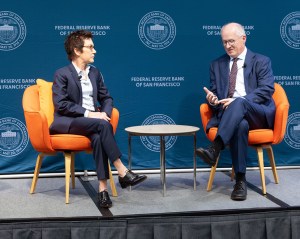
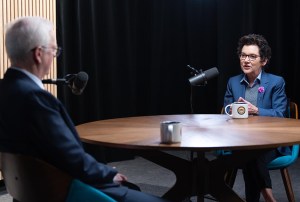
Mary C. Daly, president and CEO of the Federal Reserve Bank of San Francisco, delivered keynote remarks at the Stanford Institute for Economic Policy Research (SIEPR) Fall Policy Forum, “Economic Policy in the Age of AI.” Following her presentation was a moderated conversation led by Neale Mahoney, Trione Director of SIEPR and T.G. Wijaya Professor of Economics at Stanford University.
From the Event

Sign up for notifications on Mary C. Daly’s speeches, remarks, and fireside chats.
About the Speaker

Mary C. Daly is President and Chief Executive Officer of the Federal Reserve Bank of San Francisco. In that capacity, she serves the Twelfth Federal Reserve District in setting monetary policy. Prior to that, she was the executive vice president and director of research at the San Francisco Fed, which she joined in 1996. Read Mary C. Daly’s full bio.
Related: