
U.S. labor force participation rose for decades until the mid-1990s but has fallen steadily since then. This general pattern masks different paths for men and women in the workforce. Aging and rising education explain much of the long-run changes but do not account for the divergence by gender. Men’s trend participation has fallen steadily since the late 1970s, while women’s participation rose through 2000 before flattening. The difference mainly reflects younger male cohorts participating less than earlier ones, whereas younger female cohorts—especially those with more education—have higher participation.
The U.S. labor force participation (LFP) rate rose over the past half century through the late 1990s and then declined. However, that general pattern hides a striking divergence: Men’s participation in the workforce trended down almost continuously after the late 1970s, while women’s participation continued rising for decades before flattening. This raises a question: Do the long-run changes in participation mainly reflect a population that is older and more educated than before, or are there deeper shifts within demographic groups?
In this Economic Letter, we summarize results from Hornstein and Kudlyak (2026), who study long-run trends in labor force participation and unemployment. The Letter focuses on building the overall trend from the bottom up: We estimate trend participation for 44 groups separated according to age, gender, and education and then weight each group’s trend by its share of the total population. This allows us to distinguish the demographic composition, captured by the population shares, from the changes in participation within groups, captured by the group-specific trends.
We find that the changing population shares associated with aging and rising education explain much of the long-run movement in overall labor participation. However, these factors do not explain the divergence between men’s and women’s participation rates. Men’s trend LFP rate fell roughly 10 percentage points between 1976 and 2024, while women’s rose about 10 points through 2000 and then slipped about 2 points since then. The difference is largely a cohort phenomenon: More recent male cohorts participate less than earlier male cohorts, regardless of age, whereas more recent female cohorts, especially those with some college or higher education, participate more than earlier female cohorts.
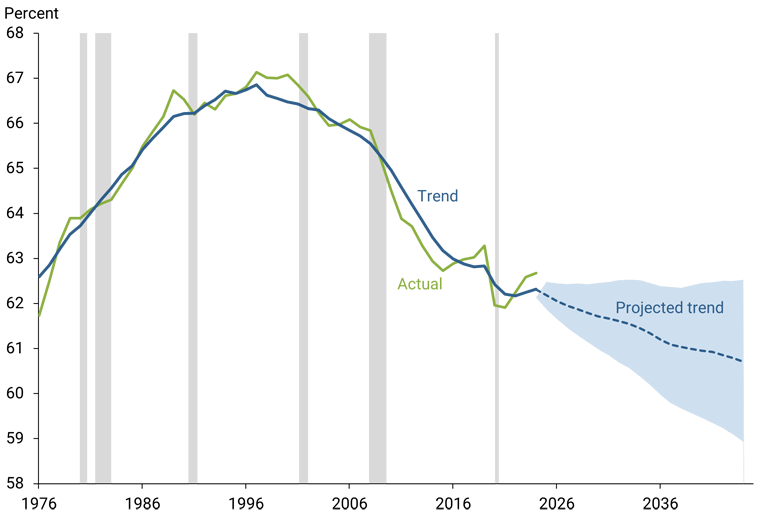
Combining the estimated group-specific trends with the age-gender population projections from the U.S. Census Bureau (2023) and the educational composition estimates from our educational attainment model, we project that trend LFP will decline about 1.6 percentage points from its 2024 level over the next two decades.
From group trends to aggregate participation
Trend LFP is the participation rate expected to prevail once business-cycle effects dissipate. Because that trend is not observed directly, Hornstein and Kudlyak (2026) estimate it from group-level data defined by gender, age, and education using Current Population Survey microdata from 1976 to 2024. This aggregate LFP is a weighted average of participation rates across demographic groups. Changes in the trend can therefore reflect changes in either the population shares of the groups, which affects the weights, or participation within groups. The distinction by gender, age, or education matters because, for example, older people typically participate less, while more educated people participate more.
Within each gender-education group, unemployment and participation rates at each age are specified to be the sum of three unobserved components. The first is a cohort effect—a participation rate component that remains constant throughout the life cycle of a cohort but varies from one cohort to another. The second component is an age-specific effect that reflects participation rates for workers of the same age. The age effect allows those rates to be different at different points of time: For example, 25- to 54-year-old women participate at higher rates now than three decades ago. The third is a time-varying cyclical component that captures how group-specific unemployment and participation rates vary with an unobserved indicator of the business cycle.
The model does not include separate explanatory variables, such as the rates of school enrollment, disability, or program participation, because our three estimated time-varying effects capture the various observed and unobserved economic forces that shape labor force participation. This methodology differs from common approaches used in many prior studies such as Aaronson et al. (2014) and Montes (2018). Those approaches often attribute shifts in overall participation rates to observable variables using regression analysis.
Cohort effects capture the fact that people born in a given year or group of years often have similar LFP rates, which may differ from people born at different times. Age effects capture life-cycle patterns, such as high participation among people in their prime working years and lower participation among those nearing retirement. Allowing age effects to vary over time means that the usual participation profile at a given age can shift depending on other characteristics such as changing economic incentives due to new laws or societal trends.
Figure 1 shows the resulting overall trend LFP rate estimates (blue line) from our methodology. Trend LFP rose about 4.1 percentage points from 1976 to the mid-1990s. We find that rising educational attainment, reflected in rising population shares of higher educated groups, added about 2.2 points, and rising within-group participation trends added another 1.2 points. From the mid-1990s to 2024, the trend fell –4.4 percentage points. Population aging accounted for about –4.3 points of that decline, and falling within-group participation trends contributed another –2.3 points, partly offset by the positive contributions from continued educational attainment over time. These estimates indicate that the familiar hump shape reflects both demographics and persistent within-group shifts.
Figure 1
Trends for overall labor force participation
Source: Authors’ estimates based on Current Population Survey microdata, 1976-2024.
Why participation rates for men and women look so different
Figure 2 unpacks the aggregate pattern as separate participation trends for men and women. Each panel shows a smooth red line for the cumulative change in the gender-specific LFP trend from 1976 to 2024. The figure also shows contributions to this cumulative change from changes in age composition (green line), changes in education composition (light blue line), and changes in group-specific trend LFP (dark blue line). The age and education pieces are compositional forces. That is, for each year, the figure shows how much of each gender’s change in its LFP trend since 1976 comes from each source.
Figure 2
Components of the change in labor force participation trends for men and women, 1976-2024


Source: Hornstein and Kudlyak (2026) and authors’ calculations.
Figure 2 shows that, between 1976 and 2024, the trend LFP for men declined 10.1 percentage points while the trend LFP for women increased 8.2 percentage points. Population aging pushed down the LFP rate about the same amount for both genders, –4 points. Rising education pushed it up for both genders, though the contribution was somewhat more important for women (+6 points) than for men (+3 points).
However, the divergent trends for men and women are dominated by the age-gender group-specific LFP trends rather than by changes in the education and age compositions for each gender. The magnitudes are striking. Between 1976 and 2024, the within-group trend LFP component contributed roughly 9 points to the decline of men’s LFP trend and 6 points to the increase of women’s LFP trend. In other words, although men and women in the same age and education groups faced similar demographic changes, their participation in the labor force evolved in sharply different directions.
Cohorts are central to the diverging trends
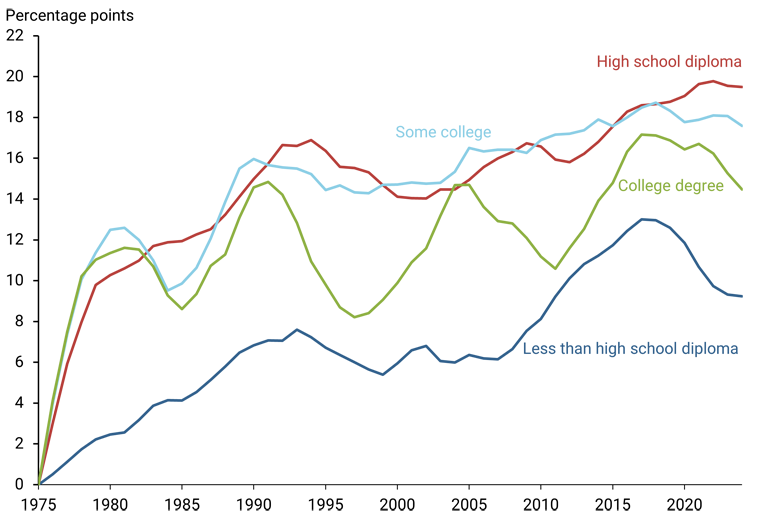
In the Hornstein-Kudlyak model, the differences in group-specific trend participation can come from two sources: changes over time in participation of new cohorts entering the labor market and changes in participation of people of the same age at different points in time. For the data sample between 1976 and 2024, they find that the new-entrant cohorts account for almost the entire decline in the group-specific LFP trends for men and almost the entire increase in the group-specific LFP trends for women.
Figure 3 summarizes the cohort story by subtracting the male participation rate from the female rate, resulting in a female-male participation gap for cohorts at age 25 within each education group. Positive values mean that, relative to the 1976 entry cohorts, the more-recent entry cohorts of women participate more than their male counterparts. The gap widens markedly for high school (red line), some college (light blue line), and college graduates (green line), showing that each new cohort entering the data sample steadily raised women’s participation rates relative to men’s across much of the education distribution. Successive male cohorts tended to participate less than earlier male cohorts, especially for lower education levels. Successive female cohorts tended to participate more than earlier female cohorts through the 1990s, with the largest gains among women with at least some college. For women entering more recently, the gains flatten, which helps explain why overall female LFP stopped rising after 2000.
Figure 3
Female entry participation gap at age 25, by education
Source: Hornstein and Kudlyak (2026) and authors’ calculations.
Hornstein and Kudlyak (2026) also find that the contribution of age effects to the group-specific LFP trends varied over time for men and women, though these effects are not shown separately in the figure. Even so, the dominant contribution to the gender gap comes from new entrant cohorts.
Looking ahead
The same framework can be used to project future LFP trends. Under the Hornstein and Kudlyak (2026) model, the best forecast of each group’s age and cohort trend is its latest estimated value. Future overall trend movement therefore comes mainly from changes in the demographic composition of the population and new-entrant cohorts.
With this caveat in mind, their model estimates a decline in trend labor force participation of about 1.6 percentage points over the next 20 years from its 2024 level of 62.3%. Aging remains the dominant source of downward pressure, as the population shifts toward lower-participation ages. Rising education is expected to continue to offset part but not all of that loss. The projected decline is driven primarily by men’s cohort effects, while women’s trend participation is projected to be comparatively stable over the forecast horizon.
Conclusion
This Letter provides evidence that long-run labor force participation trends are best understood from the bottom up. Demographic composition, especially aging and rising education, explains much of the overall changes in LFP, but it does not explain the divergence between men and women. That divergence mainly reflects persistent cohort differences, with especially weak participation growth among younger and less-educated men and stronger participation among more-educated women. As the population continues to age, those slow-moving forces are likely to keep weighing on labor force participation, even when cyclical labor market conditions are strong. This suggests that participation gaps should not be read solely as cyclical weakness that is likely to reverse quickly. Instead, some gaps may reflect slow-moving demographic and cohort forces.
References
Aaronson, Stephanie, Tomaz Cajner, Bruce Fallick, Felix Galbis-Reig, Christopher Smith, and William Wascher. 2014. “Labor Force Participation: Recent Developments and Future Prospects.” Brookings Papers on Economic Activity, Fall, pp. 197-255.
Hornstein, Andreas, and Marianna Kudlyak. 2026. “Trends in Labor Force Participation and Unemployment, 1976–2024.” FRB San Francisco Working Paper 2026-11.
Montes, Joshua. 2018. “CBO’s Projection of Labor Force Participation Rates.” Congressional Budget Office Working Paper 2018-04.
U.S. Census Bureau. 2023. “National Population Projections Tables: Main Series.” Data set.
Data
Download data for figures (Excel file, 331 KB)
Opinions expressed in FRBSF Economic Letter do not necessarily reflect the views of the management of the Federal Reserve Bank of San Francisco or of the Board of Governors of the Federal Reserve System. This publication is edited by Anita Todd and Karen Barnes. Permission to reprint portions of articles or whole articles must be obtained in writing. Please send editorial comments and requests for reprint permission to research.library@sf.frb.org