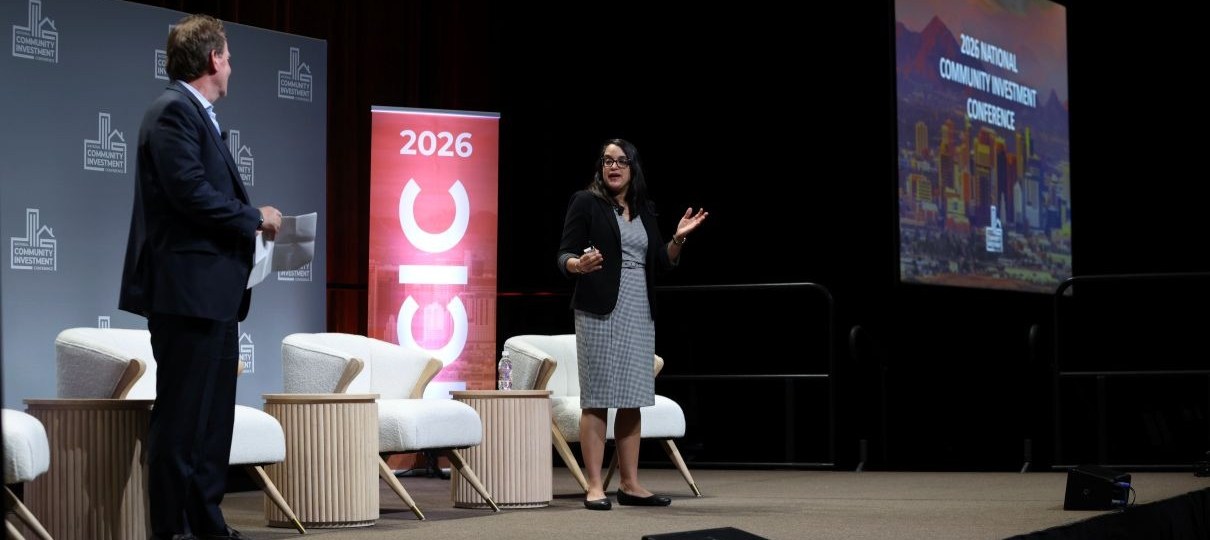
The 2026 National Community Investment Conference in Phoenix brought together community development practitioners, policymakers, banks, Community Development Financial Institutions (CDFIs), nonprofits, philanthropic organizations, and local leaders from around the country for four days of learning, connection, and creative problem-solving. This year’s theme, Innovations in Public-Private Partnerships, highlighted a range of partnership-building approaches that span different sectors and draw on different strengths—often while navigating resource constraints and challenging conditions—to advance community goals. Attendees engaged across plenaries, panels, site visits, workshops, and networking sessions, each offering a different vantage point on what’s working in the community development field today.
What We Heard: Key Themes Across the Conference
Panels and plenary sessions covered the breadth of interconnected issues facing communities, including housing affordability, workforce and small business development, rural infrastructure and capacity constraints, consumer needs, the nonprofit ecosystem, and CRA in practice. Discussions highlighted the broad range of expertise shaping community development and opportunities to engage in partnership. Key themes that emerged over the course of the conference include:
Housing Affordability: Local Leaders Getting Creative
Multiple sessions focused on the rental and homeownership needs of low- and moderate-income households and solutions to address those needs, including innovative uses of traditional subsidies, non-traditional funding models, alternative production models to boost housing supply, and pathways to expand homeownership and housing stability. Attendees also heard from the mayors of Clearfield (UT), Tempe (AZ), and Chattanooga (TN), who described how rising costs are reshaping their cities and squeezing workers and families. They discussed the role municipal leaders can play in forging partnerships to address housing needs. Approaches included zoning reforms and strategic use of publicly owned lands.
Opportunity Zones 2.0: Adding Tools to the Community Development Toolbox
Speakers reflected on lessons learned from the initial round of Opportunity Zones (OZ) investments and looked to the next round, OZ 2.0, which will include some notable changes to the tax incentive. Panelists highlighted that, when OZ 2.0 takes effect in 2027, it will be a permanent provision of the tax code, and will also come with new census tract designations, stronger incentives for rural markets, and increased transparency and reporting requirements. To make the most effective use of this new tool, panelists urged communities to lean into partnerships to align OZ investments with local community development goals.
Supporting Small Business: AI, Capital Needs, and Resilience
Rising costs and cash‑flow instability remain challenges for small businesses. Speakers outlined a range of potential responses, such as flexible philanthropic dollars, rapid micro‑grants, and responsible, transparent lending ecosystems, to support small business resilience. Panelists also highlighted AI as a potentially transformational capacity-builder for small businesses, allowing individuals to augment their current skills in new ways.
Continued Capacity Building: CRA’s Role in Supporting Community Investment
Community Reinvestment Act (CRA)-focused bankers had the opportunity to attend multiple skill-building sessions, including ones specific to asset size. Sessions focused on topics such as real-time performance tracking and earlier documentation habits—key practices highlighted as drivers of stronger results and, thus, deeper community impact.
Engagement in Motion: Site Visits, Workshops, and Networking
The program offered numerous ways to learn and connect. Site visits illustrated community partnerships in action, showcasing ways public-private partnerships in the Phoenix metro area are supporting small business development, helping to house Native populations, and strengthening relationships between local banks and community organizations. Workshops invited in-depth listening and dialogue on a range of topics from workforce development to lending in Tribal communities to the ways in which AI is impacting the community development field, and networking time gave participants the chance to strengthen relationships and spark new collaborations.
What Stood Out: Optimism Grounded in Real Work
Across sessions, conversations, and site visits, a shared sentiment emerged: optimism rooted in tangible results. Participants saw examples of creative problem-solving and innovative partnerships underway across the country and had the chance to make new connections with others working on similar issues.
The 2026 National Community Investment Conference demonstrated what’s possible when stakeholders come together to pursue public-private partnerships that advance community goals.
A forthcoming Community Investments issue will highlight additional examples and partnership lessons from the conference.
The National Community Investment Conference is sponsored by the Federal Reserve Banks of San Francisco, St. Louis, Richmond, Philadelphia, New York, Minneapolis, Kansas City, Dallas, Cleveland, Chicago, Boston, and Atlanta, Fed Communities, and the Board of Governors of the Federal Reserve System. View the 2026 conference agenda.
Related:


The views expressed here do not necessarily reflect the views of the management of the Federal Reserve Bank of San Francisco or of the Board of Governors of the Federal Reserve System.