
Prior research shows the Federal Reserve responds more aggressively to demand-driven inflation than supply-driven inflation, consistent with its balanced approach when policy goals for employment and prices conflict. While this implies that short-term interest rates are more sensitive to demand-related conditions, recent analysis shows the same holds for longer-horizon yields. Policy surprises primarily pass through to longer-horizon forward rates during demand-driven inflationary episodes. With the recent reemergence of supply-side inflationary pressures, monetary policy surprises are likely to have a smaller impact on longer-horizon yields.
The reemergence of supply-driven inflation pressures since the pandemic has prompted a deeper examination of how the underlying sources of inflation affect monetary policy. Recent evidence indicates that whether inflation is driven by supply or demand is a key determinant of the Federal Reserve’s interest rate policy decisions (Hoffman, Manea, and Mojon 2024 and Kakhbod, Kermani, and Maciel 2026). Specifically, the Fed tends to be more aggressive in responding to demand-driven than supply-driven inflationary pressures. This asymmetry in monetary policy decisions aligns with the Fed’s 2025 Statement on Longer-Run Goals and Monetary Policy Strategy, which discusses a “balanced approach” when employment and price stability goals conflict, as they tend to do in response to supply shocks.
While this evidence implies that short-term interest rates tend to be more sensitive to demand-driven inflationary pressures, it is not known if the same sensitivity holds true for longer-horizon yields. Financial markets may take into account the underlying reasons behind Fed policy changes, which itself depends on the source of inflationary pressure. In this Economic Letter, we assess whether the degree to which monetary policy surprises are transmitted to bond markets varies with the source of inflationary pressure at the time of the policy change.
To address this question, we use high-frequency data from the San Francisco Fed’s U.S. Monetary Policy Event-Study Database (USMPD), as developed in Acosta et al. (2026). This data set isolates policy “surprises”—the unexpected component of Fed announcements. Because these surprises are not already anticipated, tracking their immediate impact on forward rates—what the market expects interest rates to be in the future—provides a relatively clean measure of monetary policy transmission. We test whether the pass-through of these surprises into Treasury forward rates is associated with the underlying source of inflation, using the San Francisco Fed’s supply- and demand-driven inflation breakdown. Our analysis indicates that these surprises primarily pass through to longer-horizon forward rates during demand-driven inflationary episodes. That is, monetary policy transmission is strongest during episodes of demand-driven inflationary pressures. This also implies that because supply-side inflation pressures have increased in recent years, monetary policy shocks will likely have a more muted impact on longer-horizon yields.
The source of inflation pressure matters
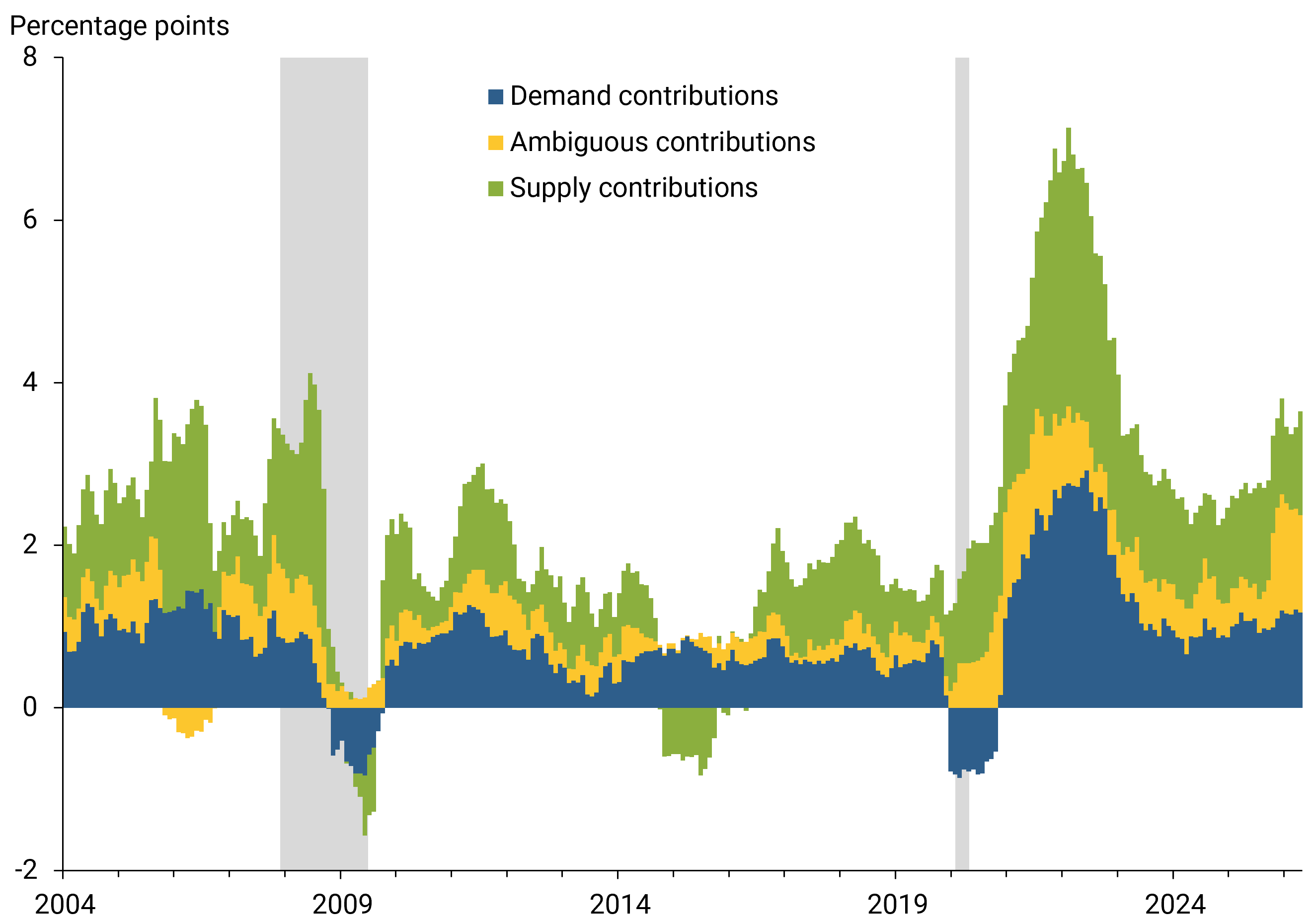
Our analysis uses the San Franscisco Fed’s Supply- and Demand-Driven PCE Inflation data series which separates personal consumption expenditures inflation into distinct components. The series is based on methodology developed in Shapiro (2026) that identifies these drivers by assessing the joint movement of price and quantity indexes within individual categories. When prices and quantities move in the same direction, the change is attributed to demand-side factors, and when they move in opposite directions, it is attributed to supply-side factors.
Figure 1 shows the contributions of these factors to headline PCE since 2004, the beginning of the sample period used in our analysis. The supply component tends to move more with food and energy prices, while the demand component fluctuates more during recessions. The series also includes an ambiguous component—instances where the methodology cannot distinguish between inflation sources.
Figure 1
Contributions to headline PCE inflation
Source: Shapiro (2026) and Supply- and Demand-Driven PCE Inflation data page.
Recent work by Hoffman et al. (2024) uses these inflation components to assess whether the Fed’s monetary policy decisions depend on the source of inflationary pressure. They find that the Fed’s response to demand-driven inflation contributions tends to be four times larger than its response to supply-driven contributions. A similar result was found by Kakhbod et al. (2026), who analyze Federal Open Market Committee (FOMC) transcripts and statements and find that the policy path is more sensitive to discussions of demand pressures than supply pressures. Both studies attribute the result to the Fed being more constrained in addressing supply-driven inflationary pressures.
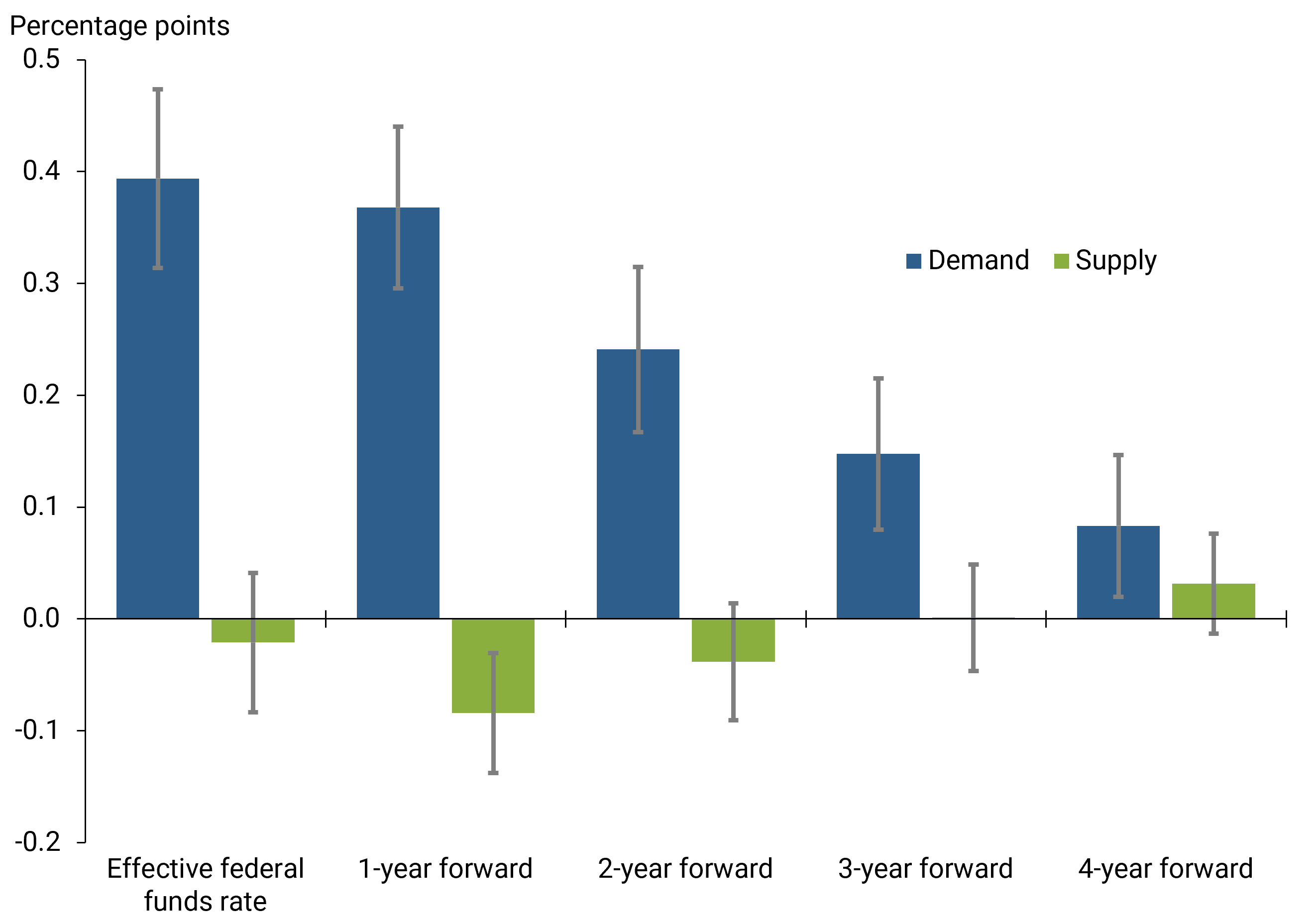
We first assess whether these findings extend to investors’ expectations for future monetary policy, as reflected in longer-term instantaneous forward rates. If investors expect the Fed to adopt a state-dependent approach—that is, a policy that responds specifically to the current source of inflationary pressures—they may price this into long-term interest rates. We thus estimate a similar specification as in Hoffman et al. (2024) but replace short-term interest rates with Treasury instantaneous forward rates—the implied interest rate for the asset at a specific date in the future.
Figure 2 illustrates this relationship across various interest rate horizons. Despite differences in methodologies, the response of the effective federal funds rate aligns with the results found in Hoffman et al. (2024)—a 1 percentage point increase in the demand-driven PCE inflation component is associated with a 0.4 percentage point increase in the federal funds rate (left-hand side blue bar), while the same increase in the supply-driven component is associated with no change in the federal funds rate (left-hand side green bar). Our findings indicate that a similar relationship holds with the forward rates, but the magnitudes decline as the horizon increases. These results suggest that financial market participants tend to anticipate a stronger, more persistent response by the Fed to demand-related inflation pressures compared with its response to supply-driven price pressures.
Figure 2
Forward rate sensitivity to inflationary pressure source
Monetary policy transmission and the inflation source
The results from using forward rates as a proxy for expected future interest rates shown in Figure 2 may not necessarily be due to anticipated future monetary policy actions. For instance, changes in longer-term rates may reflect market changes in term premiums or structural factors like changes in productivity growth.
To assess the extent to which the state-dependent interest rate sensitivities shown in Figure 2 reflect how monetary policy actions transmit to financial markets, we use data on monetary policy surprises from the San Francisco Fed’s USMPD. The series contains the high-frequency changes of short-term rates at different horizons within a 120-minute window around FOMC policy announcements. Isolating surprises is important because it removes the component of monetary policy decisions already anticipated by financial markets.
We use the surprises as measured by the unexpected changes in federal funds futures for the next FOMC meeting. We evaluate how these surprises affect longer-horizon forward rates, while allowing the size of the impact to vary with the level of the supply- and demand-driven inflation. We find that the impact of policy surprises on long-term interest rates depends strongly on the source of the inflationary pressures. Monetary policy surprises primarily feed through to longer-horizon rates when demand-driven inflation is high.
Figure 3 illustrates the economic significance of these results. The blue bars correspond to the implied pass-through of monetary policy shocks to forward rates of different horizons when the supply-driven contribution to inflation is at its historical average and the demand-driven contribution is 0.5 percentage point above its historical average; the red bars correspond to the inverse case.
Figure 3
Forward rate responses to monetary surprises
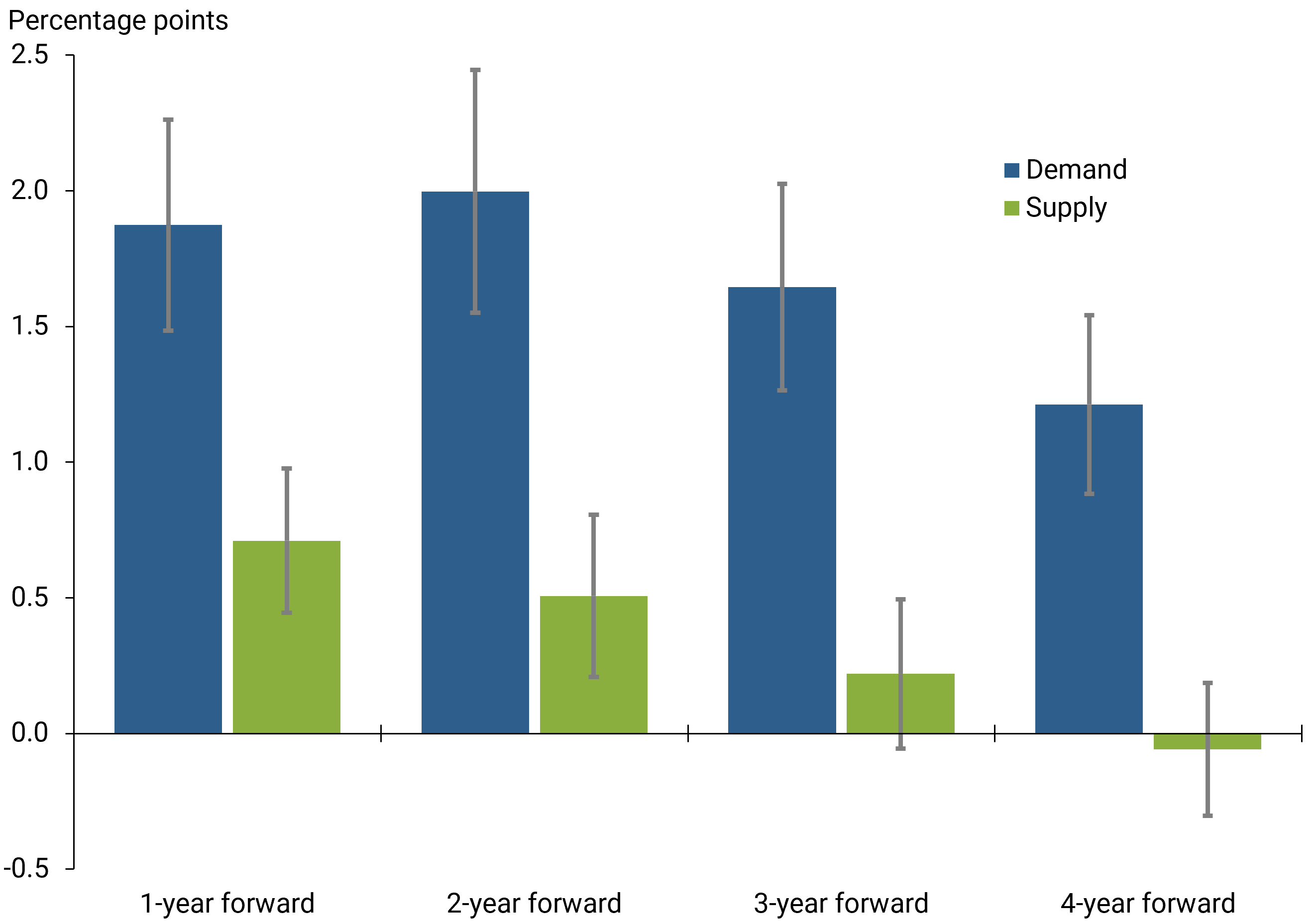
The results imply that, over the sample period of 2004–2026, a 1 percentage point shock to near-term interest rates is associated with a 2 percentage point rise in two-year nominal forward rates when demand-driven inflation is elevated, but only a 0.5 percentage point rise in two-year forward rates when supply-driven inflation is above its historical average.
Potential mechanisms
As mentioned above, previous research finds that the Fed tends to respond more to demand-driven inflationary pressures than supply-driven pressures. In Najjar and Shapiro (2026), we test two potential mechanisms that may explain why monetary policy transmission to longer-dated securities displays a similar state dependence of inflationary pressures. First, market participants might perceive demand-driven inflation episodes to be more persistent than supply-driven episodes. Transmission would appear more persistent during demand-driven inflation if demand pressures are typically expected to persist in the economy for a longer period than supply pressures. To assess this, we measured the relationship between market-based inflation expectations and the two inflation components separately. We find no clear differences in the two correlations, suggesting that markets expect both demand and supply shocks to be about equally long lasting.
Second, market participants might learn more about the Fed’s reaction function during demand-driven inflationary episodes. For instance, markets might perceive any monetary policy surprise during a demand-driven imbalance as a strong signal of a change in the policy stance, but they might instead consider it a one-off during a supply-driven imbalance. To test this mechanism, we use a data series constructed by Bauer, Pflueger, and Sunderam (2024) that tracks how professional forecasters perceive the Fed will react to inflation pressure. Specifically, the series measures how many percentage points forecasters expect the Fed to raise interest rates for every 1 percentage point increase in inflation.
Our findings show that forecasters on average do not change their perception during supply-driven imbalances, but they revise this perception toward a more aggressive response to inflation during demand-driven imbalances. This suggests that a monetary policy surprise during demand imbalances serves as a signal that the Fed is shifting to a persistently stricter monetary policy stance.
Conclusion
This Economic Letter assesses whether the strength of monetary policy transmission to bond markets depends on the source of inflationary pressure, measuring the degree to which policy surprises pass through to Treasury forward rates. Our findings indicate that transmission is strongest during demand-driven inflationary episodes, suggesting financial market participants anticipate more persistent policy responses to demand-side inflationary pressures. Our results highlight that market participants recognize that the Fed tends to take a more aggressive approach in countering demand-driven inflationary pressure but follows a more balanced approach during supply-driven inflationary episodes.
References
Acosta, Miguel, Andrea Ajello, Michael D Bauer, Francesca Loria, and Silvia Miranda-Agrippino. 2026. “Financial Market Effects of FOMC Communication: Evidence from a New Event-Study Database.” Federal Reserve Bank of San Francisco Working Paper 2025-30, revised August 2026.
Bauer, Michael, Carolin Pflueger, and Adi Sunderam. 2024. “Perceptions About Monetary Policy.” Quarterly Journal of Economics 139(4, November), pp. 2,227–2,278.
Hofmann, Boris, Cristina Manea, and Benoit Mojon. 2024. “Targeted Taylor Rules: Some Evidence and Theory.” BIS Working Paper 1234 (December).
Kakhbod, Ali, Amir Kermani, and Bernardo Maciel. 2026. “In the Fed’s Mind.” NBER Working Paper 35106.
Najjar, Rami, and Adam H. Shapiro. 2026. “Not All Inflation Is the Same: State-Dependent Transmission of Monetary Policy.” Federal Reserve Bank of San Francisco Working Paper 2025-28, revised June 2026.
Shapiro, Adam H. 2026. “Decomposing Supply- and Demand-Driven Inflation.” Journal of Money, Credit and Banking 58(2, March), pp. 365–388.
Data
Download data for figures (Excel 157 kb)
Opinions expressed in FRBSF Economic Letter do not necessarily reflect the views of the management of the Federal Reserve Bank of San Francisco or of the Board of Governors of the Federal Reserve System. This publication is edited by Anita Todd and Karen Barnes. Permission to reprint portions of articles or whole articles must be obtained in writing. Please send editorial comments and requests for reprint permission to research.library@sf.frb.org