

Business leader surveys can be an important and reliable source for insights into future labor market conditions, particularly for expected wage growth. Survey responses from financial executives regarding their expectations for wages at their firms have closely tracked subsequent actual U.S. nominal wage growth since 2002, outperforming household survey projections in their accuracy. Estimates for this year point to continued nominal wage growth in 2026. Respondents also expect employment growth to moderate, though their projections reflect uncertainty regarding potential gains in workers’ purchasing power.
Expected wage growth plays a central role in the economic outlook. When businesses anticipate faster wage growth, they expect higher future costs, which can add to inflation pressures. At the same time, wage gains boost workers’ purchasing power when they outpace prices. Thus, how fast wages grow matters for workers, firms, and the inflation outlook (Almuzara, Audoly, and Melcangi 2026).
However, expected wage growth is difficult to measure. The most widely followed source for projected wages is household surveys that ask how much respondents expect their earnings or family income to grow. Recent research by Salter and Villar (2026) finds that these survey projections perform poorly when compared with actual wage growth: Despite large swings in realized wage and price growth, household earnings growth expectations barely moved.
In this Economic Letter, we introduce a new measure of expected wage growth from the CFO Survey. Unlike household surveys, which ask workers about their own expected earnings, the CFO Survey asks senior financial executives how much they expect average wages and employment at their firms to change. Their responses provide employer perspectives that are grounded in firms’ financial planning. We find that overall wage expectations from the CFO Survey have tracked subsequent U.S. wage growth closely since 2002 and have smaller forecast errors than household expectations. We also find firm’s employment expectations align with subsequent growth in private payrolls.
The survey
The CFO Survey is conducted quarterly by Duke University’s Fuqua School of Business and the Federal Reserve Banks of Richmond and Atlanta (Graham et al. 2020). It covers firms of different sizes across all major industries. Respondents include senior financial decisionmakers at these firms, with approximately 530 survey respondents in the second quarter of 2026.
We use responses to survey questions about nominal wages and employment. The current survey asks how much firms expect their average wages and number of full-time employees to change in the current and following calendar years. The wording of the wage question has changed over time but remains closely related.
We construct an annual series starting in 2001, using the expectations for a specific year as reported in the fourth quarter of the preceding year. Throughout, we rely on published aggregates, which account for the size of the business by weighting each firm’s wage and employment expectations by the number of its employees.
Wage growth expectations
We compare the CFO wage growth expectations series with realized nominal wage growth, taken from the Atlanta Fed’s Wage Growth Tracker. The Tracker is constructed from the monthly Current Population Survey, in which households are interviewed for four consecutive months, rotated out for eight months, and then interviewed for four more months. Wages are recorded in the final month of each four-month interview period, which allows the researcher to observe the same individual’s wages 12 months apart. Following research by Daly, Hobijn, and Wiles (2012), the Tracker reports the median 12-month percentage change among these workers. Because it follows individuals over time, the Tracker is less affected by changes in the composition of employment than other measures that compare different groups of workers from one year to the next.
Figure 1 compares yearly realized wage growth (dashed green line) with CFO average wage growth expectations (solid blue line), measured in the fourth quarter of the preceding year. For example, data for 2002 reflect median wage growth measured from December 2001 to December 2002 and CFO expectations reported in the fourth quarter of 2001. The distance between the two lines represents how close aggregated expectations are to realized wage growth. If CFO wage growth expectations had perfectly forecasted wage growth, the two lines would be indistinguishable.
Figure 1
CFO wage growth expectations and realized growth
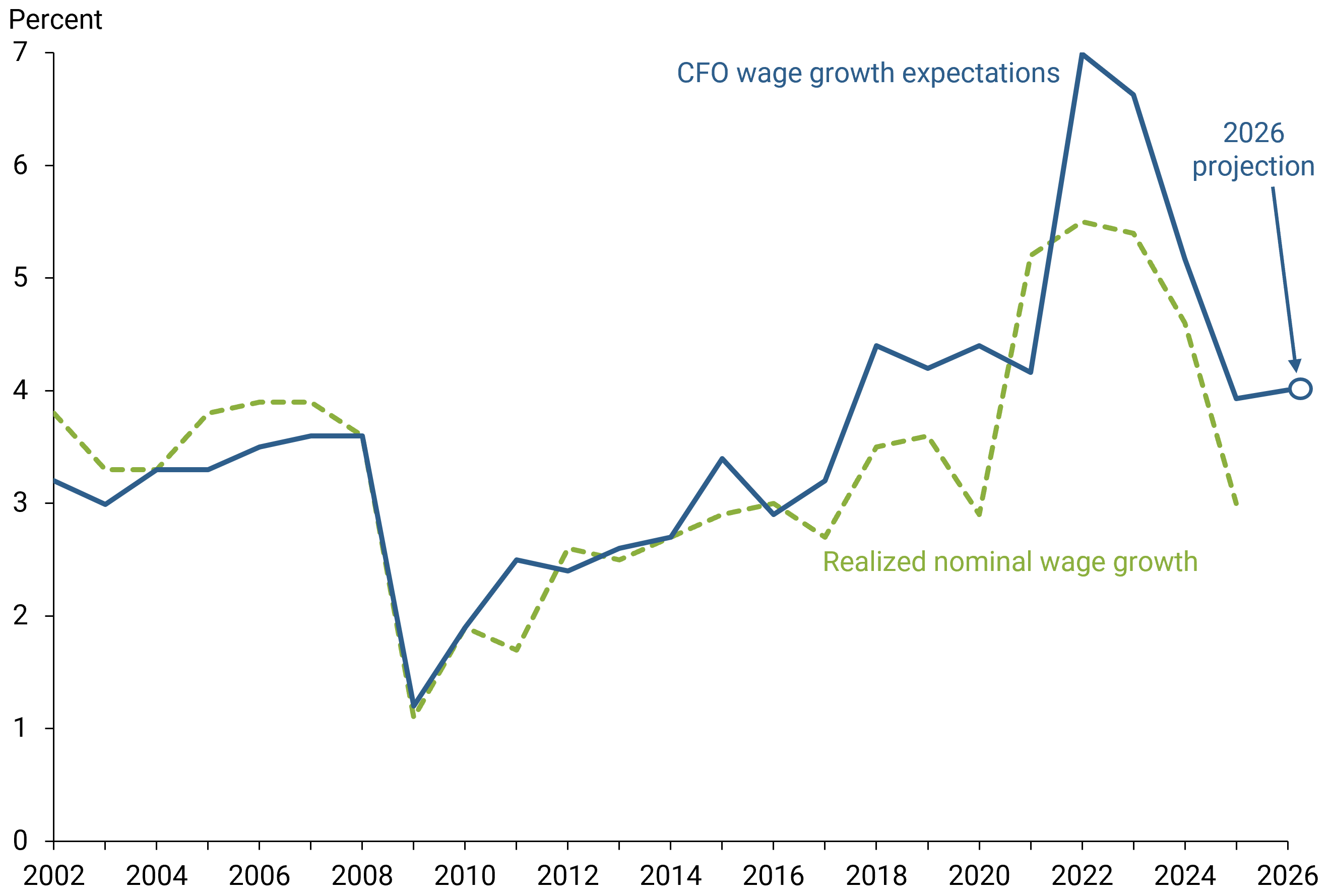
The figure shows that CFO average wage growth expectations track realized wage growth particularly closely before the pandemic. From 2002 through 2019, both measures averaged about 3%. From 2020 through 2025, realized wage growth averaged 4.4%, compared with CFO expectations of 5.2%.
The heightened uncertainty during the pandemic produced the largest gaps between expected and realized wage growth. CFOs did not predict the decline in wage growth at the onset of the pandemic and then overpredicted wage growth during the subsequent high inflation years. CFO expectations and realized wage growth have cooled substantially since 2022.
CFO wage growth expectations for 2026 equal 4%, well below their peak of 7.0% for 2022. Realized wage growth fell from its peak of 5.5% in 2022 to 3.0% in 2025. Overall, the close fit we find between CFO wage growth expectations and realized wage growth does not depend on how we measure realized wage growth. The results are similar if we instead use the employment cost index to measure realized wage growth.
Evaluating forecast accuracy
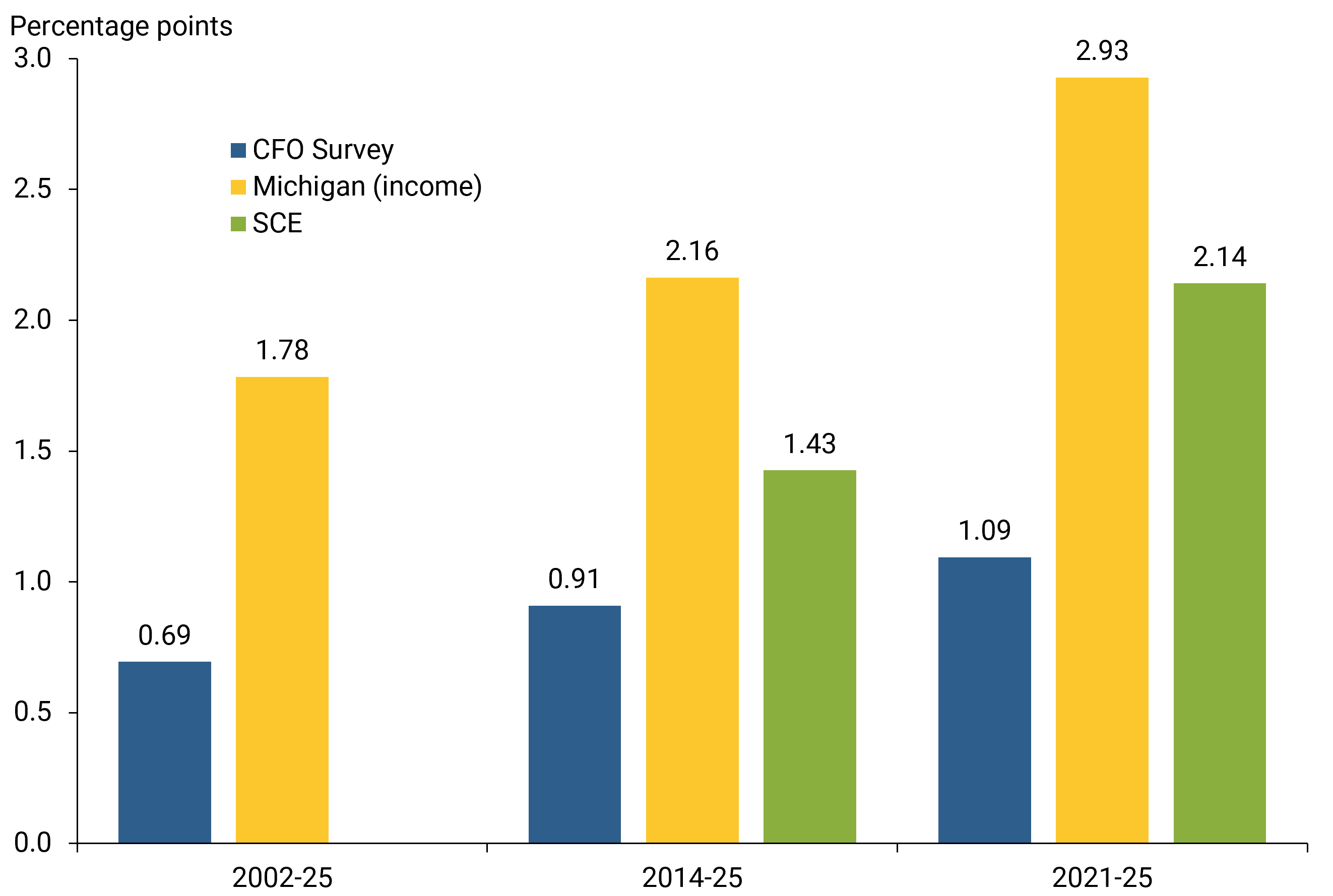
A common way to evaluate forecast performance is the root mean-squared forecast error. For each year, we compute the gap between expected and realized wage growth; we square these gaps, average them across years, and take the square root. A smaller forecast error means that expectations were generally closer to subsequent wage growth. From 2002 through 2025, CFO wage growth expectations had a forecast error of 0.69 percentage point.
We compare the CFO Survey wage growth expectations with two household surveys, the New York Fed’s Survey of Consumer Expectations (SCE) and the University of Michigan Surveys of Consumers. The SCE asks employed respondents how much they expect their earnings in their current job to change. The Michigan survey asks households how much they expect their family income to change. Neither question maps exactly to wage growth because earnings may include hours and bonuses, while family income includes other income sources. The CFO measure using average wages at firms also differs from the Atlanta Fed’s Tracker, which measures the median wage change among individual workers.
Figure 2 reports the forecast errors across three periods, reflecting the availability of each survey. We calculate the forecast errors from the raw survey expectations without adjusting them for persistent differences from realized wage growth. The first group covers the full 2002–25 CFO sample over which the Michigan survey is also available. The second group begins in 2014, when the SCE becomes available. The third group covers the post-pandemic years. CFO expectations remain the most accurate across the three periods. Our results suggest that CFO expectations provide a useful signal of near-term wage growth.
Figure 2
Forecast errors for selected wage expectations surveys
Source: CFO Survey; Federal Reserve Banks of Atlanta and New York; University of Michigan Surveys of Consumers; and authors’ calculations.
While these comparisons evaluate how well CFO expectations anticipate wage growth, they should not be interpreted as forecasts of price inflation. Research finds that the connection between wages and prices also depends on productivity growth, profit margins, and broader economic conditions (Bidder 2015).
Implications for workers’ purchasing power
How the recent declines in wage growth affect workers’ purchasing power depends on price inflation. If wages were growing slower than prices, then real wage growth, that is, adjusted for inflation, would be negative and workers would lose purchasing power. We measure real wage growth as nominal wage growth from the Tracker minus headline personal consumption expenditures (PCE) price inflation, measured as the 12-month December-to-December change in the PCE price index.
Figure 3 shows that real wage growth fell short of inflation by 0.9 percentage point in 2021 and approximately matched inflation in 2022. Wage growth then rose to 2.6 percentage points in 2023 and 1.9 percentage points in 2024. By 2025, it had fallen to 0.1 percentage point, indicating little improvement in workers’ purchasing power during that year.
Figure 3
Real wage growth
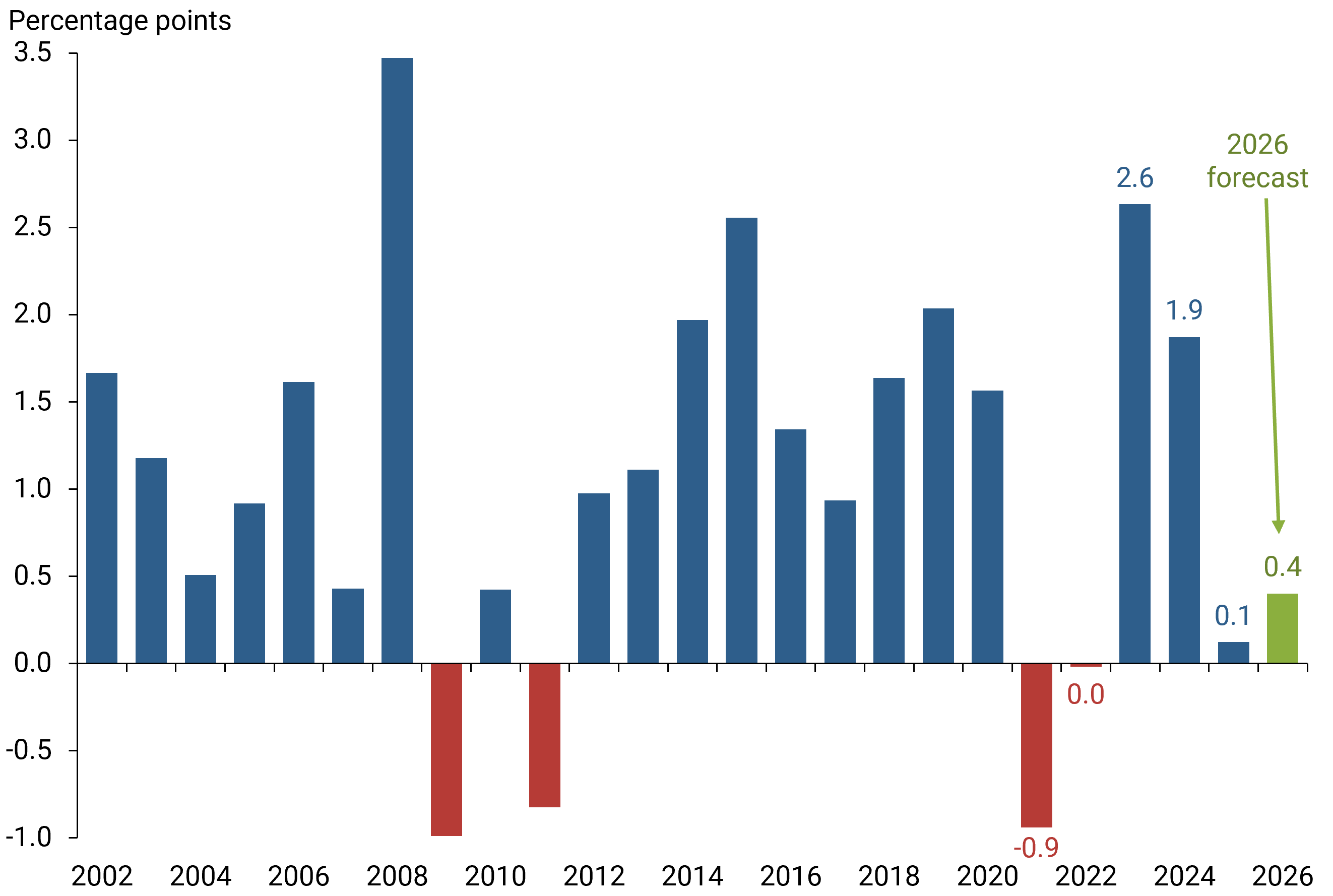
For 2026, we forecast real wage growth of 0.4 percentage point, based on CFO wage expectations of 4% and subtracting 3.6% expected headline PCE inflation from the Survey of Professional Forecasters. If the historical patterns between CFO wage growth expectations and realized wage growth persist, our findings suggest that 2026 could yield weak gains in workers’ purchasing power, at best.
CFO expectations for employment growth
CFO expectations also provide a view of labor demand. Figure 4 compares expected growth in full-time employment from the CFO Survey (blue line), with two measures of realized employment growth. The gold line shows growth in the number of people who usually work full time, based on the Current Population Survey. The green line shows growth in total private nonfarm payrolls, based on the Current Employment Statistics survey. All three measures are expressed as 12-month percentage changes. Total private nonfarm payrolls include both full-time and part-time workers.
Figure 4
Employment growth expectations and payroll growth
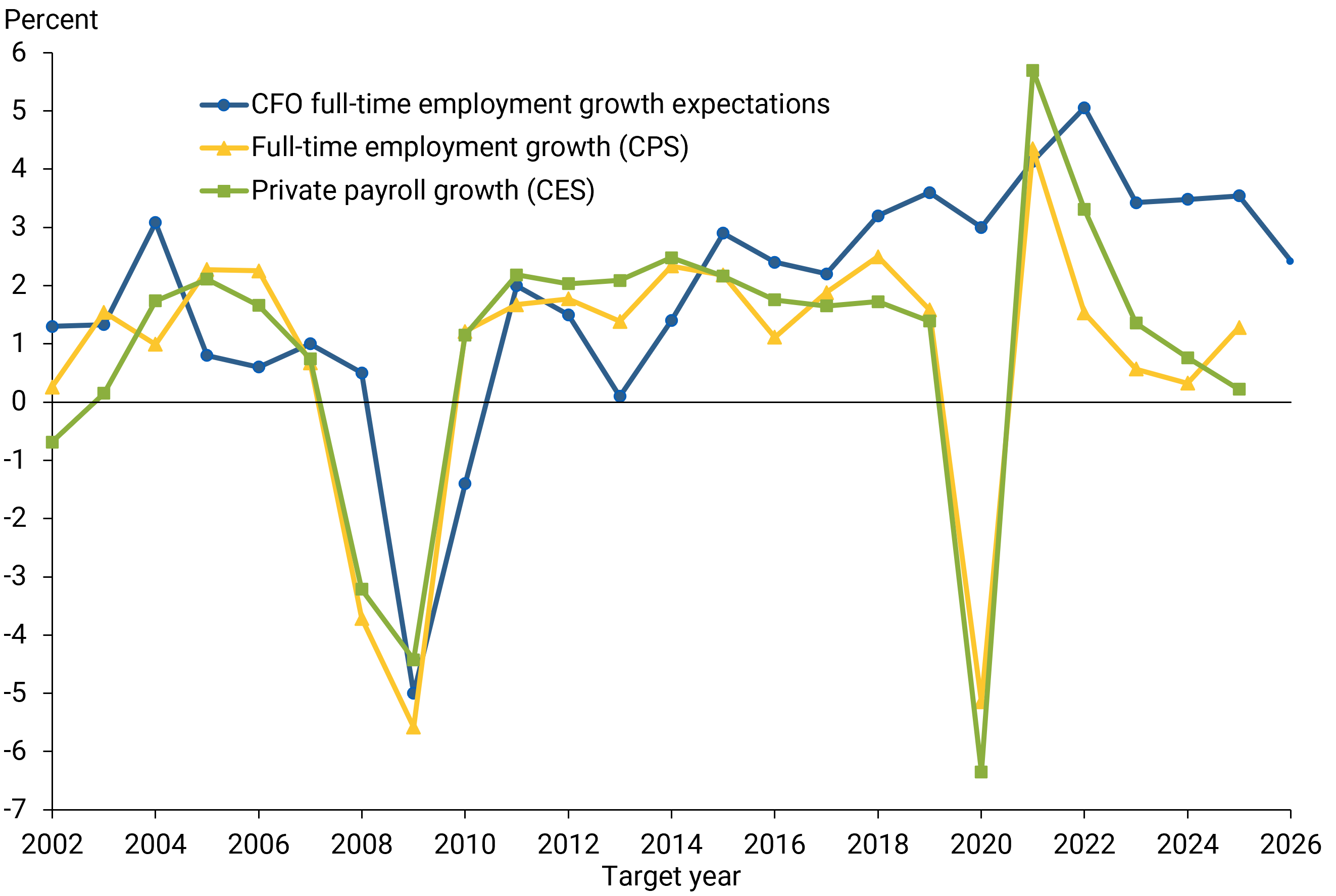
Before the pandemic, CFO employment growth expectations generally moved closely with both measures of realized employment growth. For example, CFO expectations in 2009 pointed to a 5.0% employment decline, similar to the realized decline of 5.6% in full-time employment and 4.4% in private payrolls.
Beginning in 2020, the correlation became weaker. CFOs expected employment growth of 3.0% in 2020, but full-time employment fell 5.1% and private payrolls fell 6.4%. CFO expectations for 2020 were reported in the fourth quarter of 2019, before the pandemic was widely anticipated. Since 2022, CFO employment growth expectations have consistently exceeded both measures of realized employment growth. From 2022 through 2025, CFOs expected growth of 3.9%, compared with average growth of 0.9% in full-time employment and 1.4% in private payrolls. These patterns echo our results for wage growth, where recent expectations were above outcomes.
In the survey for the fourth quarter of 2025, CFOs expected full-time employment growth to be 2.4% for 2026. That is below their expectations of about 3.5% reported for 2024 and 2025, although it remains above the 2002–25 average CFO expectations of 1.8%. The latest results point to continued expansion among surveyed firms but at a more moderate pace, nevertheless suggesting that the labor market is roughly balanced.
Conclusion
Expectations reported by employers offer a useful perspective on where wage and employment growth may be headed, combined with other indicators, as in Heise, Pearce, and Weber (2024). The most recent readings present a mixed outlook: Firms expect continued wage growth, while their employment expectations point to a roughly balanced labor market. At the same time, the narrowing gap between wage growth and inflation means that gains in purchasing power for workers look uncertain.
References
Almuzara, Martín, Richard Audoly, and Davide Melcangi. 2026. “Assessing the Current State of Wage Inflation.” Liberty Street Economics, FRB New York, May 26.
Bidder, Rhys. 2015. “Are Wages Useful in Forecasting Price Inflation?” FRBSF Economic Letter 2015-33 (November 2).
Daly, Mary C., Bart Hobijn, and Theodore S. Wiles. 2012. “Dissecting Aggregate Real Wage Fluctuations: Individual Wage Growth and the Composition Effect.” FRB San Francisco Working Paper 2011-23.
Graham, John, Brent Meyer, Nicholas Parker, and Sonya Ravindranath Waddell. 2020. “Introducing The CFO Survey.” FRB Richmond, May 15.
Heise, Sebastian, Jeremy Pearce, and Jacob P. Weber. 2024. “A New Indicator of Labor Market Tightness for Predicting Wage Inflation.” Liberty Street Economics, FRB New York, October 9.
Salter, Corinne, and Daniel Villar. 2026. “Wage and Income Growth Expectations Before, During, and After the Pandemic Period.” FEDS Notes, Board of Governors of the Federal Reserve System, April 13.
Data
Download data for figures (Excel, 188 kb)
Opinions expressed in FRBSF Economic Letter do not necessarily reflect the views of the management of the Federal Reserve Bank of San Francisco or of the Board of Governors of the Federal Reserve System. This publication is edited by Anita Todd and Karen Barnes. Permission to reprint portions of articles or whole articles must be obtained in writing. Please send editorial comments and requests for reprint permission to research.library@sf.frb.org