

Sylvain Leduc, executive vice president and director of research at the Federal Reserve Bank of San Francisco, shared views on the current economy and the outlook from the Economic Research Department as of October 15, 2026.
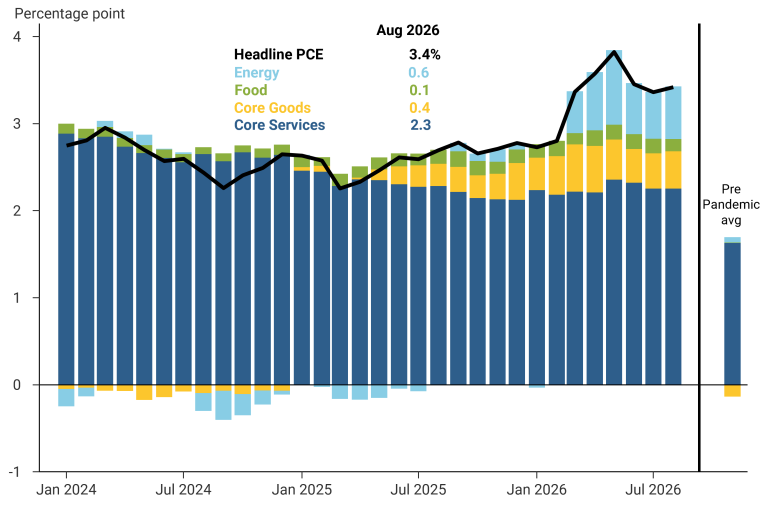
The artificial intelligence (AI) infrastructure buildout continues to boost economic growth. The surge in AI-related investment over the past year has exceeded growth rates observed during the tech boom of the late 1990s. In particular, imports of AI information processing equipment have risen significantly in recent years. These developments together have pushed up prices for consumer electronics, such as laptops and cell phones, reversing decades-long deflationary trends. Still, the current gap between 12-month inflation readings and the Federal Reserve’s 2% inflation goal mostly reflects elevated contributions from energy and core goods categories linked to the Middle East conflict and higher tariff rates. As the impact of these shocks dissipates, we expect inflation to gradually decline to 2% over the next two years. Solid economic growth is expected to keep unemployment close to its longer-run natural rate. Due to the high level of uncertainty surrounding the outcome of the Middle East conflict, we consider an alternative scenario in which the conflict continues for longer than expected, leading to a higher inflation path relative to our baseline outlook.
AI buildout is boosting growth, with limited labor market impact so far
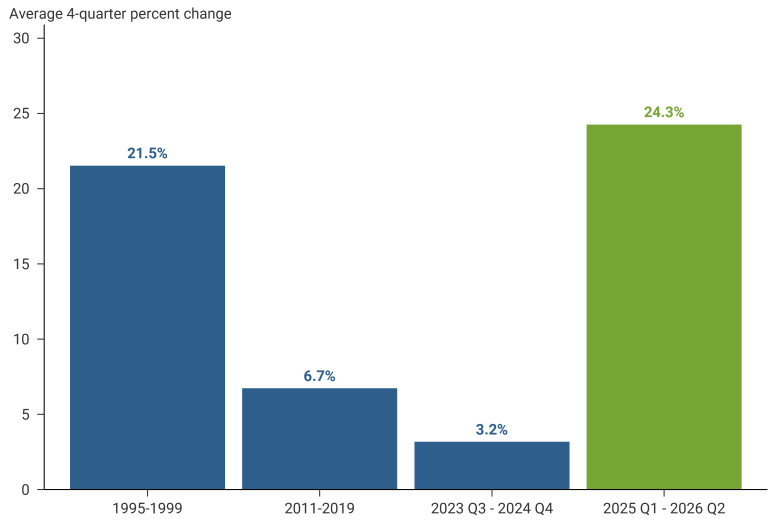
The AI buildout is triggering strong demand by firms for information processing equipment, such as memory and computing chips, resulting in major business investment. Since the start of 2025, investment in information processing equipment has grown at an average annualized rate of more than 20%, notably higher than the years following the Great Recession of the late 2000s and exceeding the growth rates observed during the internet and computer boom of the late 1990s.
Strong AI-induced equipment investment
Real investment in information processing equipment
Source: Bureau of Economic Analysis.
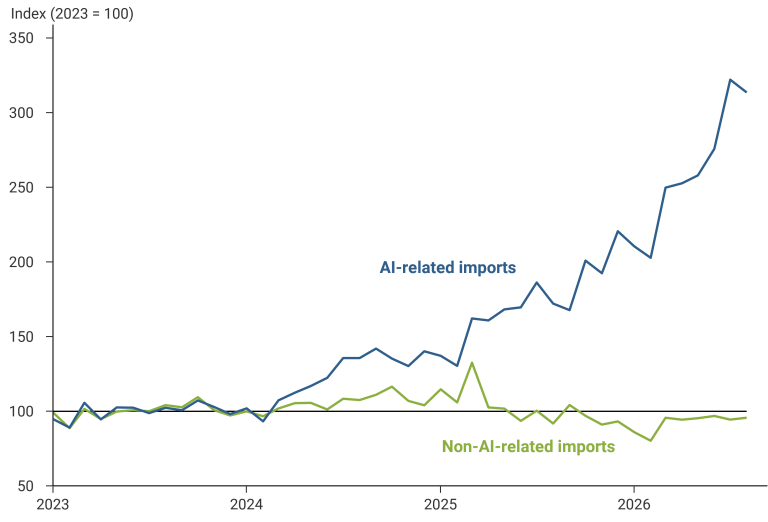
An important part of the demand for information processing equipment is being met by foreign production. Calculations by economists at the Federal Reserve Bank of Minneapolis highlight strong growth in AI-related imports since the start of 2024, which contrasts with the nearly flat movements in imports unrelated to AI.
AI-related imports rising rapidly
U.S. imports of AI-related vs. non-AI-related products
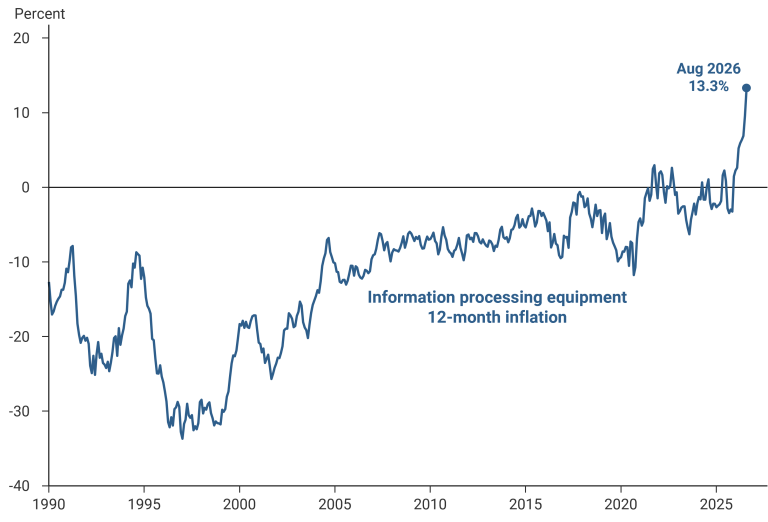
The strong demand is pushing up associated prices for consumer technology products. The 12-month inflation rate for information processing equipment reported by the Bureau of Economic Analysis (BEA) reached 13% in August, the highest reading for this category since the BEA began tracking it in the 1960s. This striking development highlights the magnitude of the AI buildout and the pressure it is putting on consumer technology prices in general.
Tech prices now experiencing inflation
12-month PCE inflation: information processing equipment
Source: Bureau of Economic Analysis.
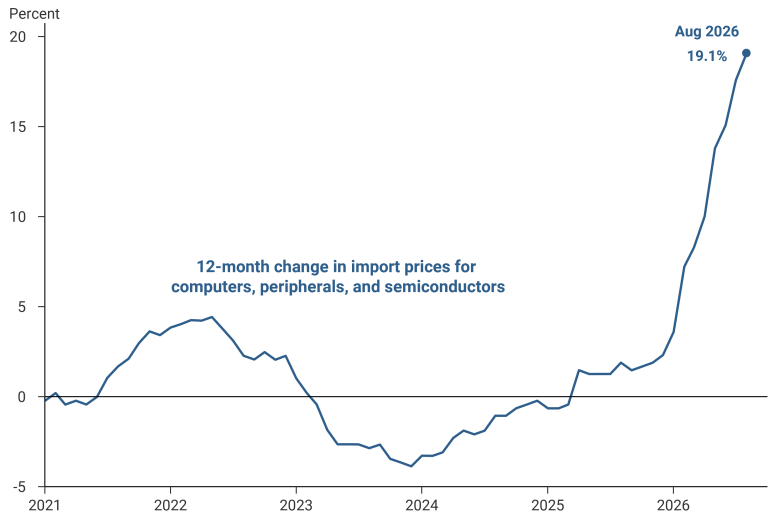
For decades, 12-month price inflation for information processing equipment had been negative or close to zero, up until last year. Similarly, the 12-month inflation rate for AI-related imports has also surged, approaching 20% in August. Incoming data do not suggest that these AI-related price pressures have spilled over to other sectors or product categories, suggesting that the impact on overall inflation has been limited thus far.
Import prices of tech equipment surging
Growth in import prices for computers, peripherals, and semiconductors
Source: Bureau of Labor Statistics.
Labor market conditions are broadly balanced
In contrast to its impact on technology prices, the AI buildout has had limited impact on the aggregate labor market. Over the past year, the unemployment rate has remained close to our estimate of the longer-run natural rate of unemployment. This outcome reflects a balance between the demand for labor from firms and the supply of labor from available workers. But some segments of the labor market do appear to have been affected by AI. For example, among positions that require at least some college education, firms’ demand for entry-level jobs has declined notably over the past three years, in contrast to the steady demand for intermediate and senior jobs. This pattern is consistent with findings in the academic literature.
Unemployment levels remain steady
Unemployment rate
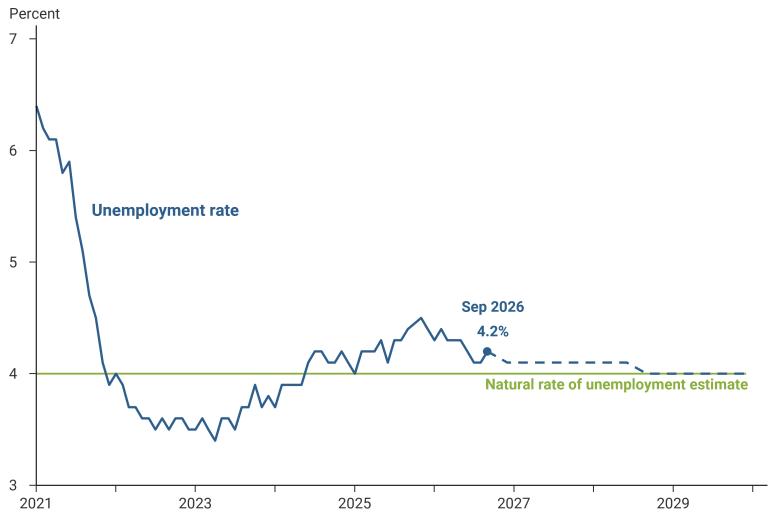
Source: Bureau of Labor Statistics and FRBSF staff.
Openings and seekers have converged
Job openings and number of people actively looking for work
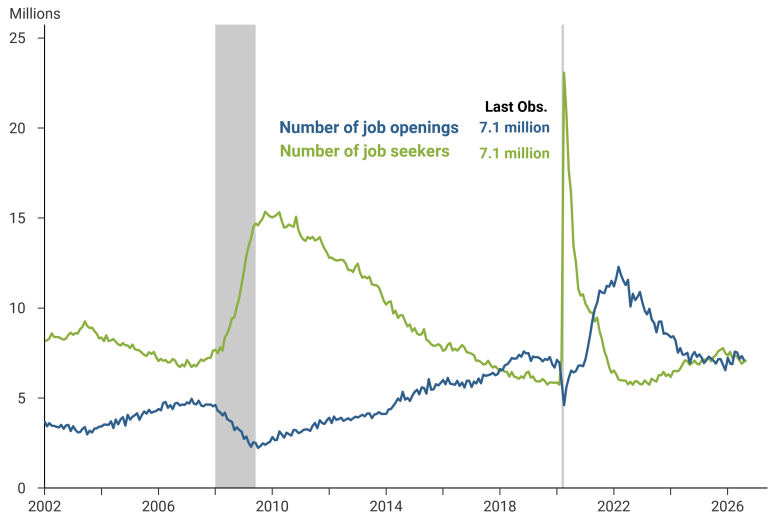
Source: Bureau of Labor Statistics.
Post-2023 fall in entry-level job postings
Degree-requiring job postings, all sectors
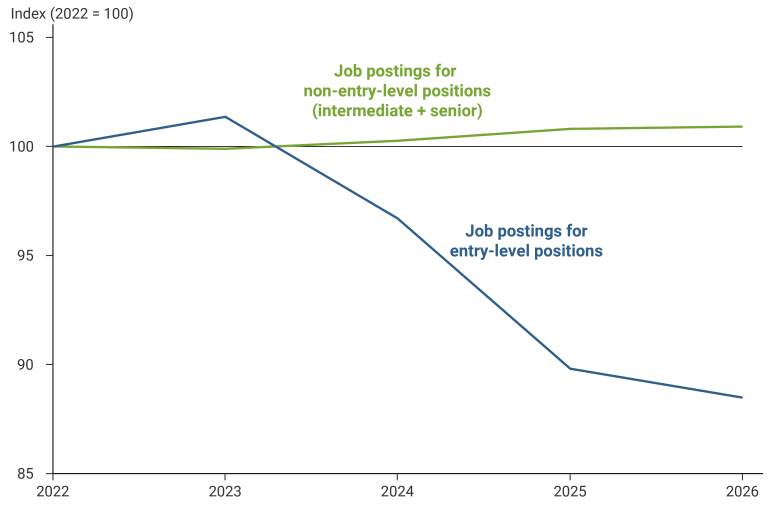
Source: Lightcast.
Elevated inflation in energy and core goods categories
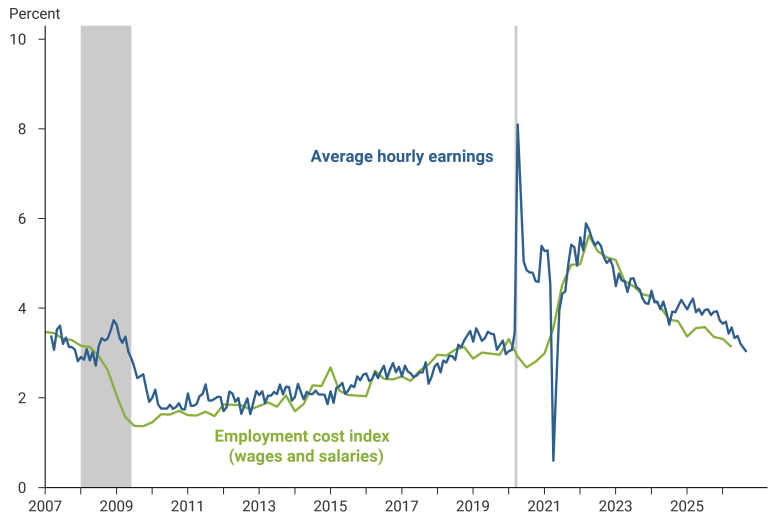
The Personal Consumption Expenditures (PCE) price index rose 3.4% in August from a year earlier and thus remains substantially above the Fed’s 2% inflation goal. The direct contribution from information processing equipment has been small, at only 0.2 percentage points. Instead, elevated PCE inflation is mostly due to rising prices in the energy and core goods categories linked to the Middle East conflict and higher U.S. tariff rates. Adding to these developments, core services inflation has persisted over the past two years, despite moderating labor costs.
Tech prices pushing inflation up a bit
Contributions to PCE inflation: information processing equipment
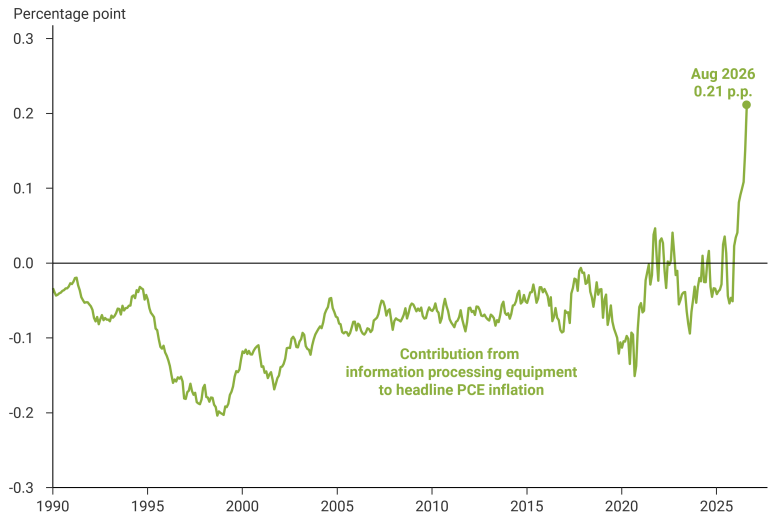
Source: Bureau of Economic Analysis and FRBSF staff calculations.
Goods and energy prices boosting inflation
Contributions to 12-month headline PCE inflation
Nominal wage growth moderating
Wage growth
Source: Bureau of Labor Statistics.
Our forecast projects inflation to resume its decline over the next two years as the Middle East conflict resolves and the impact of higher tariff rates dissipates. However, we do not expect inflation to reach 2% until the end of 2028, owing in part to the stickiness of services inflation. Due to the high level of uncertainty surrounding the outcome of the Middle East conflict, we consider an alternative scenario in which the conflict continues, leading to a higher inflation path relative to our baseline outlook.
Upside risks to the inflation outlook
Headline PCE inflation, annual change

Source: Bureau of Economic Analysis and FRBSF staff.
Policymakers face uncertainty from AI
The supply- and demand-side effects of AI on the economy is another source of uncertainty. On the supply side, as more firms adopt AI and use it to boost efficiency, we would expect productivity gains to lower costs and prices, contributing to lower inflation. On the demand side, the AI buildout is already pushing up prices for technology equipment, and its impact on overall inflation may grow. Another demand channel is the impact of AI on stock market wealth, which influences personal consumption expenditures and business investment. The appropriate path for monetary policy takes into account the net impact of these demand and supply forces on inflation.
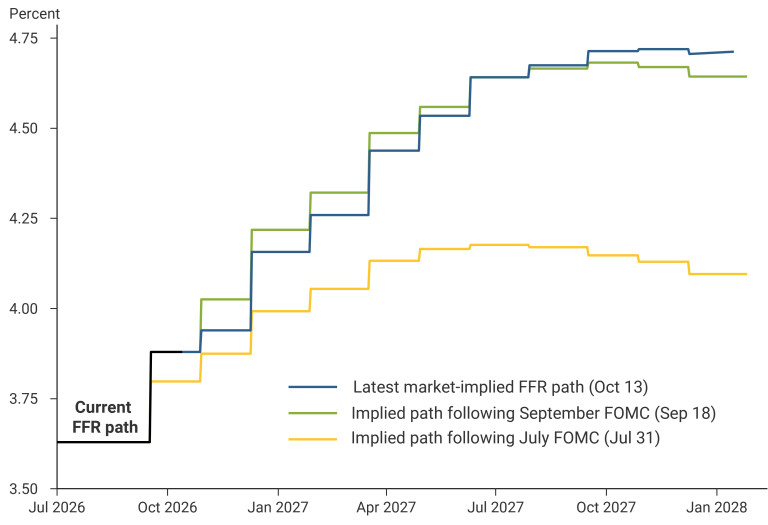
In this context, financial market participants expect one more 25-basis-points increase in the federal funds rate this year and additional hikes in 2027. This expected path for the federal funds rate in 2026 is slightly lower than that following the September Federal Open Market Committee (FOMC) meeting, but higher than those following the July FOMC meeting. Current market forecasts are somewhat higher than the median rate path contained in the FOMC’s Summary of Economic Projections for September, which had no additional interest rate hikes next year.
Markets expect increases in the policy rate
Market-implied federal funds rate path
Source: CME Group, Bloomberg, and FRBSF staff calculations.
Charts were produced by Jacob D. Herbold.
The views expressed are those of the author with input from the Federal Reserve Bank of San Francisco forecasting staff. They are not intended to represent the views of others within the Bank or the Federal Reserve System. This publication is edited by Kevin J. Lansing, Karen Barnes, and Hamza Abdelrahman. SF FedViews appears eight times a year. Please send editorial comments to Research Library.