

Commercial banks have led the adoption of artificial intelligence (AI) in recent years. Evidence suggests that banks using AI more intensively tend to have higher returns on assets and higher shares of problem loans. Increased AI usage is also associated with declines in the shares of small business lending. This pattern suggests that AI helps banks in processing hard data, such as credit scores and financial statements, and issuing fewer small business loans that rely more on soft information, such as personal and business relationships.
Banks use artificial intelligence (AI) for credit analysis, fraud detection, and other applications (see, for example, Ahmadi 2022). AI usage has also been associated with increased lending volume and cost savings for banks. However, the pace of AI adoption has differed by bank size. Small and medium-sized banks face greater hurdles in adopting AI than large banks (see, for example, Manoharan 2024). Those hurdles include constraints for financing AI investment, challenges in attracting AI-capable workers, limited access to necessary data, and reliance on older computing systems that are ill-suited for AI applications.
This Economic Letter examines how AI adoption might affect bank lending. By enhancing how banks gather and process information, AI can increase lending efficiency and ease the management of complex loans, such as those with more intricate borrower characteristics. This could encourage banks to take more risks in lending, which would require higher risk compensation. As a result, increased AI adoption should be associated with higher average returns on assets (ROA). However, the impact on more complex loans is unclear in advance. AI could help improve credit evaluations, enhancing banks’ ability to manage riskier loans and therefore reducing the shares of problem loans that later have high delinquency rates. However, we cannot make causal claims here, as banks with greater shares of complex loans in their portfolios would also have more incentives to invest in AI technology to enhance their skills at managing riskier loans.
Studies suggest that AI and other information technologies primarily help with gathering hard information, such as credit scores, financial statements, and formal credit histories (see, for example, Jakšič and Marinč 2019 and Fasano and Cappa 2022). Large banks tend to have more access to hard data sources and so may be more inclined to adopt AI to process that data. However, bank lending to small and medium enterprises (SMEs) relies more heavily on soft information, such as borrower relationships and knowledge of local economic conditions. Because soft information is harder to process using currently available AI tools, AI adoption might tilt bank lending away from SMEs.
AI adoption in the banking sector
We use bank-level regulatory filings data from the Call Report of the Federal Financial Institutions Examination Council (FFIEC). We follow the convention of the Call Report and define small banks as those with assets below $10 billion, large banks as those with assets exceeding $100 billion, and medium-sized banks as those with assets between these values. We also adopt the Call Report definition of SME loans, which include those under $1 million for small business loans and under $500,000 for farm loans.
Since bank-level AI adoption information is not publicly available, we construct a proxy for the intensity of a bank’s AI usage based on online job postings data from Lightcast. Banks that post higher shares of jobs that require AI-related skills are likely using AI more intensively. We identify AI-related job postings using textual analysis. In particular, we search for keywords related to traditional AI skills according to a list proposed by Acemoglu et al. (2022) or generative AI (GenAI) skills based on keywords generated from a large language model. Our resulting matched sample has 1,006 banks representing over 87% of total assets in the banking system.
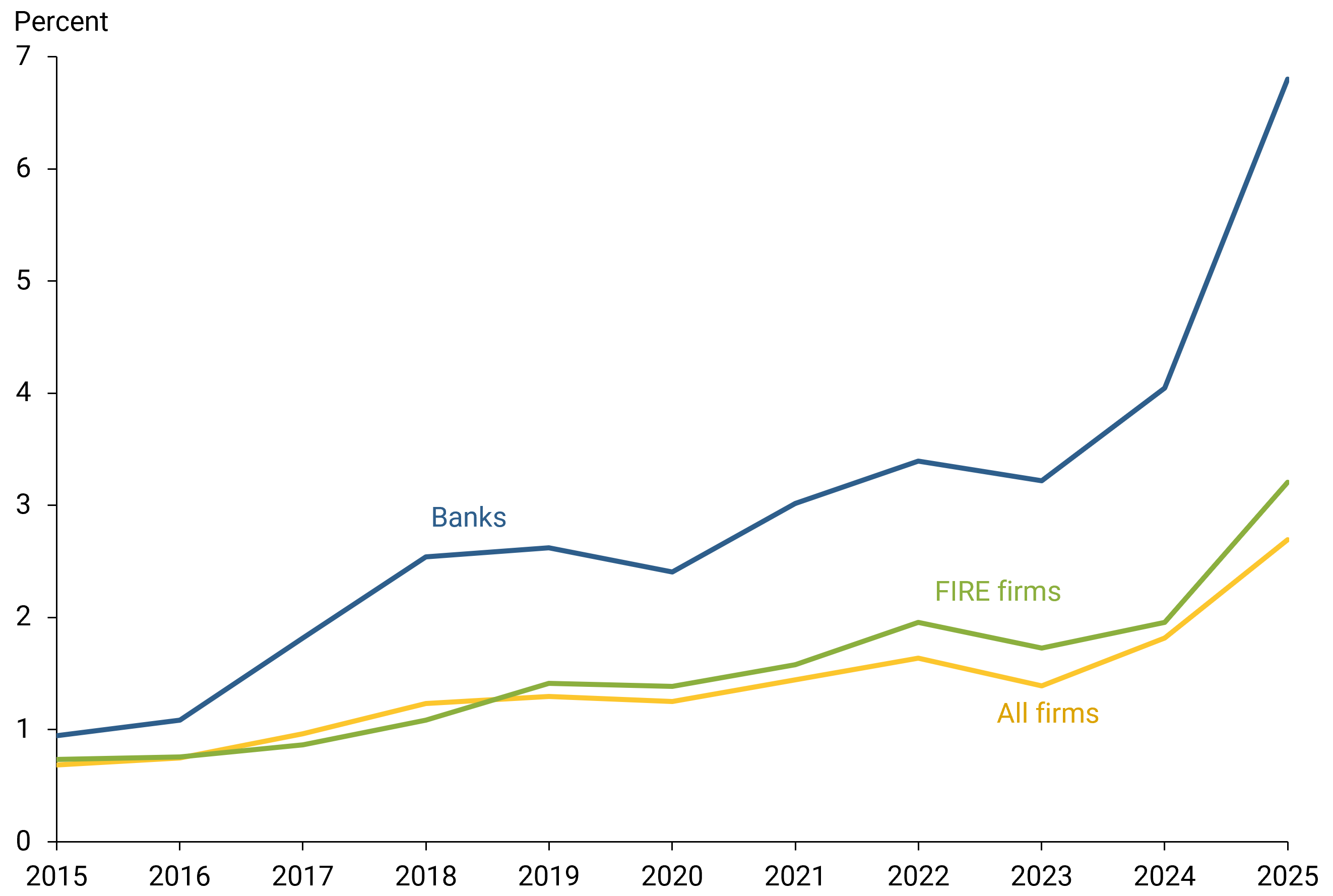
Figure 1 shows the share of AI job postings in the banking sector compared with both the average share of AI job postings in the finance, insurance, and real estate (FIRE) sector and the average share among all firms in the economy. The figure shows that commercial banks have been early adopters of AI. In our sample, the share of AI job postings in the banking industry surged to 6.80% by the end of 2025, up from less than 0.94% in 2015. This share is much higher than both the nonbank FIRE sector (3.20%) and the average share among all firms in the economy (2.69%).
Figure 1
AI adoption in banking and in other selected sectors
The pace of AI adoption has also differed across banks of different sizes, as shown in Figure 2. Large banks have a higher average share of AI job postings than medium-sized banks, which have a higher share than small banks. The AI job shares of larger banks also grew faster in our sample from 2015 to 2025. Large banks have more resources to cover upfront costs associated with AI adoption, such as those for restructuring the computing environment, retraining workers, and hiring new workers with AI skills. In our sample, 84% of small banks have never posted any AI-related jobs.
Figure 2
AI adoption shares by bank size
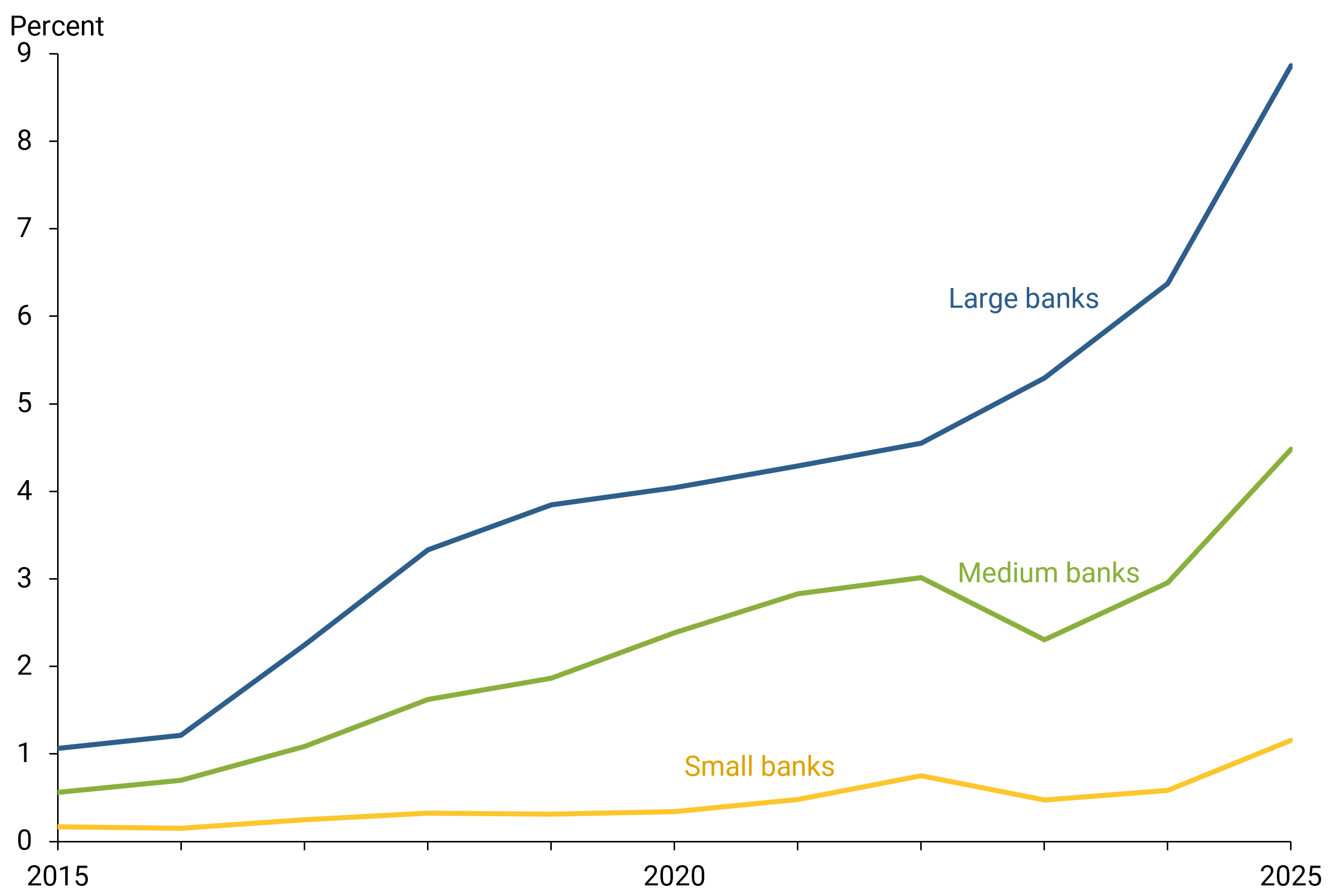
Our measure indicates that, by the end of 2025, the share of AI-related job postings by small banks was only 1.15%, far below those for medium-sized banks (4.48%) and for large banks (8.86 %). One caveat of our measure of AI adoption based on online job postings is that it reflects mainly in-house AI activity. Some banks, especially small banks that lack resources for in-house adoption, could use AI through third-party vendors. Thus, our measure may overstate the disparities in AI adoption by bank size.
AI use and loan complexity
AI usage may help banks process more complex loans, encouraging them to tilt their lending portfolios towards loans that are riskier but also potentially more profitable. Figure 3 compares the average ROA and the average share of problem loans, that is, those that have been designated as substandard or with doubtful repayment, between high-AI banks and low-AI banks. Banks are designated as “high-AI” if their share of AI-related job postings is above the average share, while those with below-average shares are designated as “low-AI” banks. We use the average share instead of the median share as a threshold because only a small share of small banks in our sample post for AI-related jobs, and the median AI job share for small banks is zero. Since AI adoption has surged in recent years, we focus on data from 2021 through 2025.
Figure 3
AI adoption impact on ROA, problem loan shares
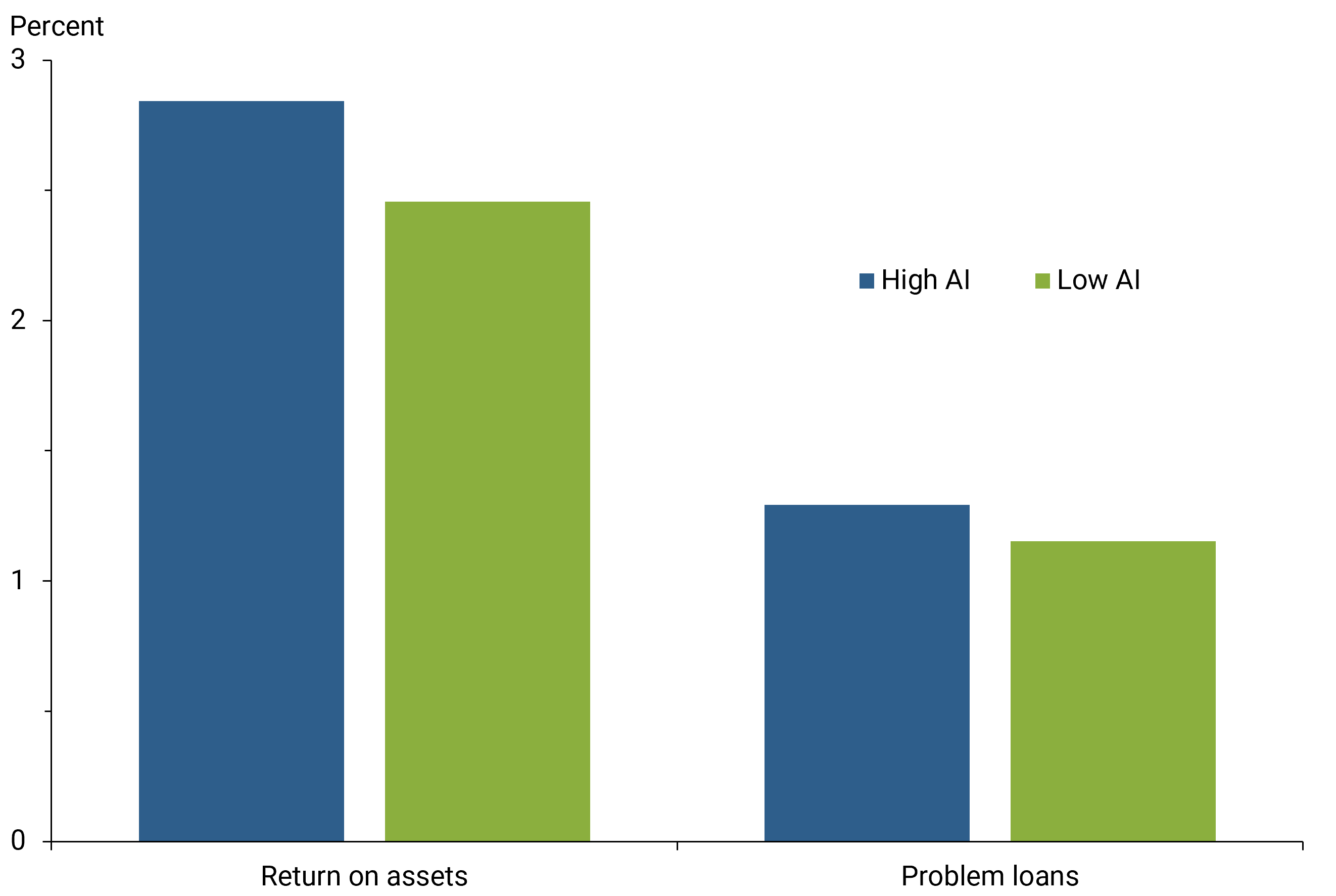
Figure 3 shows that increased AI adoption is associated with higher average ROA and also a higher share of problem loans. The average ROA for high-AI banks is about 0.38 percentage point higher than for low-AI banks. Our data also suggest that the ROA disparity between high- and low-AI banks is similar across bank sizes but is particularly noticeable among large banks (not shown), with an ROA difference of 0.61 percentage point.
The figure also shows that high-AI banks also have higher average shares of problem loans than low-AI banks, although the disparity is small. This pattern is not surprising because increased AI adoption could encourage banks to take on more complex loans, but AI also enhances banks’ ability to evaluate the loan quality.
While these results are correlations and do not necessarily reflect causal effects, they support the hypothesis that increased AI adoption is associated with more risk-taking in bank lending, as indicated by higher bank ROA and also higher problem loan shares.
AI adoption and SME lending
Lending to SMEs generally relies more on soft information such as relationship lending than on hard data. SMEs tend to be less extensively covered by analysts due to economies of scale in producing such information. SMEs are also much less likely to be publicly traded, which reduces the amount of hard information available for formal credit analysis. Historically, SMEs have received more loans from small banks, which have a comparative advantage in processing soft information, based on both enhanced knowledge of the borrowing firm and the community in which the firm operates.
However, the potential impact of AI adoption on SME lending by banks of different sizes is unclear. On one hand, AI usage reduces the cost of processing hard information, while tilting bank lending away from SME loans that rely on soft information. On the other hand, GenAI might eventually assist banks in processing soft data, which could bridge the information gap for SME lending.
Figure 4 shows that high-AI banks have a smaller share of SME lending than low-AI banks. This correlation pattern holds for all three groups of banks by size. Moreover, the disparities related to AI adoption appear to be quite large. In our full sample, high-AI banks have a much smaller average share of SME loans than low-AI banks (12% versus 21%). The difference in the shares of SME loans between high-AI and low-AI banks is most pronounced within the group of small banks (13.3% versus 21.4%). For the group of medium-sized banks, the gap is smaller (3.8% versus 7.8%). For the group of large banks, the gap is even smaller (2.2% versus 3.3%).
Figure 4
Higher use of AI associated with reduced SME lending
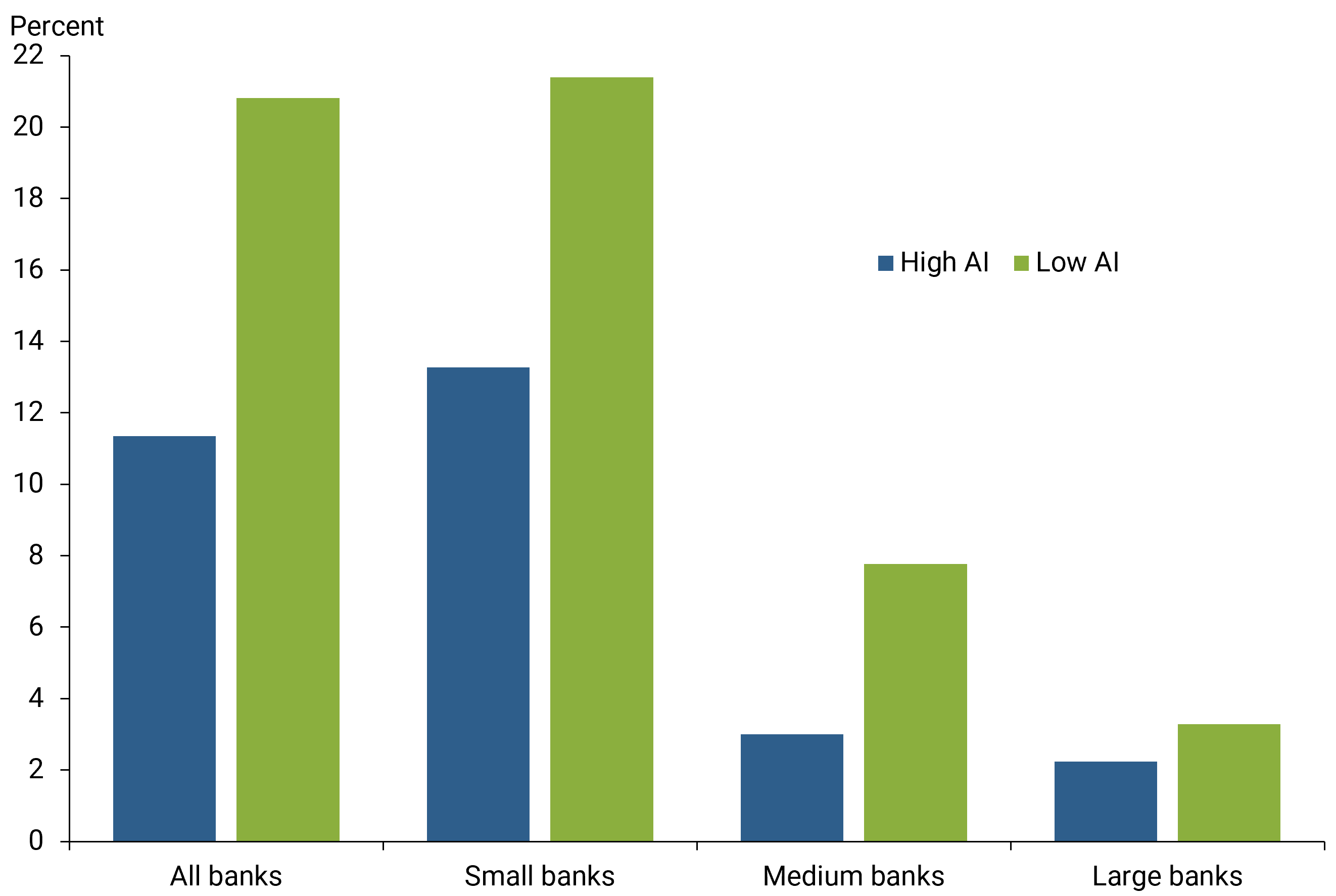
Our results therefore suggest that increased AI usage by banks has been associated with decreases in the shares of loans offered to small and medium enterprises. This may suggest more difficulties for SME financing going forward as AI adoption continues to grow. Still, it is premature to predict how much the capacities of AI will develop, which could change the way banks make lending decisions. It is possible that the relative advantages of AI technology in processing hard information may not persist.
Conclusion
In this Economic Letter, we analyze the association between AI adoption and bank lending. Our results indicate that increased AI usage—represented by the share of AI-related job postings—is associated with more complex lending patterns, resulting in increased returns on assets on average but also increased shares of problem loans and decreased lending shares to small and medium enterprises.
It is likely premature to assess the implications of AI for patterns of economic activity and productivity growth. However, early evidence suggests that AI may influence bank lending activity, particularly for access to credit across borrowers. Those changes may reflect the availability of hard information that AI technology can help assess more easily. Moreover, to the extent that commercial banks are industry leaders in AI adoption, their experiences may shed some light on the broader economic impacts of AI as its adoption spreads to other business sectors.
References
Acemoglu, Daron, David Autor, Jonathon Hazell, and Pascual Restrepo. 2022. “Artificial Intelligence and Jobs: Evidence from Online Vacancies.” Journal of Labor Economics 40(S1), pp. S293–S340.
Ahmadi, Sina. 2022. “Open AI and Its Impact on Fraud Detection in Financial Industry.” Journal of Knowledge Learning and Science Technology 2(3), pp. 263–281.
Fasano, Fasano, and Francesco Cappa. 2022. “How Do Banking Fintech Services Affect SME Debt?” Journal of Economics and Business 121(106070).
Jakšič, Marko, and Matej Marinč. 2019. “Relationship Banking and Information Technology: The Role of Artificial Intelligence and Fintech.” Risk Management 21, pp. 1–18.
Manoharan, Giriprasad. 2024. “Bridging the AI Gap: Adoption Strategies for Small and Medium-Sized Banks in a Digital Era.” International Journal of Advanced Research and Emerging Trends 1(2).
Data
Download data for figures (Excel, 228 kb)
Opinions expressed in FRBSF Economic Letter do not necessarily reflect the views of the management of the Federal Reserve Bank of San Francisco or of the Board of Governors of the Federal Reserve System. This publication is edited by Anita Todd and Karen Barnes. Permission to reprint portions of articles or whole articles must be obtained in writing. Please send editorial comments and requests for reprint permission to research.library@sf.frb.org