
The SF Fed maintains three advisory councils: the Community Advisory Council, Community Depository Institutions Advisory Council, and Economic Advisory Council. Members of these councils represent businesses, financial institutions, and community organizations across the Twelfth District. They convene to discuss the District’s economy, bringing valuable perspectives from around the District to the San Francisco Fed. This Advisory Council Observations series highlights key insights contributed by the council members in recent meetings.
The San Francisco Fed’s advisory councils are a crucial source of on-the-ground insights about the Twelfth District’s economy, and each has a specific focus:
- The Community Advisory Council (CAC) serves as an important source of information on economic conditions in lower-income communities in the District.
- The Community Depository Institutions Advisory Council (CDIAC) shares information about banking conditions, the ability of community depository institutions to support local markets, and other issues of interest in the District.
- The Economic Advisory Council (EAC) provides observations about the District’s economic, business, and labor conditions.
President and CEO of the San Francisco Fed Mary C. Daly, other leaders from the Bank’s Executive Leadership Team and the Economic Research, Regional Engagement, and Banking Supervision groups attend council meetings and facilitate robust discussions. They ask Council members to provide their assessments of the general health of the economy, while also surfacing specific short- and longer-term opportunities and concerns.
Here are some photos and key observations from the most recent meetings of the Councils:
Economic Advisory Council
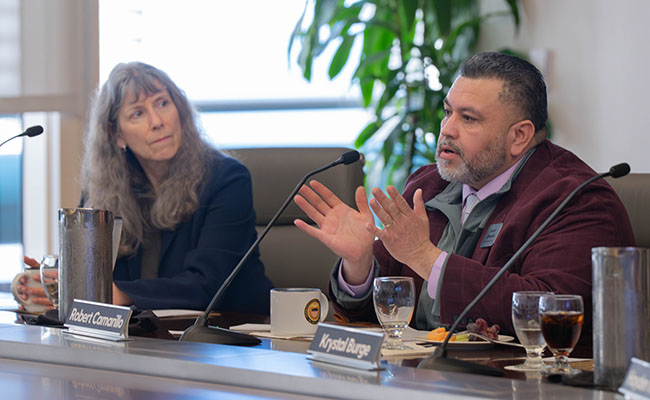
- Members of the Economic Advisory Council reported that economic activity slowed slightly in recent months. Council members described a bifurcated, or K-shaped, economy and noted that spending growth has been largely driven by high-income households. Overall, they said that retail sales and demand for consumer and business services declined slightly.
- Council members noted demand for computer chips and related energy products was very strong, while activity in other sectors was generally stable to somewhat softer. They observed that uncertainty around the outlook increased due to geopolitical tensions and their potential impact on financial and energy markets.
- Comments reflected that head counts were stable on net, and Council members remained focused on efficiency gains and rightsizing operations. They reported that pay levels grew at a slight pace, and annual pay increases were down from recent years but in line with historical averages. Members also noted that prices rose moderately, and input costs generally rose at a faster pace than selling prices.
- Council members noted broad AI adoption, primarily in office operations but also increasingly for revenue generation. Council members anticipated increased AI-related productivity gains without head count growth in many industries over the next two years as the technology matures, with some shifts in skill requirements across certain business areas needed.
Community Advisory Council
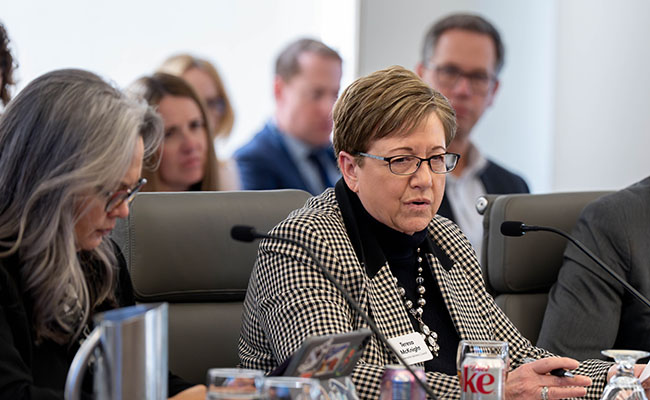
- Across multiple regions, Council members reported that housing, utilities, food, and transportation costs continue to strain household finances, particularly for low- and moderate-income families. Community organizations noted increases in credit card balances, loan delinquencies, and reliance on high-cost financial products. They also shared that many households are operating with little financial cushion and entering assistance programs during acute financial stress rather than seeking preventative counseling.
- Council members from tourism-heavy regions reported declining visitor volumes, particularly in Las Vegas, where visitor activity, including gaming, is down. They noted that these shifts are producing ripple effects across hospitality, retail, and food service sectors, where businesses simultaneously face higher input costs and thinning margins. Community lenders are also reporting significantly reduced small business lending activity.
- Council members noted that economic pressures are often amplified in Tribal and rural communities due to geographic isolation and infrastructure constraints.
- Nonprofit organizations reported significant increases in demand for housing assistance, food security, and crisis stabilization services. Simultaneously, many nonprofits are experiencing declines in philanthropic contributions and government contract reductions. Council members shared that this dynamic is pushing organizations to prioritize emergency response services while scaling back long-term programs, creating potential capacity constraints across community support systems.
Community Depository Institutions Advisory Council

- Council members reported that credit performance remains generally strong, with commercial real estate (CRE) showing particular resilience. They noted that where borrowers face debt service coverage pressures, most maintain ample liquidity and continue making timely payments. Council members shared that banks are actively managing refinance risk as loans reprice, in part by maintaining ongoing dialogue with borrowers.
- Council members shared that competition for deposits persists, reinforcing banks’ continued focus on full-service relationships and various balance sheet management strategies.
- Council members indicated that vendor management remains a key factor in addressing cybersecurity risks, as a considerable portion of security challenges originate from vendors. They felt that multi-layered sub-vendor relationships add complexity to due diligence.
- Looking across the industry, Council members observed that strategic consolidation continues among institutions seeking portfolio diversification and deposit acquisition.
Advisory Councils are a vital source of information for the San Francisco Fed. They provide valuable insights into how businesses and households across the Twelfth District are navigating economic conditions on a daily basis. These insights help inform and support the San Francisco Fed’s mission to advance the nation’s monetary, financial, and payment systems to build a stronger economy for all Americans.
Related:


The views expressed here do not necessarily reflect the views of the management of the Federal Reserve Bank of San Francisco or of the Board of Governors of the Federal Reserve System.