
Job-finding rates have declined over the past three years for people who are unemployed or are out of the labor force. Analysis shows that the decline in job finding for unemployed people has been pronounced for prime-age and college-educated individuals, while the decline in job finding for people who are out of the labor force has been driven by younger and less-educated individuals. These demographic patterns differ from job-finding rates during typical economic expansions and imply both a cooling and a restructuring within the labor market.
The unemployment rate gauges labor market health by measuring how many people are looking for work. Job-finding rates—the rates at which individuals transition into employment each month—provide a complementary picture. A high job-finding rate is generally a signal of a healthy labor market.
People without a job fall into two categories. Unemployed people are actively searching for work. People who are out of the labor force, or nonparticipants, are not actively searching for jobs, including retirees, students, and others who are not actively looking. Job-finding rates for these two groups capture different dimensions of labor market health. A high unemployment-to-employment transition rate signals that demand is strong to absorb active job seekers quickly. A high nonparticipation-to-employment transition rate typically signals that abundant opportunities for paid work might pull people in from the sidelines.
In a typical recovery, both job-finding rates rise. The unemployment-to-employment rate rises because strengthening demand means employers hire more readily from the pool of unemployed. The nonparticipation-to-employment rate rises because a hot labor market pulls in marginal workers. This “pulling-in” effect is a hallmark of a mature expansion: As a recovery lengthens, it draws in groups that would not have found jobs in a weaker economy—younger, less-educated, and less-experienced workers (Aaronson et al. 2019, Hotchkiss and Moore 2022).
Over the past three years, however, the overall job-finding rate in the United States has fallen, which is unusual during economic expansions. This Economic Letter shows that the recent drop in job finding for unemployed individuals was pronounced among people of prime working-age and college-educated individuals. The decline for nonparticipants was concentrated among younger people and those with less education.
The changes in job-finding rates by age and education over the past three years are an anomaly for a mature stage of a typical expansion. Job finding among nonparticipants weakened for traditionally marginal workers, which may reflect a normalization following extraordinarily strong post-pandemic labor demand. The unemployment-to-employment pipeline weakened for workers who traditionally can find jobs more easily, which may reflect larger structural shifts in demand for skilled labor, such as technology-related downsizing, managerial restructuring, or government contractor reductions, or the early effects of AI-related displacement in professional occupations.
For comparison, the current demographic patterns of job-finding declines also differ from the last sustained decline in the job-finding rate during the 2007–09 recession, which was more broad based across education groups.
Job-finding rates in the post-pandemic recovery
To analyze these two groups, we measure the monthly employment transition rates using matched individual records from the Current Population Survey. The unemployment-to-employment rate captures the share of unemployed workers who find a job; the nonparticipation-to-employment rate captures the share of nonparticipants who transition into employment.
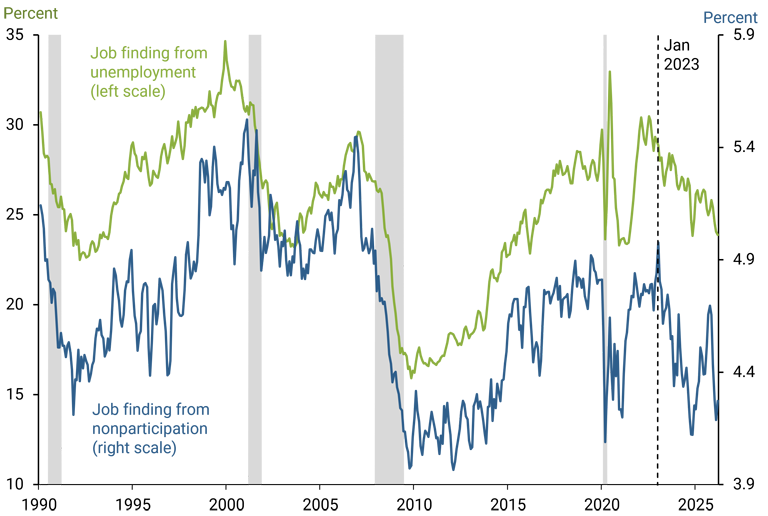
The job-finding rate for unemployed people is typically 25–30%, much higher than the typical job-finding rate for the nonparticipation group of 4–5%, showing that the unemployed are far more likely to find a job (Figure 1). This is not surprising because a large share of nonparticipants are retirees or students who are not looking or not interested in a job. However, even though their job-finding rate is relatively low, nonparticipants make up two-thirds of all people who transition from nonemployment to employment each month on average. This is mainly because the pool of nonparticipants is much larger than the pool of unemployed individuals (Kudlyak and Lange 2018).
Figure 1
Job finding from unemployment and nonparticipation
Source: Bureau of Labor Statistics, Current Population Survey, and authors’ calculations.
Coming out of the pandemic recession, both job-finding rates rose, peaking around January 2023. They have since declined, even as the unemployment rate has remained relatively low. The rate for nonparticipants fell from 4.9% to 4.2%, while the rate for unemployed workers fell from 30% to 25%.
The recent decline suggests that the labor market is neither efficiently absorbing the unemployed nor drawing in nonparticipants. To understand whether this decline reflects a broad-based slowdown or is concentrated among specific groups, we break down the change in job-finding rates by demographic groups.
Which groups are less successful at finding work?
We break down the change in overall job-finding rates from January 2023 to January 2026 into two components using a so-called shift-share analysis. One component reflects changes in the age-gender-education demographic composition of the pool of unemployed individuals. The other component reflects changes in job-finding rates for each demographic group.
We find that the decline in job-finding rates from unemployment reflects mostly rate decline by age and education groups and not compositional changes towards groups with typically lower rates. The decline in job-finding rates from nonparticipation reflects rate declines by age and education groups as well as some contribution from a compositional change towards an older population.
To further examine which demographic groups’ rates drive the overall lower job-finding rate, Figures 2 and 3 show the decline of the job-finding rates from unemployment and from nonparticipation by age and education, respectively. The figures show that the demographic profiles of the decline in job-finding rates differ between unemployment and nonparticipation.
The decline in job finding from nonparticipation is driven primarily by lower job-finding rates among younger and less-educated individuals. Individuals ages 16–24 saw a 20% decline and those ages 25–34 fell 16%, while the job-finding rates of those ages 35–64 changed little (blue bars, Figure 2). Those with a high school diploma saw a decline of 23%, and those with less than high school fell 19%, while those with a bachelor’s degree or higher saw no decline (blue bars, Figure 3).
Figure 2
Changes in job-finding rates by age

Source: Bureau of Labor Statistics, Current Population Survey, and authors’ calculations.
By contrast, the decline in job finding from unemployment is particularly large for those of prime working ages 35–54 and primarily concentrated in college-educated groups (red bars, Figure 3). College-educated individuals saw a decline of 30%, those with some college degree declined 18%, while workers with less than high school saw their job-finding rate increase.
Figure 3
Changes in job-finding rates by education

Source: Bureau of Labor Statistics, Current Population Survey, and authors’ calculations.
Considering that January 2023 through January 2026 can be described as a mature stage of the recovery from the 2020 recession, our findings go against typical expectations for a recovery. The current job-finding decline for nonparticipants is concentrated among some of the groups that a hot labor market typically pulls in from the sidelines—young and less-educated workers (Okun 1973). Instead of being pulled in, the pipeline into employment is shrinking such that the recovery is no longer reaching workers at the margins.
The current decline from unemployment is concentrated among groups that typically have the highest job-finding rates: prime-age and college-educated workers. They normally find jobs quickly even in weaker labor markets. The drop in their job-finding rates is particularly surprising and suggests something other than a standard cyclical slowdown.
Putting the job-finding decline into historical perspective
Do these demographic patterns align with previous declines in job finding, or does the current period represent something new? The last episode of sustained decline occurred from December 2006 to December 2009 (Figure 1), a period that included the Great Recession.
We follow changes in job-finding rates across three years of sustained decline, starting in December 2006. The nonparticipation-to-employment job-finding rate over this period dropped 1.3 percentage points, a 24% decrease—about double the current decline in both absolute and percentage terms. The unemployment-to-employment job-finding rate dropped about 13 percentage points, a 45% decrease—more than double the current decline. These large declines in both rates were expected given the severity of the recession, when the unemployment rate rose from 4.4% to 9.9%.
We find sharp differences in job-finding rate changes by education between the two periods, shown in Figure 4. The 2006–09 declines in job-finding rates from nonparticipation and especially from unemployment were experienced across all education levels, shown by the lighter bars. In contrast, the recent decline in job-finding rates from nonparticipation is concentrated among lower-educated groups, and the recent decline in job-finding rates from unemployment is concentrated among higher-educated groups.
Figure 4
Post-pandemic vs. Great Recession job finding, % change

Source: Bureau of Labor Statistics, Current Population Survey, and authors’ calculations.
Conclusions
Job-finding rates have declined since early 2023, an unusual development for a stable economy. In this Letter, we first note that the decline in job finding out of nonparticipation is more concentrated among younger and less-educated individuals. Second, the decline in job finding out of unemployment is pronounced among prime-age individuals and more concentrated among higher-educated individuals. These patterns suggest that the current slowdown may reflect structural forces rather than being a signal of a cyclical downturn. There may be several contributing factors for future research to consider, including immigration-driven changes, sector-specific slowdowns in technology and government contracting, policy uncertainty, or early signals of broader labor market deterioration.
References
Aaronson, Stephanie R., Mary C. Daly, William L. Wascher, and David W. Wilcox. 2019. “Okun Revisited: Who Benefits Most from a Strong Economy?” Brookings Papers on Economic Activity, Spring, pp. 333–404.
Hotchkiss, Julie L., and Robert E. Moore. 2022. “Some Like It Hot: Assessing Longer-Term Labor Market Benefits from a High-Pressure Economy.” International Journal of Central Banking 18(2), pp. 193–243.
Kudlyak, Marianna, and Fabian Lange. 2018. “Measuring Heterogeneity in Job Finding Rates among the Non-Employed Using Labor Force Status Histories.” Federal Reserve Bank of San Francisco Working Paper 2017-20.
Okun, Arthur M. 1973. “Upward Mobility in a High-Pressure Economy.” Brookings Papers on Economic Activity 4(1), pp. 207–262.
Data
Download data for figures (Excel, 434 kb)
Opinions expressed in FRBSF Economic Letter do not necessarily reflect the views of the management of the Federal Reserve Bank of San Francisco or of the Board of Governors of the Federal Reserve System. This publication is edited by Anita Todd and Karen Barnes. Permission to reprint portions of articles or whole articles must be obtained in writing. Please send editorial comments and requests for reprint permission to research.library@sf.frb.org