

Japanese government bond markets present a puzzling pattern. Unlike U.S. markets, where bond liquidity and other premiums have been shown to drive a wedge between prices of nominal U.S. Treasury securities and those of matching portfolios comprised of inflation-indexed bonds and derivative contracts, analysis shows no such wedge for similar asset combinations in Japanese markets.
Portfolios of Treasury Inflation-Protected Securities (TIPS) and inflation swaps—derivative contracts that compensate investors for realized value changes related to inflation—with fixed cash flows that exactly match those of U.S. nominal bonds have significantly different prices. While a basic premise in financial markets is that contracts with the same cash flow should have the same price, an influential paper by Fleckenstein, Longstaff, and Lustig (2014) reconciles this pattern with financial theory by noting that U.S. TIPS rates include bond-specific premiums, such as liquidity premiums. Indeed, they suggest that their findings of significant pricing disparities for the pairs of U.S. bonds could be explained by the liquidity advantages of nominal Treasury bonds relative to TIPS.
In this Economic Letter, we examine whether Japanese financial markets behave in the same way as U.S. markets. We focus on Japanese inflation swaps and breakeven inflation (BEI) rates, defined as the difference in yields on nominal Japanese government bonds (JGBs) and inflation-indexed JGBs, also known as JGBi’s. Like U.S. TIPS, inflation-indexed JGB prices are influenced by bond-specific premiums tied to the bonds’ liquidity risk and the protection they offer against deflation. Because the Japanese consumer price index (CPI) inflation has averaged well below U.S. CPI inflation for several decades, the risk of deflation is likely to be more prevalent in Japanese markets. As a result, the Japanese market could exhibit even greater discrepancies between inflation swaps and BEI rates than the U.S. market.
Applying a term structure model from Christensen and Spiegel (2024) to the Japanese data, we show that both inflation-adjusted bond-specific premiums are sizable. As such, these premiums should result in substantial inflation swap-BEI spreads, comparable to those documented by Fleckenstein et al. (2014) for the United States. However, in our comparison, Japanese inflation swaps and BEI rates turn out to be nearly identical.
One explanation for this discrepancy could be that the Japanese premiums for liquidity risk and deflation protection exactly cancel each other out at all maturities. However, our model estimates provide clear evidence against this possibility, suggesting that other factors may be affecting prices in the Japanese inflation swap market.
Inflation swaps and BEI rates in the United States and Japan
We compare U.S. and Japanese inflation swaps and BEI rates, emphasizing two important characteristics of inflation-indexed bonds. First, similar to U.S. inflation-indexed bonds, inflation-indexed JGBs provide conventional inflation protection, compensating bondholders for cumulative inflation that has occurred over the life of the bond. Both types of bonds also provide deflation protection in that they pay off the full principal value if cumulative inflation over the life of the bond was negative. As Japanese inflation has averaged well below that of the United States for extended periods, this protection is especially valuable and should affect inflation-indexed JGB prices even more than for U.S. TIPS.
Second, there are large differences in liquidity between Japan’s small inflation-indexed bond market, which represents only about 1% of government debt in Japan, and its huge nominal bond market. These differences suggest sizable liquidity premiums, which would be expected to meaningfully impact Japanese BEI rates, similar to U.S. TIPS (see, for example, Andreasen, Christensen, and Riddell 2021).
Like U.S. inflation swaps, neither liquidity premiums nor deflation protection apply to Japanese inflation swaps. First, Japanese inflation swaps have zero value at inception and are never sold back to the market, unlike inflation-indexed JGBs. Instead, either the net value of the swap contract is settled, or parties agree to an offsetting new zero-value inflation swap. Therefore, inflation swap rates do not contain liquidity premiums. Second, standard inflation swaps do not offer deflation protection. The inflation-indexed JGB bond-specific premiums should therefore drive a wedge between Japanese inflation swaps and BEI rates because the spreads between inflation swaps and BEI rates are pushed up by liquidity premiums and pushed down by the deflation protection.
While our comparison focuses on the 10-year maturity, our results also hold for other maturities. Figure 1 shows the four series starting in 2018, when our Japanese inflation swap data became available from Bloomberg.
Figure 1
Ten-year U.S. and Japanese inflation swap and BEI rates
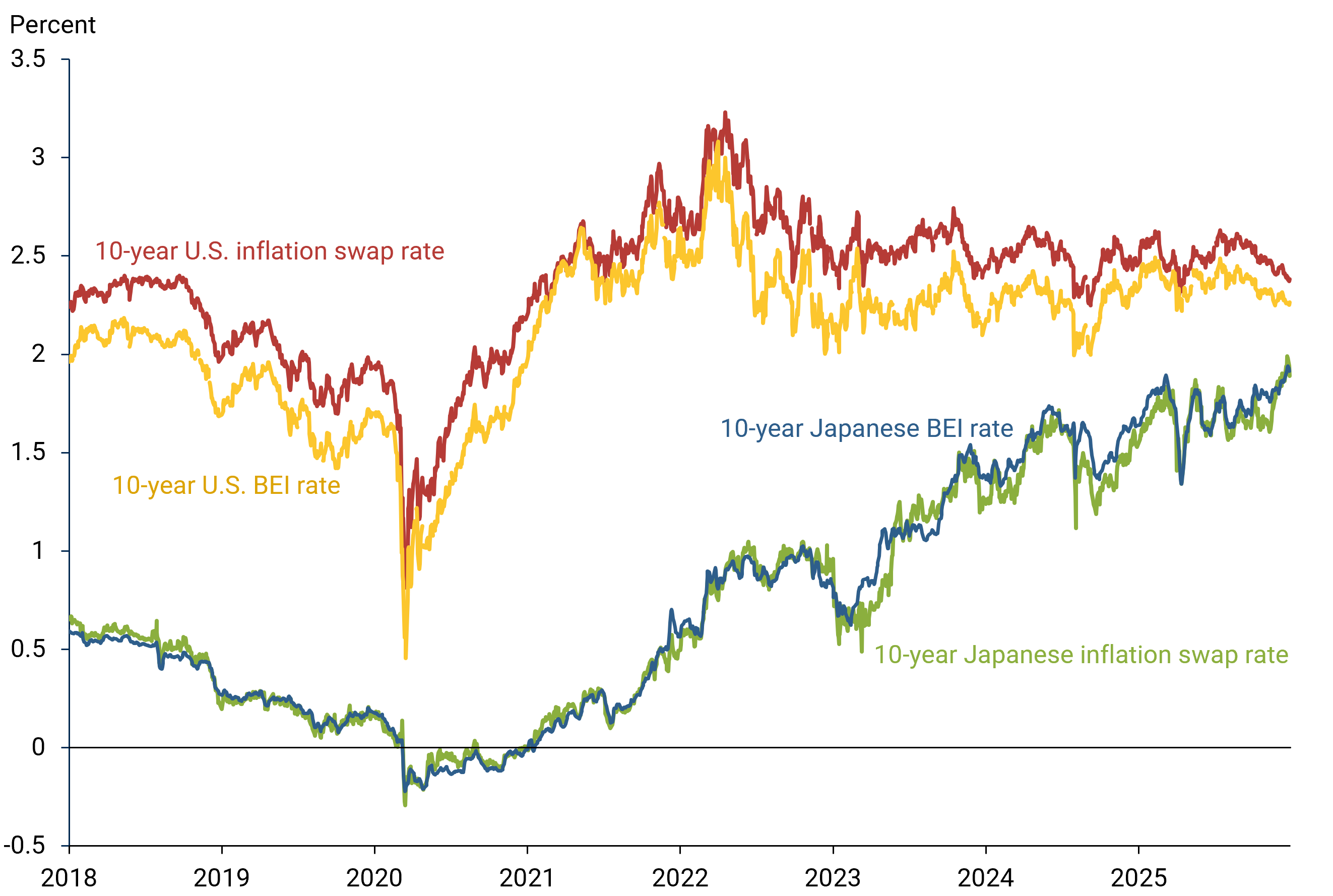
U.S. inflation swap rates (red line) and BEI rates (gold line) are higher and more volatile due to the generally higher and more volatile U.S. inflation rates. There also is a sizable spread, with U.S. inflation swap rates systematically higher than matching BEI rates. This spread is consistent with the evidence in Fleckenstein et al. (2014) for an earlier historical sample period. However, because deflation is very unlikely over a 10-year period in the United States, deflation protection for U.S. bonds is not very valuable (see Christensen, Lopez, and Rudebusch 2012). Liquidity premiums thus exceed deflation protection and systematically push the U.S. BEI rate downward relative to the inflation swap rate, resulting in the positive swap-BEI spread in Figure 1.
Surprisingly, Figure 1 demonstrates that Japanese inflation swap rates (green line) and inflation-indexed JGB BEI rates (blue line) are nearly identical.
A yield curve model with bond-specific risk premiums
Liquidity premiums can push BEI rates both up and down, but the deflation protection afforded by inflation-indexed JGBs always has positive value and pushes them up. Thus, it is theoretically possible that the effects of these premiums exactly cancel each other out. To evaluate this possibility, we turn to a yield-curve model fitted on 20 years of Japanese bond prices from Christensen and Spiegel (2024) to evaluate the size of both premiums.
We model deflation protection in inflation-indexed JGBs using a standard yield curve model from Christensen and Spiegel (2022), which we augment with a bond-specific liquidity risk factor as described in Andreasen et al. (2021). By observing the entire cross section of inflation-indexed bond prices over time, we can identify the marketwide bond-specific liquidity risk factor and estimate its impact over time.
We examine yields for the 30 inflation-indexed bonds issued by the Japanese government from January 2005 to the end of December 2025. We also include a sample of Japanese nominal zero-coupon bond yields from 1995 through the end of December 2025. Our sample contains nominal bond yields for six different maturities, ranging from six months to ten years. We also incorporate biennial survey inflation forecasts to help pin down expected inflation.
Figure 2 shows the estimated liquidity premium of inflation-indexed JGBs (blue line) for each observation date since 2018. It is measured as the difference between the fitted inflation-indexed (real) bond yield, which is very close to the actually observed yield, and the corresponding hypothetical real yield that has been adjusted for liquidity risk. The liquidity premium is large and switches sign from negative to positive over our sample period.
Figure 2
Bond-specific premiums in inflation-indexed JGB yields

Figure 2 also shows the average estimated deflation protection values of individual inflation-indexed JGB prices (gold line), measured as the spread between the model-implied real bond yields without and with the deflation protection value included. We perform this calculation for the bonds issued since 2013, when deflation protection was first offered. Due to Japan’s very low inflation and occasional deflation, deflation protection turns out to be relatively valuable—around a full percentage point for extended periods—though volatile in the years before and during the pandemic. The value of deflation protection has dropped to near zero following the persistent firming of Japanese inflation since 2022.
The green line in Figure 2 shows the total premium, including liquidity and deflation protection. This premium is large and negative until around 2022 before turning positive. The model therefore predicts that we should observe a negative spread between Japanese inflation swap rates and BEI rates before 2022 and a positive spread thereafter. However, as shown in Figure 1, we do not observe any meaningful spread: Empirically, the swap-BEI spread in Japan is close to zero. This constitutes a puzzle relative to the model, which predicts large effects from liquidity differences and deflation protection.
Model-implied Japanese inflation swap rates
To shed light on this finding, we calculate the model-implied values of the 10-year inflation swap rates, that is, the rates that should prevail in the absence of any liquidity premium or deflation protection effects. Comparing these with the observed inflation swap rates shown in Figure 3, except for the 2022-2023 period, the model-implied swap rates are markedly different from the observed rates.
Figure 3
Ten-year Japanese inflation swap rates
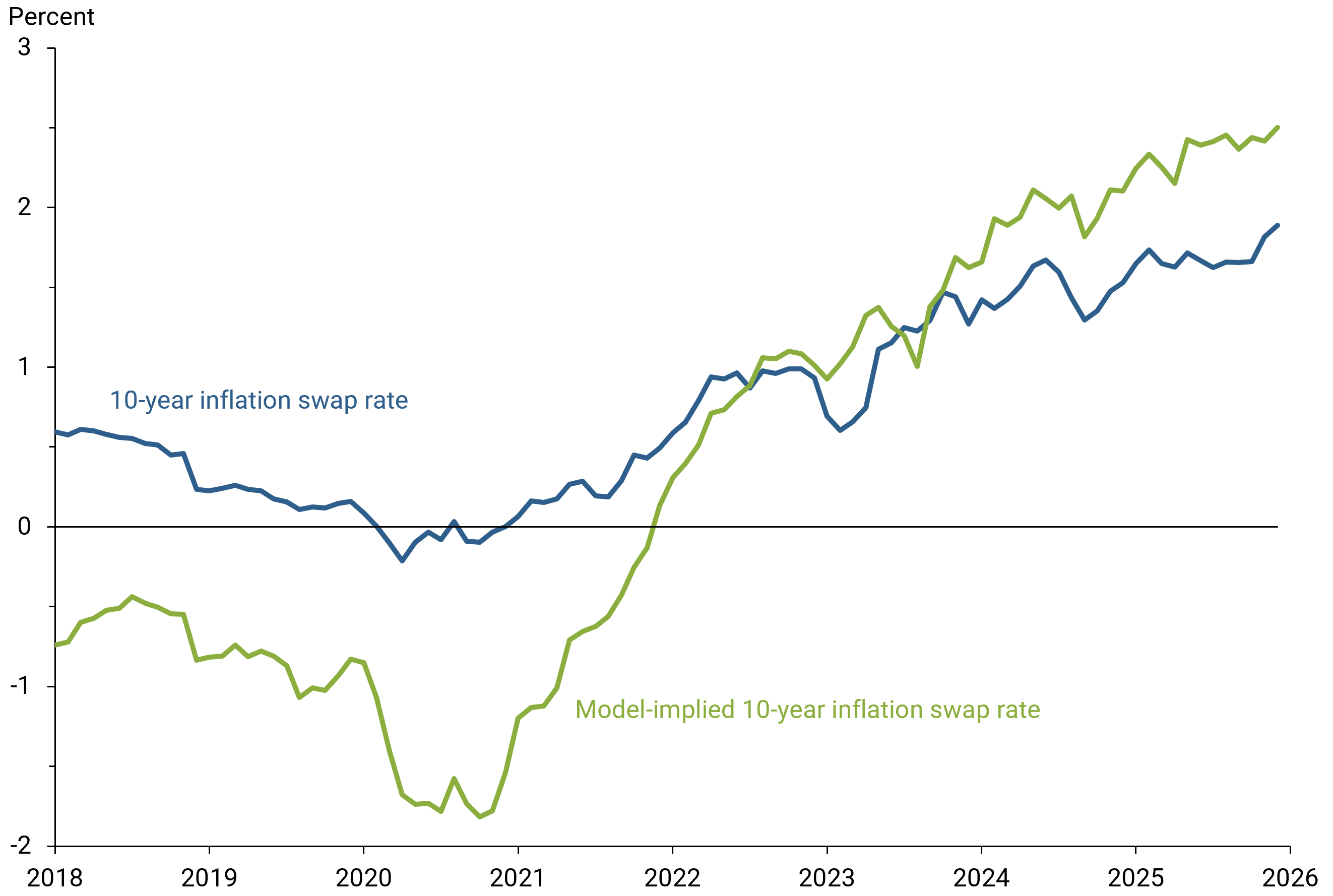
One possible explanation for this pattern is that pricing in the market may reflect the perceived need among inflation swap dealers to hedge their positions in inflation-indexed JGB markets under potential economic or financial conditions. Rates in these markets reflect liquidity risk and are also distorted by deflation protection enhancements. However, the large values of the distortions implied by the Christensen and Spiegel (2024) model—which in combination average 0.24%, with a standard deviation of 0.85%—seem excessive for the pricing anomalies to be explained solely through that channel. As a result, properly assessing the implications of inflation-indexed JGB BEI rates for expected Japanese inflation is likely to require some adjustment of the BEI rates for the embedded premiums discussed above.
Conclusion
In this Letter, we document a puzzle in the Japanese bond and inflation swap markets: The inflation swap-BEI spread is close to zero, in stark contrast to similar spreads in U.S. markets that have been explained by bond-specific premiums. Inflation-indexed Japanese bond prices should also exhibit premiums related to their liquidity risk, and their deflation protection should arguably be large as well. This suggests that Japanese swap-BEI spreads over comparable maturities should be similar to those documented in U.S. financial markets.
We investigate this pattern using a term structq1ure model that correctly prices inflation swaps while accounting for both the liquidity premiums and deflation protection effects found in inflation-indexed Japanese government bonds. While these enhancements are valuable, the resulting swap-BEI spreads in Japanese data are inconsistent with those predicted by our model. This implies that other factors may be affecting prices in the Japanese inflation swap market.
References
Andreasen, Martin M., Jens H.E. Christensen, and Simon Riddell. 2021. “The TIPS Liquidity Premium.” Review of Finance 25(6), pp. 1,639–1,675.
Christensen, Jens H.E., Jose A. Lopez, and Glenn D. Rudebusch. 2012. “Extracting Deflation Probability Forecasts from Treasury Yields.” International Journal of Central Banking 8(4), pp. 21–60.
Christensen, Jens H.E., and Mark M. Spiegel. 2022. “Monetary Reforms and Inflation Expectations in Japan: Evidence from Inflation-Indexed Bonds.” Journal of Econometrics 231(2), pp. 410–431.
Christensen, Jens H.E., and Mark M. Spiegel. 2024. “What’s Up with Inflation Expectations in Japan?” FRBSF Economic Letter 2024-13 (May 20).
Fleckenstein, Mathias, Francis A. Longstaff, and Hanno Lustig. 2014. “The TIPS-Treasury Bond Puzzle.” Journal of Finance 69(5), pp. 2,151–2,197.
Data
Download data for figures (Excel, 414 kb)
Pacific Basin Notes are published occasionally by the Center for Pacific Basin Studies. Opinions expressed in FRBSF Economic Letter do not necessarily reflect the views of the management of the Federal Reserve Bank of San Francisco or of the Board of Governors of the Federal Reserve System. This publication is edited by Anita Todd with the assistance of Karen Barnes. Permission to reprint must be obtained in writing.