

Housing availability and affordability help support labor market participation and financial stability for households. The Federal Reserve Bank of San Francisco’s Community Engagement and Analysis (CE&A) team studies these issues to support the Bank’s understanding of economic conditions for low- and moderate-income (LMI) communities and geographies in the Twelfth Federal Reserve District. Through its research and engagement, CE&A helps inform banks and other stakeholders about the financial and credit needs of local communities. “Missing middle” housing, in between one-unit homes and larger multi-unit buildings, has gained attention as one way to help address growing affordability challenges.1 Accessory dwelling units (ADUs) are often included in the definition of missing middle housing because they can add “gentle density” to single-family neighborhoods. They support affordability because they can give families more options with their existing homes, such as downsizing, renting out a unit, or housing a family member. ADUs are smaller homes that can be attached or detached from a larger existing single-family home but have their own living space (including kitchen and bath) and a separate entrance.2
This article highlights the San Francisco Fed CE&A team’s work quantifying existing ADUs and tracking recent developments in ADU lending for low- and moderate-income (LMI) homeowners.
How many single-family homes have ADUs?
The number of ADUs has grown in recent years3 in part due to demand and regulatory changes in different states4 that make it easier to build an ADU than previously. A brief from San Francisco Fed CE&A recently estimated that at least 1.6 million single-family homes in the U.S. have an ADU.5 The western U.S.—including the nine western states that make up the Federal Reserve’s Twelfth District—is home to a large share of single-family homes with lot sizes that could accommodate a detached ADU. This contributes to the higher number of existing ADUs in western states. There are an estimated 425,000 ADUs in the Twelfth Federal Reserve District, with individual western states, led by California, having the highest totals in the country (Figure 1).
By our estimates, those numbers mean that 1% to 3.7% of existing single-family homes in western states likely have an ADU.6 Some of the highest estimated concentrations of ADUs are in Nevada, Hawaiʻi , Washington, and Oregon (Figure 1). These estimates are based on 2023 data, and the numbers/shares of ADUs have likely grown, although the order of magnitude is likely still similar.7 New home subdivisions increasingly advertise ADUs as an included amenity, particularly in California.8 9
Figure 1
Accessory Dwelling Units (ADUs) by a) Number and b) % of Homes with ADUs
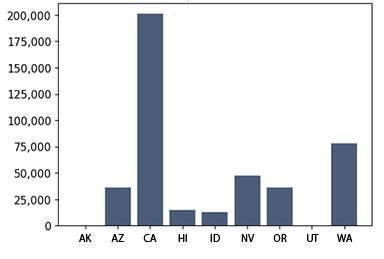
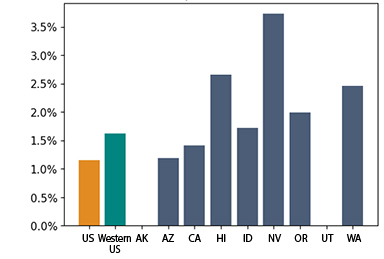
Source: Ramiller, Mattiuzzi, and Schafran 2024. Author calculations based on unique single-family listings 1997-2023 using CoreLogic MLS dataset. Note: too few observations to report for AK and UT. Download data (Excel, 17.3 kb).
Lessons from Lenders and Investors
Higher-income homeowners are often able to use savings or conventional lending products to fund the upfront renovation or construction costs of ADUs. At the same time, mission-driven lenders and investors in the western U.S. have worked to increase access to loans for ADU construction among LMI homeowners.10 Pilot programs have been administered by community development financial institutions (CDFIs) and nonprofits, some with city, state, and/or philanthropic funding to capitalize their loan pool. These programs—in Southern California, Silicon Valley, the San Joaquin Valley (CA), Portland (OR), and Denver (CO)—offered lower-cost ADU loans to LMI homeowners who could not afford interest rates on a conventional home equity line of credit, cash-out refinancing, or construction loan.11 If applicable, they also considered future rental income in the underwriting process. San Francisco Fed CE&A’s engagement work with program administrators and investors revealed key factors that shaped the outcomes of these pilots, suggesting the importance of:
Simplifying the Process: Technical assistance (TA) from lenders helped guide homeowners through the complexity of the ADU development process but added to lenders’ overhead costs. In some cases, slow permitting processes, limited information online on zoning codes, and utility hookup delays—particularly in smaller, less well-staffed jurisdictions—added to timelines, and therefore costs, for ADU projects. Although some local jurisdictions report struggling to fund and staff their planning departments, a handful are using AI tools to make permitting processes more understandable and to assist them with their work. Furthermore, the pool of contractors experienced with ADUs has grown.
Uniform Designs: Community development investors have flagged ADU nonuniformity as a challenge to financing at scale, but they note that modular construction is a bright spot for increasing standardization. The variety in what an ADU can mean in terms of size and shape, such as a garage conversion, a “junior” ADU carved out of existing living space, or a customized detached structure, can contribute to total-cost uncertainty for investors and underwriters. Neighborhood Partnership Housing Services (NPHS), a Southern California CDFI, offers a loan for prefabricated, detached ADUs that covers purchase and installation for homeowners with incomes up to 80% of area median income. Additionally, some jurisdictions have introduced pre-approved ADU designs, which help lend regularity to the underwriting process.
New Federal Policy Expands ADU Lending Opportunities
Interviewees also pointed to the ways in which the recently-enacted federal housing law, the 21st Century ROAD to Housing Act, could change the landscape for ADU lending for LMI homeowners.12 First, the law eliminates the federal requirement for manufactured homes to include a chassis, a metal frame under the structure designed for transporting them.13 Chassis are difficult to remove and make it harder to attach the unit to a foundation; mobile homes, i.e., those not attached to a foundation, have more limited eligibility for conventional lending.14 Prefabrication typically reduces construction costs for ADUs compared to site-building, and forgoing the chassis would further reduce the cost of manufacturing.15 This could allow ADU loan amounts to be lower and potentially more attainable for LMI borrowers.
Second, the Federal Housing Administration (FHA) will now be able to make its Title I Property Improvement loans available for ADUs. FHA Title I loans will also have a higher limit than previously and will increase with inflation, potentially enabling them to cover the cost of ADU construction. Title I loans are available nationally and can be in a subordinate position to a first mortgage, avoiding the cost of refinancing a homeowner’s primary interest rate.16 The new law also includes grant funding for localities to develop pre-approved plans for ADUs (and other missing-middle housing types).17
Looking Forward
ADU pilot programs provide lessons that could help increase efficiency and reduce costs related to TA for homeowners, permitting, and contracting. Standardization, for example, through pre-approved designs and off-site construction, could reduce costs. These lessons, coupled with changes in the policy landscape, may help ADU lending for LMI homeowners grow in scale.
End Notes
1. Abu-Khalaf, Ahmad. 2020. “Overcoming Barriers to Bringing Accessory Dwelling Unit Development to Scale” (PDF, 8.3 mb) [Report]. Enterprise Community Partners.
2. Scott, Walter. 2015. “Mortgage Lending and Non-Borrower Household Income” (PDF, 435 kb). Fannie Mae Housing Working Paper. Washington, D.C.: Fannie Mae.
3. Khater, Sam, and Kristine Yao. 2020. “Granny Flats, Garage Apartments, In-Law Suites: Identifying Accessory Dwelling Units from Real Estate Listing Descriptions Using Text Mining.” Economic and Housing Research Insight. Freddie Mac.
4. Hamilton, Emily, and Kol Peterson. 2025. “A Taxonomy of State Accessory Dwelling Unit Laws 2025.” Policy Brief. Mercatus Center, George Mason University.
5. Ramiller, Alex, Elizabeth Mattiuzzi, and Alex Schafran. 2024. “Homeownership Opportunities Beyond Single-Family: Quantifying the Current Landscape.” Federal Reserve Bank of San Francisco Community Development Research Brief 2024-03. doi: 10.24148/cdrb2024-03.
6. Ibid. Please see our brief for details about our methodology.
7. CoreLogic. 2023. “Real Estate – Tax” (county assessors’ parcel) [Dataset] and “Multiple Listing Service” (MLS) [Dataset]. Accessed via the Federal Reserve System.
8. McAllister, Toni. 2023. “62 New Homes with Granny Flats Approved for Murrieta’s West Side.” [Blog]. Murrieta, CA Patch.
9. Talerico, Kate. 2024. “One of Every Five New Homes Built in California Last Year Was an ADU: Homeowners, Developers Are Taking Advantage of New State Legislation That Speeds Up the Permitting Process for These Smaller Homes.” San Jose Mercury News, May 28, 2024.
10. See for example, Ramiller, Mattiuzzi, and Schafran 2024 (pp. 34-35); Abu-Khalaf 2020 (pp. 25-26); and Barnett, Leilani 2022. “From Legislation to Application: ADUs as a Response to Housing Affordability Challenges.” Community Development Articles. Federal Reserve Bank of San Francisco.
11. Organizations that led ADU pilot programs or continue to offer regionally-based ADU loans for LMI households include Craft3 in Portland, Self-Help Enterprises in the California Central Valley, Housing Trust Silicon Valley in Santa Clara County (CA), NPHS in the Inland Empire (CA), and the West Denver Renaissance Collaborative in Colorado. See descriptions in Ramiller, Mattiuzzi and Schafran 2024 pp. 34-25, Abu-Khalaf 2020 pp. 25-26, and Barnett 2022 (full citations above).
12. Darryl E., Getter, Katie Jones, Maggie McCarty, Libby Perl, and Henry G. Watson. 2026. “ROAD to Housing Act of 2025.” Congressional Research Service Report R48732.
13. Young, Arica, and Bennie Chang. 2026. “Removing the Permanent Chassis Requirement for Manufactured Homes.” [Blog post]. Lincoln Institute of Land Policy.
14. Egerter, Amy, Stephanie Hawke, and Ben Metcalf. 2026. “Beyond the Chassis: State-Level Opportunities with the New Manufactured Housing Definition from the ROAD to Housing Act.” [Brief]. Terner Center for Housing Innovation, UC Berkeley.
15. Garcia, David, and Julie Aguilar. 2026. “ROAD to Housing Crosses the Finish Line: The Most Significant Housing Legislation in a Generation.” [Blog post]. Terner Center for Housing Innovation, UC Berkeley.
16. Federal Deposit Insurance Corporation. 2021. “Title I Programs: Property Improvement Loan Insurance.” Affordable Mortgage Lending Guide – Part I: U.S. Department of Housing and Urban Development and Federal Housing Administration. FDIC Affordable Mortgage Lending Center.
17. Getter et al. 2026 [CRS Report].
Community Engagement and Analysis works to understand the economic experiences of lower-income households and communities to help build a stronger economy for all Americans. This work contributes to the Federal Reserve Bank of San Francisco’s work to support monetary policy, strengthen financial institutions, and enhance payment systems.